Biography
Benedetta Cambiagio Frassinello
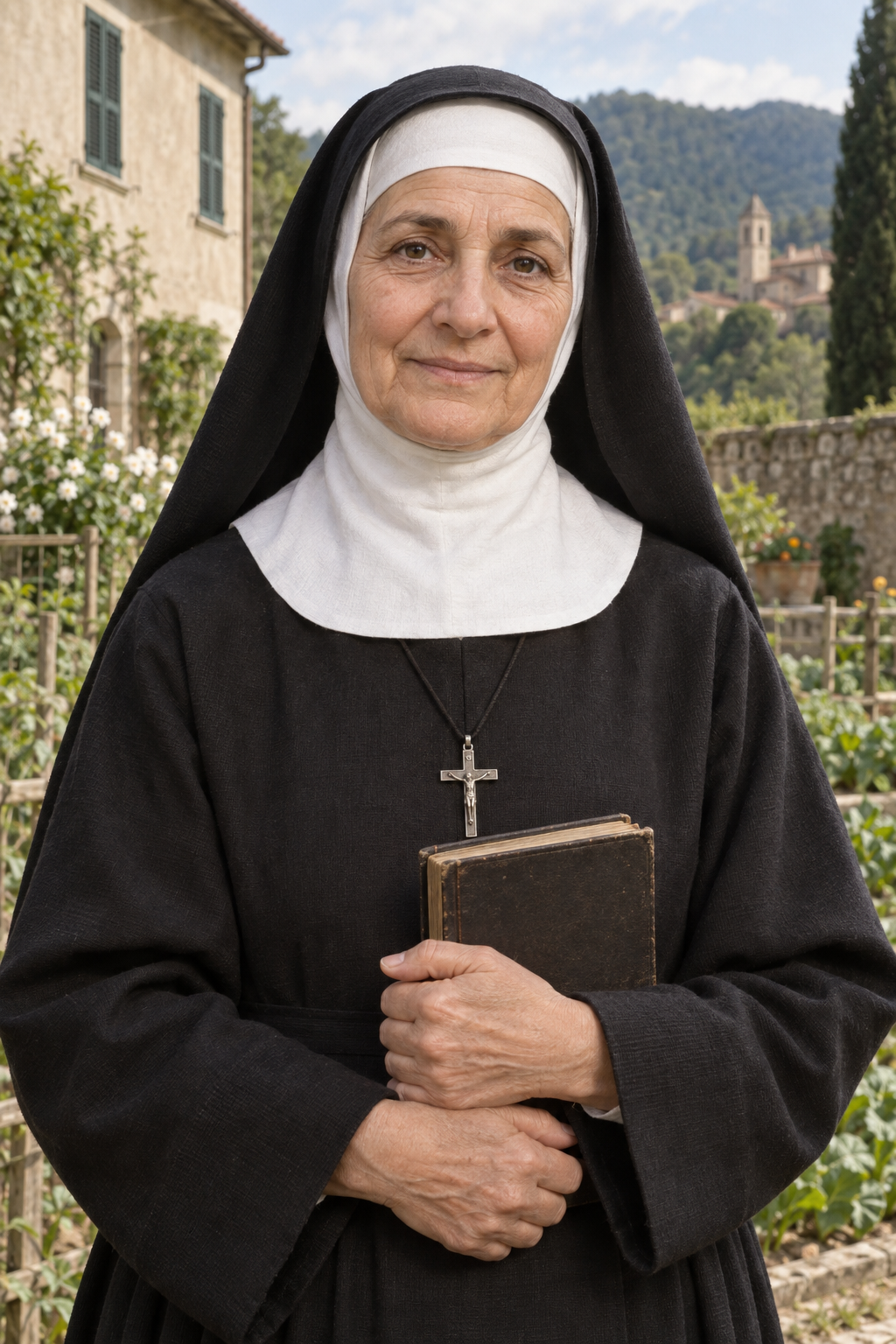
About Benedetta Cambiagio Frassinello
Benedetta Cambiagio Frassinello was born in Langasco, near Genoa, on October 2, 1791, to Giuseppe Cambiagio and Francesca Ghiglione, and was baptized two days later. Her family moved to Pavia while she was still young. The Holy See's biographical account describes a household that formed her in Christian practice and a strong-willed, persevering character. Around the age of twenty she felt drawn toward prayer, penance, and consecrated life. That inward desire did not immediately determine her public vocation. Her parents expected marriage, and on February 7, 1816, she married Giovanni Battista Frassinello, a Ligurian man whose family had settled at Vigevano.
Benedetta and Giovanni lived as a married couple for two years. In 1818, according to the official biography, they agreed to live in continence and welcomed Benedetta's younger sister Maria, who was gravely ill with intestinal cancer. They cared for her until her death in 1825. The source interprets this household as a form of spiritual parenthood, but the concrete action is important in its own right: the couple reorganized their home around a sick relative's needs. Their unusual marital arrangement should be understood as their shared religious decision, not as a general judgment on marriage. Giovanni remained an active collaborator in Benedetta's later work.
After Maria died, Giovanni entered the Somaschi Fathers and Benedetta entered the Ursuline community at Capriolo. Her stay was brief because illness forced her to leave. The Holy See biography says that, after returning to Pavia, she was miraculously healed through the intercession of Saint Jerome Emiliani. That is the Church source's interpretation; this packet does not claim independent medical documentation of the recovery. What followed is clearer historically. With ecclesiastical approval, Benedetta began educating girls in Pavia, especially those who were poor, abandoned, or without dependable family support. Bishop Luigi Tosi asked Giovanni to leave his novitiate and assist the undertaking.
Benedetta and Giovanni made a vow of continence before the bishop and worked together. Their school joined literacy and religious formation with domestic and vocational skills, including sewing and cooking. Young women volunteers gathered around Benedetta, and she gave their common life a rule that received church approval. The Austrian civil administration recognized her contribution to public education. The Holy See account presents her as a pioneer in pursuing a fuller education for girls. Her work was not merely an abstract defense of education: she opened a house, organized teaching, recruited collaborators, and created a stable community where vulnerable students could learn.
The Pavia foundation also encountered opposition. The official biography refers to resistance from powerful people and misunderstanding among clergy. In 1838 Benedetta transferred the institution to the Bishop of Pavia. She did not abandon the educational vocation when she lost control of that work. With Giovanni and five companions, she moved to Ronco Scrivia in the Genoa region and opened another school for girls. This decision shows resilience without requiring speculation about every dispute. The surviving church account makes the institutional outcome clear, though it does not give a neutral archive of each conflict or the motives of every participant.
At Ronco Scrivia, Benedetta founded the congregation now known as the Benedictine Sisters of Providence. She wrote rules and constitutions for the community and placed education at the center of its apostolate. The spirituality she taught emphasized confidence in divine providence, poverty, charity, and practical service. Houses opened as the congregation grew, and Benedetta continued directing it until her death. A house at Voghera later became a separate institute, the Benedictines of Divine Providence, while still honoring her memory. Distinguishing these institutions prevents a shared origin from being turned into an inaccurate claim that they remained one administration.
Benedetta died at Ronco Scrivia on March 21, 1858. Her formal recognition came more than a century later. John Paul II beatified her in Saint Peter's Square on May 10, 1987. His homily emphasized the way Benedetta and Giovanni made their family available to young women needing material support and moral guidance. On May 19, 2002, John Paul II canonized her with four other blesseds. The canonization homily identified her as a religious and foundress and highlighted her educational service. These ceremonies document the Roman Catholic Church's judgments about her sanctity; they do not replace the historical sourcing required for the details of her nineteenth-century life.
Benedetta's several roles belong together without collapsing into a single label. She was a wife who made consequential decisions with her husband, a caregiver to her sister, an educator who built institutions for girls excluded from opportunity, a religious sister, and a foundress who governed a new congregation. Her virtues are most visible through actions: she welcomed Maria into her home, resumed service after illness, organized an educational program, accepted institutional loss without ending the mission, and formed collaborators able to continue it. No traditional prayer is included because an exact text with verified provenance and reusable status was not established. No saying is attributed directly to Benedetta without a dependable primary reference.
Her legacy continues through the communities that trace their origins to her educational work. That continuity should not obscure the limits of this account: the principal narrative source is an official church biography prepared for canonization, not a critical edition of contemporary correspondence. The dates of birth, marriage, death, beatification, and canonization are documented; descriptions of spiritual experiences and miraculous healing are reported within ecclesial testimony. The artwork on this page is modern AI-generated devotional imagery, not a portrait from life. Benedetta is remembered most concretely wherever education becomes hospitality—where patient organization gives young people knowledge, useful skills, and a place of belonging.
Wondering how to weigh the stories and sources? Learn how to read a saint biography.