Biography
Benedict Biscop
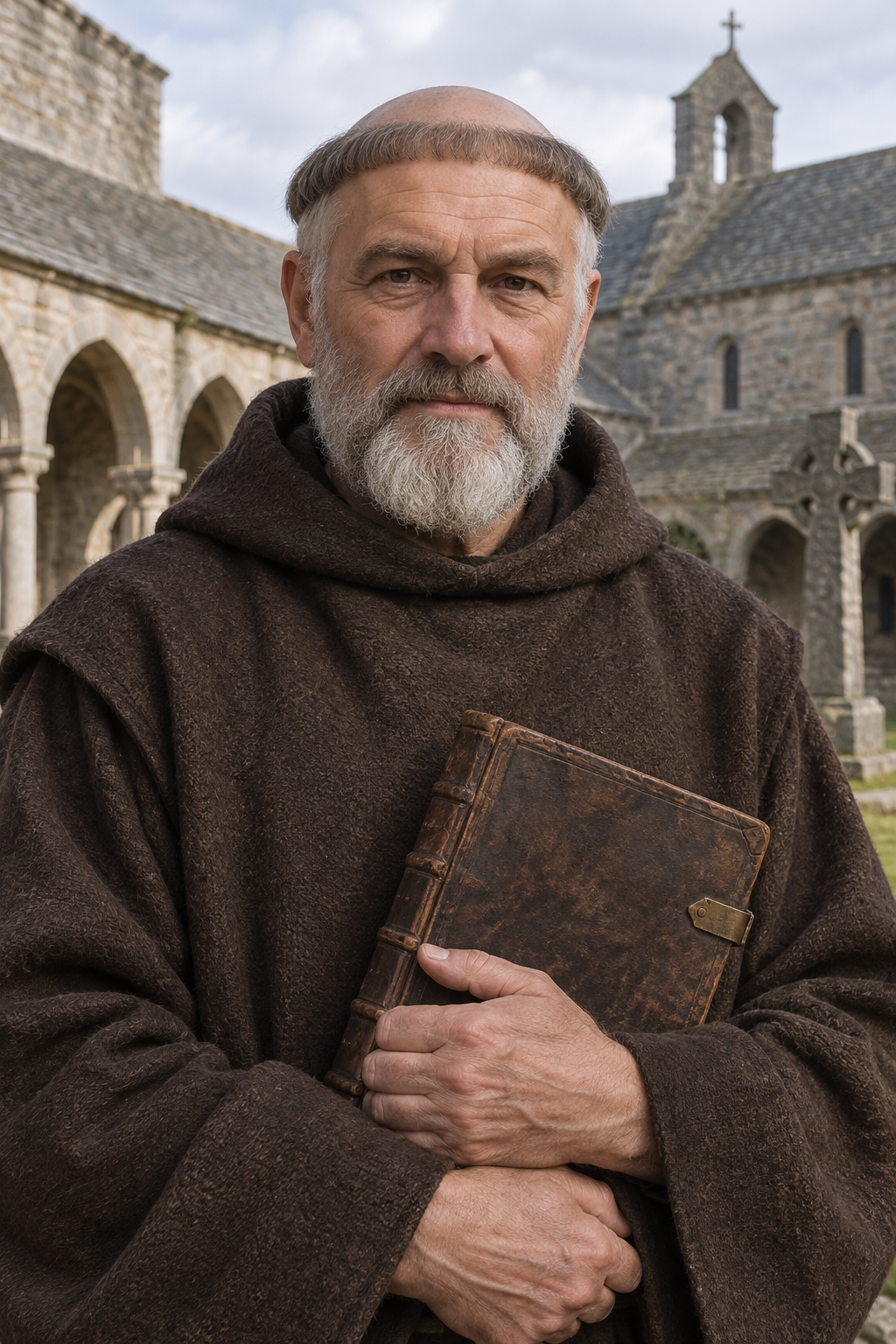
About Benedict Biscop
Benedict Biscop was born around 628. As a young man he served King Oswiu, but at about twenty-five he gave up the estate attached to his rank and left for Rome. He wanted to pray at the apostles' tombs and learn from the churches he visited.
On this early journey he became a travelling companion to the younger Wilfrid, another traveller from Northumbria. Stephen, Wilfrid's biographer, calls him Biscop Baducing and describes how the king of Kent arranged the companionship after Wilfrid had waited for a trustworthy guide. He describes the guide as a nobleman of remarkable intelligence. They travelled into Gaul and reached Lyon, where their paths separated. Stephen portrays Benedict as a stern guide, but does not explain their separation. King Eorcenberht of Kent found Benedict preparing to travel to the apostolic seat for his own pilgrimage, and asked him to take Wilfrid into his company. Wilfrid's journey had begun with the support of Queen Eanflæd, who sent him to her royal relative in Kent to wait for a suitable travelling companion.
Benedict eventually became a monk at the island community of Lérins. He stayed for two years, learning its discipline. Bede's anniversary homily remembers that he had intended to remain abroad, until the pope required him to escort Archbishop Theodore to Britain. His plans for a settled religious life thus gave way to a new responsibility for someone else's journey.
In Canterbury he governed the monastery of St Peter for two years, then handed it over to Hadrian. Another journey brought books from Rome and volumes which friends had obtained at Vienne. Returning north, he gained King Ecgfrith's support for a monastery at Wearmouth, founded in 674.
For this undertaking Benedict asked Wilfrid to release Ceolfrith as his helper. Benedict needed help with discipline and priestly ministry. Their partnership met resistance: Ceolfrith tired of leadership and returned to Ripon after opposition from some noble monks. Benedict persuaded him back. He also drew on an older friendship with Abbot Torhthelm, asking him for the builders needed at Wearmouth and bringing the craftsmen across from Gaul.
Benedict sought craftsmen in Gaul to build in stone and glaze the windows. The glassworkers completed the work and taught their craft to English learners.
Benedict also brought John, the Roman archcantor, to teach at Wearmouth. John trained the singers in chanting and reading aloud, and wrote down the arrangements for festivals throughout the year. His teaching drew singers from other monasteries, and his written instructions were copied elsewhere. Benedict's request therefore brought a teacher whose work reached beyond his own monks. On the same visit to Rome he secured papal confirmation of his monastery's privileges, with Ecgfrith's consent. John also carried a papal commission to examine the English Church's faith; the visit joined musical instruction to wider questions of Christian belief.
A second foundation followed at Jarrow, where Ceolfrith led the new community. Benedict appointed Easterwine to share responsibility at Wearmouth while travel and calls to the royal court occupied him.
For Benedict, the purchases and repeated journeys served the monks' life of prayer and learning. Bede recalls that he brought pictures to teach people who could not read, and worked so that the community could remain at home with the resources it needed. Even in illness he enjoyed speaking about monastic customs and places he had visited. The remembered traveller still shared what he had learned with the people around him.
During his final illness he asked others to read Scripture and sing the psalms beside him when he could no longer manage alone.
He died around 689–690 and was buried at Wearmouth.
Excavated glass helps us picture the material setting of the communities he established, although it cannot identify the hands responsible for each fragment. Roger Rosewell's account of Rosemary Cramp's excavations describes small pieces cut into geometric shapes, with several colours among the mostly pale glass. None of the recovered Wearmouth and Jarrow glass showed fired painted decoration. The surviving pieces point to a different kind of window from the painted narrative windows familiar in later medieval churches. Reconstructions of complete designs remain conjectural.
Art historian John Higgitt places these houses among the important early centres of book production and Mediterranean artistic influence in England. Their contribution extended across sculpture, manuscript painting and handwriting, not simply the possession of imported objects. Higgitt also notes their early departure from the artistic traditions associated with houses such as Lindisfarne. That assessment helps explain the range of Benedict's patronage: the communities he supported became places where received artistic models could shape new work.
One child placed in his care was Bede, who later remembered entering the monastery at seven and learning under Benedict and then Ceolfrith. Bede's account of a life spent studying, teaching and writing gives a personal measure of what the founder had made possible.
Wondering how to weigh the stories and sources? Learn how to read a saint biography.
Explore similar vocations
Prayers for Benedict Biscop
Benedict Biscop: sourced prayer excerpt
may St. Benedict Biscop intercede for us at the heavenly throne.