Biography
Benedict of Aniane
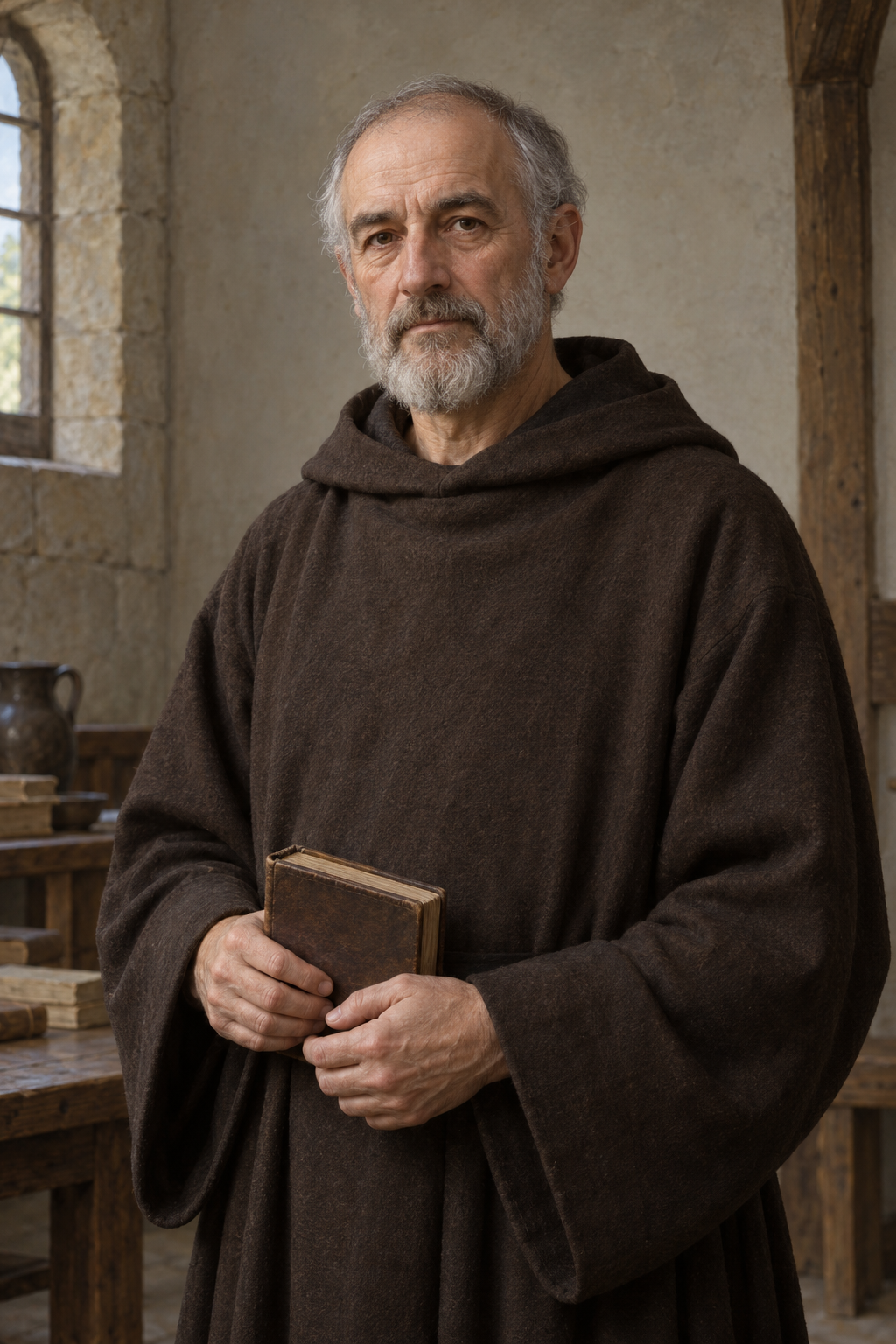
About Benedict of Aniane
Benedict of Aniane was a monk and abbot whose work became closely connected with the religious reforms of Louis the Pious. He established a community at Aniane and later lived at Inda, near the imperial court at Aachen. Jürgen Sydow’s historical account describes his effort to strengthen the observance of Benedict of Nursia’s Rule. It also notes that the reform reached only part of its intended scope.
Ardo traces life at the Frankish court, followed by entry into the monastery of Saint-Seine. Benedict later withdrew to family property by the Aniane stream, where a small community began. His own path therefore included both royal service and establishing a monastery.
The early account of his life was written by Ardo after monks at Inda asked for it. Ardo’s preface explains that he drew on people who knew Benedict’s beginnings and invited the readers to correct faults in the work. That account is a religious biography, intended to preserve an example for the community.
Ardo presents a leader who continued to seek understanding of the Rule from others, including people less learned than himself. He describes Benedict comparing monastic rules and gathering texts that explained their agreement. His account also follows the practical details of communal prayer and work, including measures intended to restrain excessive vigils as well as neglect of prayer. These passages show how the biography connects leadership with learning and with attention to the limits of communal life.
Benedict’s own preface to the Concordia regularum explains why comparing rules mattered to him. Some monks, he says, dismissed other rules because they had professed only Benedict of Nursia’s. His answer was to collect passages that showed their agreement. He placed Benedict’s rule first and joined related passages from other writers to it, allowing the reader to see the relationship within one volume. This was a way of studying a tradition together, rather than treating a single text as if it had no predecessors or companions.
The preface also states the limits of his claim to authority. Benedict addresses abbots and monks while presenting himself as the least of the abbots. He says that he began the undertaking out of concern for his own spiritual life and for those who wished to read, not to advertise his learning. He asks readers to pray for him. These are his expressed purposes, not proof that every monastery received the collection in the way he hoped. They show how he understood scholarship as a service to fellow monks.
The surviving text has its own history. The Bavarian Academy’s source catalogue dates the work to 822–823 and records later interpolation. Scholars have also debated the relationship between its longer and shorter forms. The text available today therefore needs to be read with attention to transmission, rather than treated as an unchanged manuscript from Benedict’s lifetime.
Rutger Kramer’s study places Benedict’s work within the relationship between the imperial court and monasteries. Communities that sought withdrawal from worldly concerns still depended on rulers for protection and resources. In return, they were expected to contribute to the wider Christian society through prayer and example. Kramer reads Ardo’s account as an attempt to explain how service at court could remain compatible with the abbot’s monastic vocation. That tension is part of the history, rather than a difficulty that disappears when Benedict is called a saint.
Sydow also describes limits and consequences of the reform. Its demands extended beyond a simple return to an earlier rule, touching ascetic practice, work and liturgy. The study notes the preference for educating a monastery’s own members rather than maintaining schools for outsiders. Benedict’s work affected the organization of communities, their responsibilities and their relation to the wider society.
An excerpt of Benedict’s letter to Archbishop Nibridio, preserved in an Italian translation by the Monastery of Bose, asks for continued care of the monks at Aniane. He also entrusts friends, relatives and others in the region to the archbishop’s concern. The request is made as he approaches death. It gives a personal expression to a responsibility that would have to continue when he could no longer carry it himself. The excerpt is a transmitted letter, rather than words taken from an autograph surviving here.
Benedict died on 11 February 821. The modern abbey at Kornelimünster remembers him as its founding abbot, while acknowledging that his grave has not been found. Its account records the return of Benedictines to the place in 1906 and the continued remembrance of his life in the abbey church. The local history preserves his influence without supplying a precise grave location.
Bose’s calendar places his remembrance on 11 February within Western monastic observance. His legacy includes the effort to give communities a shared discipline and the continuing question of how religious learning should serve others. The surviving accounts preserve that work alongside the complications of political support, textual transmission and a reform that was never simply uniform everywhere.
Wondering how to weigh the stories and sources? Learn how to read a saint biography.