Biography
Bernadette Soubirous
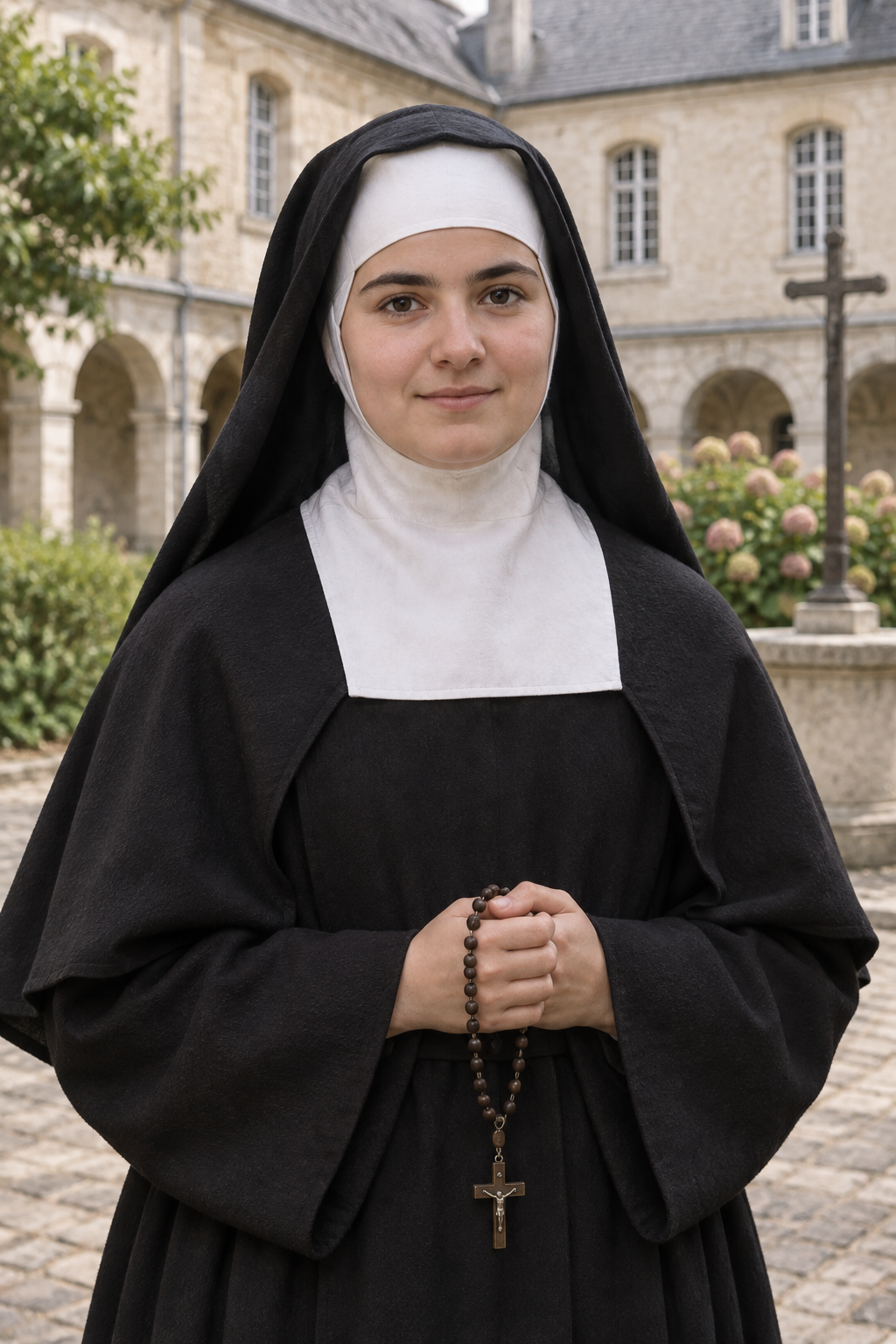
About Bernadette Soubirous
Bernadette Soubirous was born on 7 January 1844 at the Boly Mill in Lourdes, the daughter of François Soubirous and Louise Castérot. Her family's circumstances were initially more comfortable than the poverty for which her childhood became known. After the mill business failed, their security disappeared; by 1857 they were living in the Cachot. Bernadette suffered from asthma, helped relatives with work and had little opportunity for schooling. She spent time tending sheep at Bartrès before returning to Lourdes, where she wanted to prepare for her first Communion.
On 11 February 1858, she went with her sister and a friend to gather wood near the grotto of Massabielle. She reported seeing a woman dressed in white, and returned repeatedly to the place. Police questioned her about what she had seen. According to her account, she drank muddy water at the woman's instruction and later carried a request for a chapel and processions to the parish priest, Dominique Peyramale. He asked for the woman's name. On 25 March, Bernadette reported that the woman had identified herself as the Immaculate Conception, words she repeated on her way to the priest.
The reported encounters brought an investigation rather than immediate official acceptance. On 28 July 1858, Bishop Laurence established a commission to examine the events. Its questions concerned Bernadette's visions, the requests she described, the spring and the reported recoveries of sick people. Witnesses were to be questioned, and doctors and specialists in the physical sciences consulted. After nearly four years, Laurence issued his favorable judgment on 18 January 1862. He regarded Bernadette's testimony and the other evidence as sufficient to recognize the apparitions as supernatural. This was the bishop's religious judgment on the reports, not something Bernadette could establish simply by repeating her account.
The attention surrounding her made ordinary life increasingly difficult. She declined payment and resisted being treated as a seller of devotional objects. In July 1860, she was received at the hospice run by the Sisters of Nevers. There she continued learning and helped care for the sick while considering religious life. She eventually chose the Sisters of Charity of Nevers and took the religious name Marie Bernard.
The sisters' daily work gave Bernadette a practical view of the vocation she was considering. At Lourdes she saw them caring for sick people, poor older people and girls whose families lacked resources. She arrived at their motherhouse, Saint-Gildard in Nevers, on the evening of 7 July 1866. The next day she recounted the apparitions to the assembled community before beginning her formation. She made her first religious commitment on 30 October 1867. Her poor health prevented the placement in another community that she had hoped for, so she remained at the motherhouse.
Correspondence preserved her connection with Lourdes after she left. Letters reproduced by the Lourdes parish show her asking Peyramale to remember her in the prayers of the Children of Mary and seeking his help over her brother Pierre's school expenses. She also followed the building of the parish church and the work of its orphanage. Peyramale supported her refusal to write another account of the grotto events and objected to photographs of her in religious dress being displayed commercially. These exchanges reveal continuing family concerns and an effort to protect a private religious life from the public appetite for the visionary. When Peyramale died, she wrote to another priest, Pomian, expressing her grief at the loss of a pastor whose work for Lourdes she valued. In another letter to Pomian, she described the shock of her mother's death and explained that attempts to spare her feelings had not made the loss less painful.
In Nevers, Bernadette worked as an assistant nurse, took responsibility for the infirmary and served as sacristan. She was not given a privileged position because of her experiences at Lourdes. During her final four years, illness increasingly restricted her activity. She died on 16 April 1879, aged thirty-five. Her recognition as a saint came much later: she was beatified on 14 June 1925 and canonized on 8 December 1933. Her body was placed in a glass and bronze reliquary in the convent chapel in 1925, making Nevers another center of pilgrimage associated with her.
Her later significance has not been confined to the events at the grotto. In his message for the 2017 World Day of the Sick, Pope Francis recalled Bernadette's description of being treated with respect by the woman she saw. He connected that testimony with the dignity of sick and disabled people, who should never be reduced to objects of care. He also presented Bernadette's work as a Sister of Charity as an example for healthcare workers. In this reading of her life, the young witness at Lourdes and the nurse who became a patient at Nevers belong to the same story of personal dignity and service.
Wondering how to weigh the stories and sources? Learn how to read a saint biography.
Explore similar vocations
Prayers for Bernadette Soubirous
Bernadette: petition for humility
Ô Jésus donnez-moi je vous prie le pain de l’humilité