Biography
Bernard of Corleone
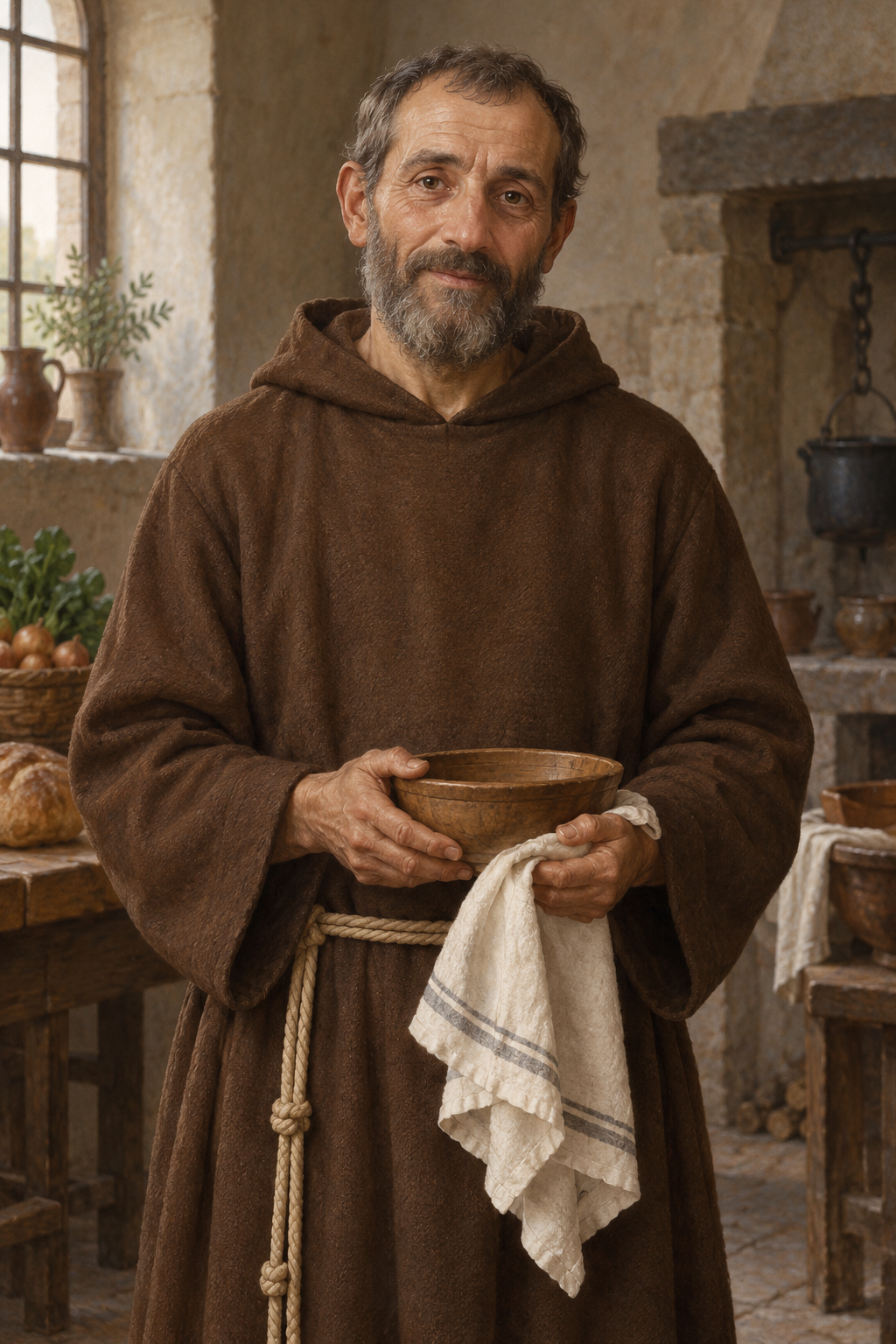
About Bernard of Corleone
Bernard of Corleone was a Capuchin lay brother remembered for work in the kitchen, care of the sick and help with the other friars’ laundry. He was born Filippo Latino at Corleone and took the name Bernard when he entered religious life. The Holy See’s biography cautions against a popular image of him as a habitual troublemaker. It acknowledges a serious incident involving his sword while describing charity as part of his life before he became a friar.
His work as cook and helper placed him among the ordinary needs of a religious household. The biography associates this service with a life of prayer. It records his final years at Palermo and his death there on 12 January 1667. The exact sequence of his earlier transfers between friaries is less clear.
The Holy See’s account places his entry into the Capuchin novitiate at Caltanissetta in December 1631.
At his canonization on 10 June 2001, John Paul II placed Bernard’s example within the Christian belief in the Trinity. The homily described a lay friar whose prayer gave life to his service amid the social difficulties of his time. It invited listeners to see an enduring connection between attention to God and the ability to communicate love. The pope’s emphasis was on persistent prayer and listening, rather than on public prominence. This was the Church’s interpretation of Bernard’s example at the moment of his recognition as a saint.
The ceremony took place on the feast of the Trinity. Its opening presented holiness through creation, redemption and the work of the Holy Spirit, before turning to the five people being canonized. Bernard’s place in this setting was therefore part of a shared theological argument. The pope treated sanctity as a gift expressed in different human vocations. His account of Bernard’s prayer was one example within that argument, rather than a claim that a lay brother held a formal teaching office.
The following day, the pope addressed pilgrims who had come for the canonization. He returned to the simplicity of Bernard’s Capuchin life and to quiet service among people. His address connected religious commitment with solidarity and a concern for justice. It also presented holiness as a transformation of the person that could become visible through the way someone lived. This later reception gives Bernard’s work a place in the present without requiring the listener to repeat every practice of his century.
The audience concluded by linking contemplation with action across the different vocations represented by the new saints. Its invitation was addressed to listeners in their own circumstances. Bernard’s remembrance thus became part of a call to practical commitment, rather than a demand that everyone adopt the same religious life.
Giovanni Spagnolo’s study of an eighteenth-century sermon examines how another image of Bernard developed. The preacher Michelangelo of Partinico used biblical comparisons and a rising emotional intensity to present an exemplary penitent. Spagnolo traces the familiar themes of the skilled swordsman and extraordinary austerity, and notes how such descriptions could make the saint seem beyond imitation. He also identifies the sermon’s literary and theological sources. This analysis helps distinguish the purpose of a panegyric from the evidence of an ordinary life. The sermon was written long after Bernard’s death and speaks to the expectations of its own audience. Its dramatic language should therefore be read as part of the history of devotion.
The sermon’s survival also helps explain what kind of evidence it offers. Spagnolo found it in a manuscript collection associated with the suppressed Capuchin convent at Partinico and preserved in the municipal library. He compared the handwriting with other sermons to support the attribution to Michelangelo. The proposed January occasion is probable, not certain. These are the editor’s conclusions about a later text; they do not turn its vivid descriptions into eyewitness testimony from Bernard’s own lifetime.
In the introduction to a modern biography, Spagnolo considers a different stereotype: the association of Corleone with organised crime in literature and film. He argues that this image can obscure the town’s religious history and the memory of people such as Bernard. The introduction presents the canonization as an opportunity to recover a wider account of the community. It also brings religious commitment and civic responsibility into the same conversation. This is a contemporary interpretation of Bernard’s significance for his birthplace. It leaves room to remember a person through service, relationships and a change of life, alongside the dramatic stories that have often drawn attention to him.
Spagnolo further challenges an interpretation of seventeenth-century religious life as merely insincere or constrained by empty rules. He reads Bernard within an active spirituality that joined ascetic practice to concern for others. This assessment is the author’s historical and religious interpretation. It is useful alongside his warning about stereotypes because it leaves both the demands of the friar’s vocation and the difficulties of its later portrayal visible.
Wondering how to weigh the stories and sources? Learn how to read a saint biography.