Biography
Bernardine of Siena
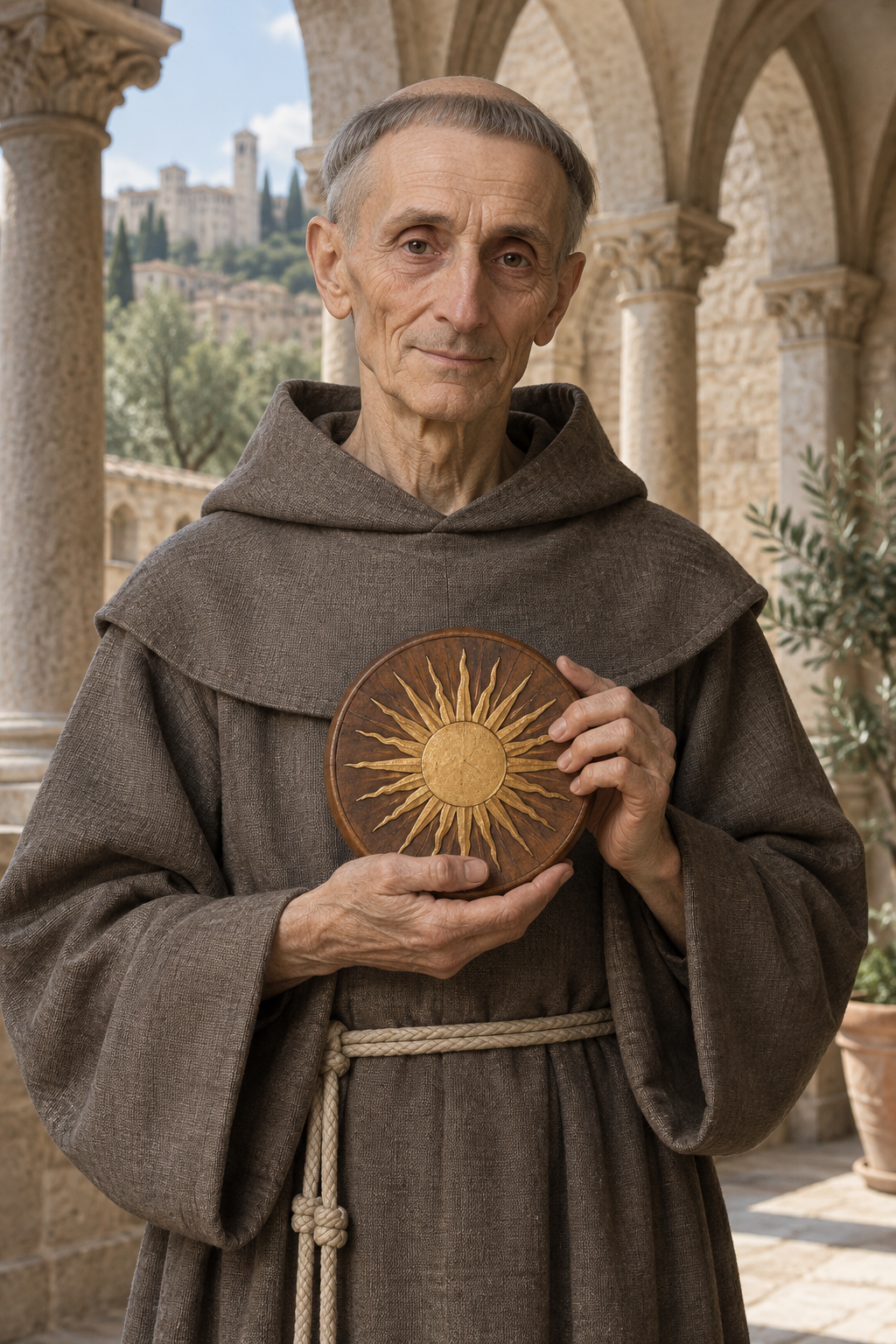
About Bernardine of Siena
Bernardine of Siena was born in Massa Marittima in 1380, into the Albizzeschi family. After losing both parents as a small child, he grew up with relatives and later moved to Siena. He studied the liberal arts and canon law but did not complete a doctorate. His education was initially that of a layman, rather than the formal preparation of a friar. In 1400, he and companions nursed plague patients at Siena's hospital. Testimony gathered for his canonization remembers sustained service during the epidemic, not simply a promise made in exchange for his own survival.
He entered the Franciscan Order in 1402 and made his novitiate at Colombaio, on Mount Amiata. The community belonged to the Observant movement, which sought a demanding practice of Franciscan poverty. He professed his vows in 1403 and became a priest the following year. A serious illness in 1411 interrupted that work. When he resumed preaching, town squares became important settings for addressing audiences too large for an ordinary conversation. He repeatedly declined episcopal appointments, including those proposed for Siena, Ferrara and Urbino.
Bernardine used memorable images to bring religious teaching into the life of Italian towns. Before his entry, he also cared for an aunt during her final illness. He challenged hostility between political factions. He encouraged people to replace rival party emblems with the name of Jesus over houses and businesses. He carried a plaque bearing IHS as a visible focus for this appeal. The emblem joined devotion with a call for reconciliation.
In a sermon delivered at Siena, Bernardine recalled his own efforts at Crema, where factional conflict had driven families into exile. He described speaking cautiously about political matters while still urging a change of conduct. In his account, a council eventually allowed the exiles to return. One returning man found that a former enemy welcomed him and that others restored his house and possessions. Bernardine presented the episode as a movement from injury toward practical restitution.
His use of the Holy Name nevertheless brought opposition and accusations of heresy. Called before Pope Martin V in 1426, he was acquitted and permitted to continue preaching. The Observant movement also brought difficult questions about authority within the Franciscan Order. Appointed to leadership of the Italian Observants in 1438, Bernardine faced complaints that the arrangement gave the reforming friars excessive independence. The Order's account describes him relinquishing disputed prerogatives rather than pressing every claim attached to his position. Stricter poverty coexisted with efforts to maintain relations with other friars.
Bernardine also examined the moral responsibilities of economic life. His discussions of contracts and lending formed part of a larger sequence of Latin sermons, not an economics textbook in the modern sense. He drew extensively on earlier theologians and jurists, including the Franciscan Peter John Olivi. He distinguished useful commerce from practices that harmed the community, such as monopolizing goods. Questions about prices, professional competence and trust belonged together in this analysis. A seller who exploited a customer's confidence was not merely making a clever bargain: he was breaking a relationship on which exchange depended. Historian Giacomo Todeschini cautions against treating Bernardine as a modern economist detached from this theological and legal setting.
His public influence also had a destructive side. Mormando treats these campaigns as part of the history of intolerance in Renaissance Italy, not as an incidental flaw in an otherwise uncomplicated achievement. The University of Chicago Press's account of Franco Mormando's research identifies Jews, people accused of witchcraft, heretics and people condemned for sexual conduct among the targets of his inflammatory preaching. It describes a sermon in which he approvingly recounted a vigilante's burning of men accused of sodomy. This recommended persecution, rather than merely illustrating moral teaching. The account concerns a story he told; it does not establish that Bernardine personally carried out the killings described. His calls for reconciliation must be read alongside rhetoric that encouraged fear and hostility toward marginalized people.
The Holy Name sermon offers another view of how Bernardine understood his vocation. He compares the proclamation of Jesus to light breaking into darkness. Yet he insists that the speaker's own life must be fit for the message entrusted to him. In the sermon, Paul becomes the example of a messenger whose words, letters and conduct all serve the same proclamation.
Still traveling in 1444, Bernardine reached L'Aquila, where his final illness ended his preaching journeys. He died there on 20 May. His disciples helped advance the cause for his recognition, and Nicholas V canonized him in 1450.
His influence outlived those journeys through the growth of the Observants and his involvement with Franciscan women's communities. The reforming friar, civic preacher and author remain inseparable parts of his historical legacy.
His modern liturgical collect associates his memory with love of Jesus' name and asks that divine love shape the worshipping community.
Wondering how to weigh the stories and sources? Learn how to read a saint biography.