Biography
Bertrand of Comminges
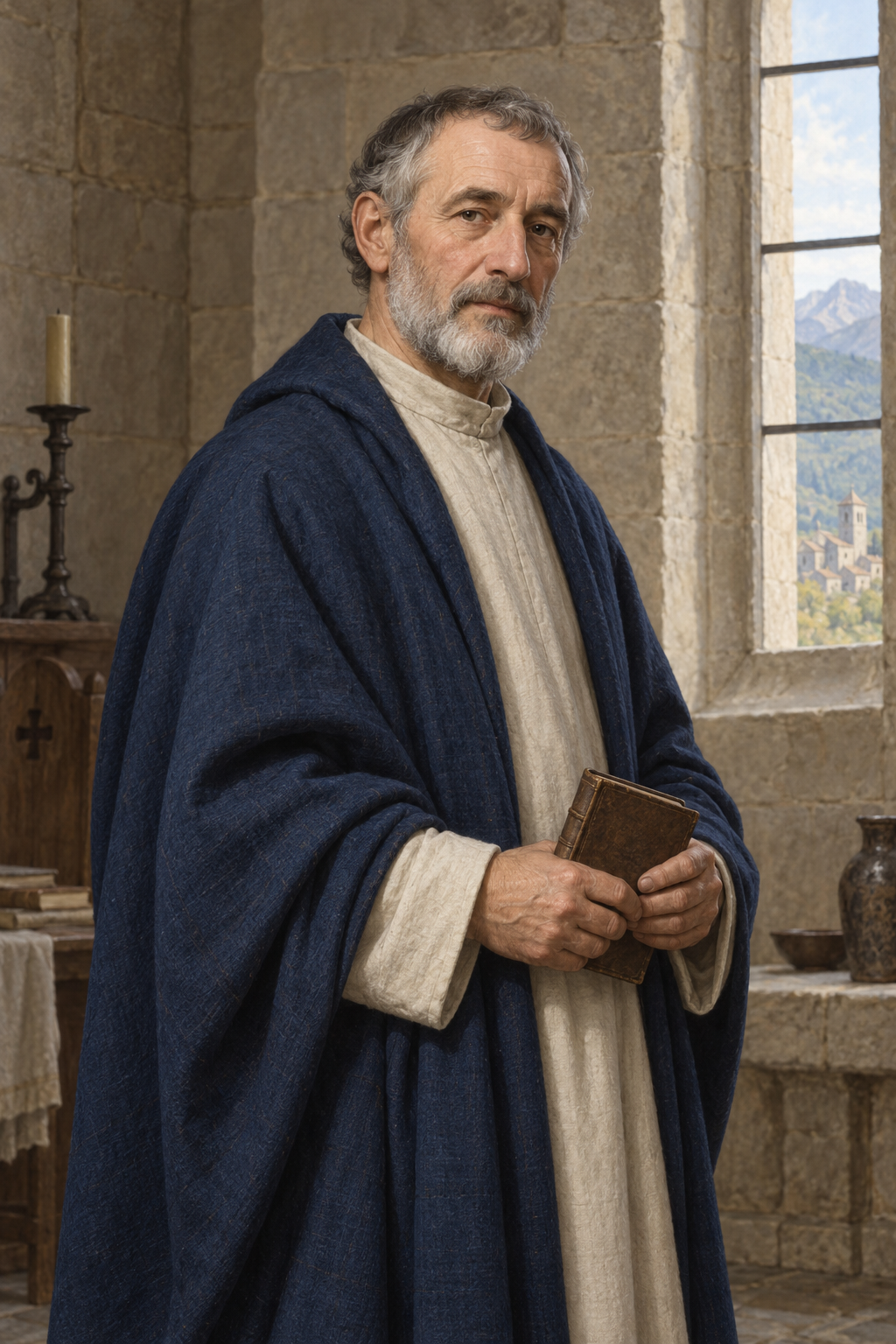
About Bertrand of Comminges
Bertrand of Comminges was a bishop remembered for reforming his clergy and supporting the rebuilding of his cathedral community. Vital’s medieval Life places his beginnings in a noble family and describes a passage from military life to church service. As archdeacon at Toulouse, he was chosen to lead the Church of Comminges. The account associates his care for the cathedral with a community of canons following Augustine’s rule. It praises hospitality towards travellers and people in need. Written after his death, the Life presents these actions through the language of Christian virtue and draws on recollections from people connected with him.
The cathedral preserves his memory, but its surviving buildings cannot all be assigned to his lifetime. Oriane Pilloix’s architectural study questions the familiar picture of a single bishop rebuilding an entire city and cathedral from nothing. She points out that the medieval narrative does not clearly distinguish new construction from repair or enlargement. Even the word translated as a cloister can have the wider sense of an enclosure for common life. It does not by itself prove that Bertrand built the cloister visible today. Her study brings the account of a reforming bishop into conversation with the changing building and the history of its interpretation. That approach leaves room for his contribution while recognising work done by later communities.
Pilloix nevertheless argues that the Romanesque church and its tower belonged to one overall project, developed in successive stages. Her conclusion places parts of the lower walls before Bertrand’s death, while the tower’s architectural comparisons point to later work. This allows a connection with his episcopate without assigning every surviving feature to his commission. The building records a community’s continuing work as well as the memory of the bishop associated with its renewal.
His recognition as a saint has likewise been attached to different dates. In their critical study, Étienne Delaruelle and Charles Higounet distinguish Clement V’s ceremony involving Bertrand’s relics from canonization. They compare the language of the papal document with documents that formally enrolled other saints. They also examine evidence that the town was already called Saint-Bertrand before Clement’s visit. A document from 1222 is especially important to their argument. The authors place the likely recognition after the renewed inquiry ordered in 1218, while leaving its exact date unresolved. Their work shows why the moving of relics, the beginning of an inquiry and formal recognition should not be collapsed into one event. Each can preserve evidence for devotion without supplying the same historical answer.
Local remembrance continues in worship as well as in the building’s name. At Bertrand’s feast in October 2025, Archbishop Guy de Kerimel dedicated a new altar in the cathedral. In his homily, he connected care for the historic church with the community that still gathers there. He described the altar as a sign of Christ and spoke of the relics of Bertrand placed within it. This was a present-day interpretation of the cathedral’s purpose, joining preservation with ongoing worship. The homily recalled Bertrand’s pastoral work while asking the contemporary community to continue serving people in need.
Vital records an illness during a parish visit and Bertrand’s return to the cathedral. Its account of his death closes with the people and church entrusted to his care. The surviving story and the cathedral that bears his memory remain connected, even as the later history of both requires careful interpretation.
Wondering how to weigh the stories and sources? Learn how to read a saint biography.