Biography
Bertulf of Bobbio
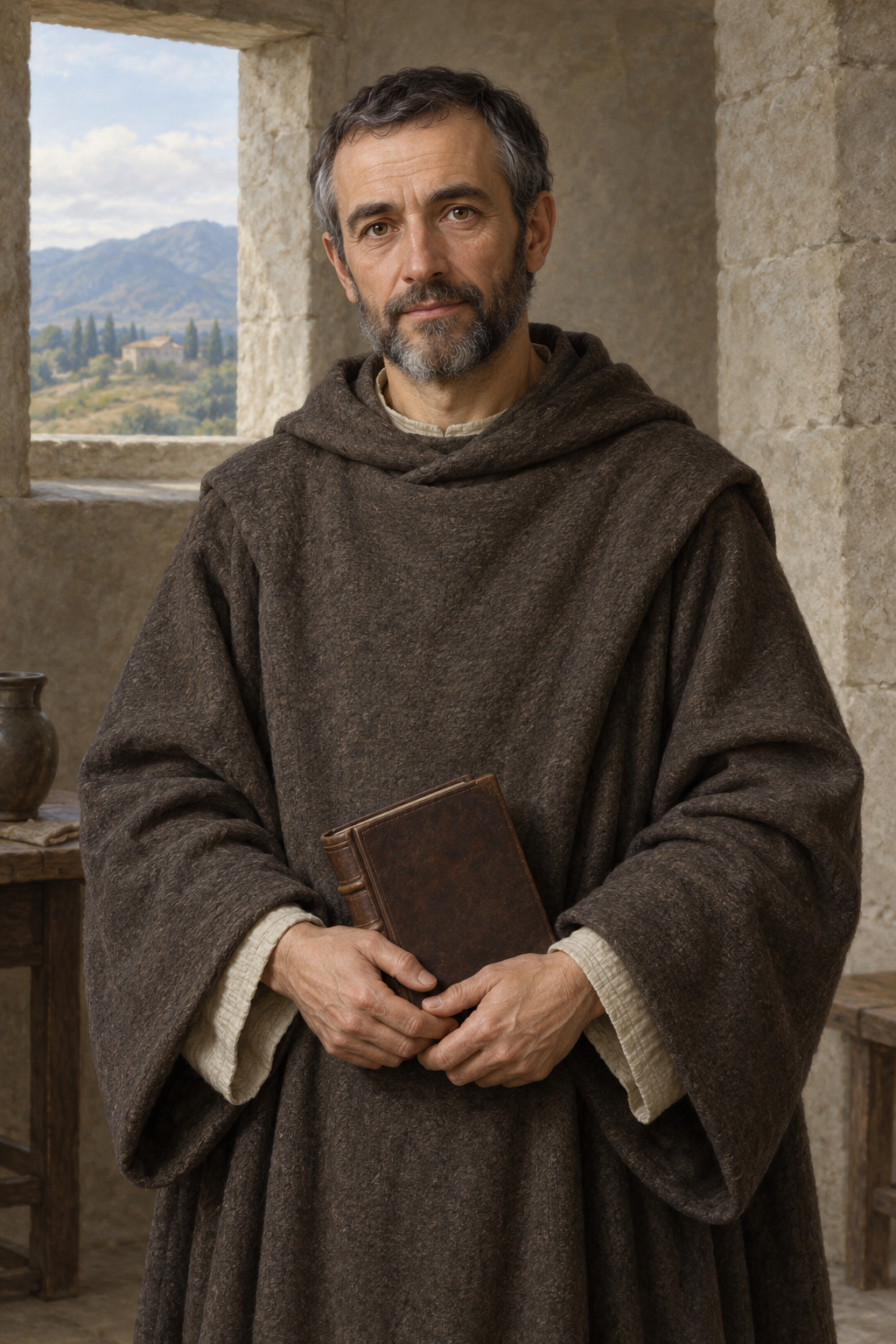
About Bertulf of Bobbio
Bertulf led the monastery of Bobbio after Attala. Jonas traces his formation through Arnulf of Metz and Luxeuil, then a move to Bobbio with Attala. After the monks chose him as abbot, a jurisdictional dispute with the bishop of Tortona led him to seek Pope Honorius’s protection in Rome. Jonas accompanied him.
The account places monastic leadership within a network of relationships. Alexander O’Hara’s study of Jonas considers how the writer presented the communities that continued Columbanus’s work. He reads the second book as more than a collection of isolated saints’ lives: its attention turns to abbots, monks and the preservation of a shared way of life. His interpretation of the Rome episode connects the community’s wish for protection with the way Jonas told its story. In this reading, the reported vision involving Peter also gives religious meaning to an institutional claim. This is an analysis of the narrative’s purpose, rather than independent verification of a miraculous event. It helps explain why an account by someone close to an abbot still needs attention to what the author wanted to communicate.
The wider political setting requires similar care. Stefano Gasparri’s study questions a familiar account that divides the Lombard kingdom into fixed religious camps and assigns Bobbio a mission to defeat one of them. He finds that the evidence does not support that simple division. In particular, he reads the language about opposing Arianism in Jonas’s papal encounter as part of a narrative meant to demonstrate the monks’ religious fidelity. Gasparri distinguishes that language from evidence for an extensive programme of conversion. His broader argument presents Bobbio as an early royal monastery, supported through the patronage of rulers. He also rejects the idea that its setting automatically made it a military outpost. The monastery’s relationships with power were therefore important without being reducible to a story of religious warfare.
His death is conventionally placed about 640. The Catholic Encyclopedia gives 639 or 640, while the diocesan Mass proper gives 641; the surviving narrative supplies no secure death date.
Present-day devotion remembers Bertulf through monastic life. The diocesan Mass proper places his memorial in the context of prayer, humility and concern for others. Its intercessions pray for monastic communities, people facing hardship and peace among nations. This is the language of current worship, rather than another narrative of seventh-century events. It shows how the memory of an abbot can connect a local observance with the needs of people far beyond one monastery. The proper identifies the observance as an optional memorial on 19 August.
Bobbio’s basilica also preserves his memory in its art. The diocesan heritage account identifies medallions of Bertulf and Attala in the side vaults, and their tombs along the sides of the crypt. These belong to the later history of the church and its remembrance of the early abbots. The present basilica was built long after Bertulf’s lifetime. Its images express the devotion of later communities; they do not establish what he looked like. His memory survives through these objects, the liturgical observance and the devotion of later communities.
Wondering how to weigh the stories and sources? Learn how to read a saint biography.