Biography
Bonifacia Rodríguez de Castro
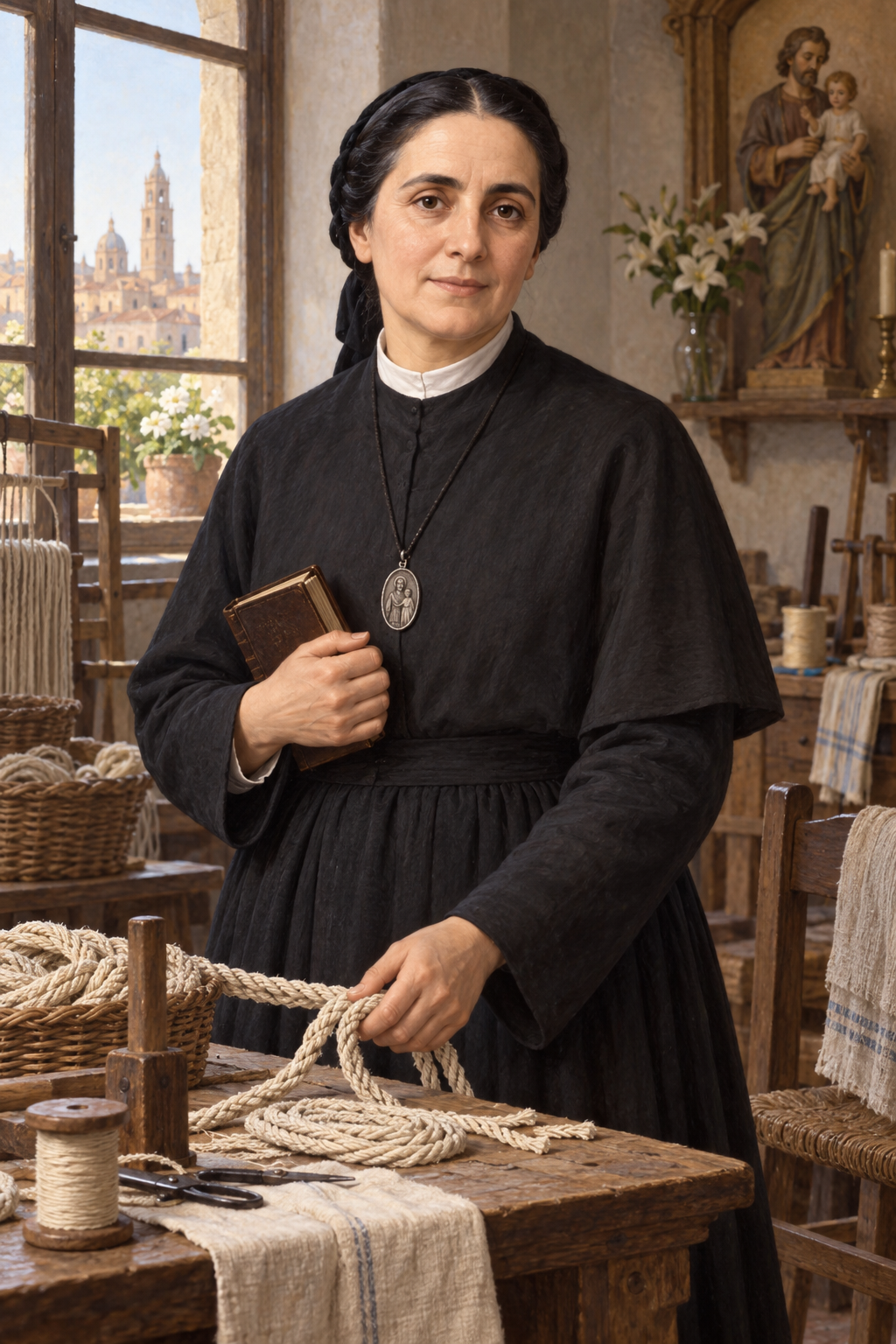
About Bonifacia Rodríguez de Castro
Bonifacia Rodríguez de Castro was born in Salamanca, Spain, on June 6, 1837. The says she grew up in an artisan family. Her father Juan was a tailor, her mother was Maria Natalia, and the family's main concern was Christian education for their six children.
Her first school was the family home and sewing workshop. After elementary studies she learned the trade of cord-making. When her father died, she was fifteen and began earning wages as an employee so she could help her mother support the family. The source connects this early labor with a strong personality formed by necessity.
Bonifacia knew the hard conditions of working women in her time: exhausting hours and minimal wages. Once the family's first economic hardships eased, she opened her own workshop for cords, passementerie, and other handmade goods. She worked there with recollection, imitating the hidden life of the Holy Family of Nazareth.
Her workshop gradually became more than a workplace. After her sister Agustina married in 1865, Bonifacia and her mother lived a life of deep piety and daily prayer at the nearby Jesuit church of La Clerecía. Young women friends began visiting the house-workshop on Sundays and feast days.
Those visits became the Association of the Immaculate and Saint Joseph, later called the Josephine Association. The official profile says the workshop gained a clear apostolic and social purpose for preventing harm to working women. The profile should describe this as prayer joined to dignified work, not as a factory reform program.
That emphasis matters because Bonifacia's holiness is not detached from the workbench. The source presents her workshop as a place where young women could find friendship, formation, and safer habits of life. The final page should make the artisan setting central rather than merely decorative.
Bonifacia felt drawn to religious life and considered becoming a Dominican at Santa Maria de Dueñas in Salamanca. Her path changed when she met the Catalan Jesuit Francisco Javier Butinyà, who came to Salamanca in October 1870 with a strong apostolic concern for workers and humble trades.
Through Bonifacia, Butinyà came into contact with the young women of her workshop, most of them manual workers. Bonifacia accepted his proposal to found the Congregation of the Servants of Saint Joseph rather than enter the Dominican convent. The source presents this as a new religious form rooted in work.
On January 10, 1874, Bonifacia began the new community in Salamanca, in her own house-workshop, with six other young women from the Josephine Association, including her mother. Three days earlier, the Bishop of Salamanca had signed the decree erecting the institute.
The foundation aimed to create in the congregation's houses a Laboratory of Nazareth. In that setting the Servants of Saint Joseph offered work to poor women who had none and joined labor with prayer. This detail should remain central because it explains why the workshop, not a cloister image, belongs in her profile.
The project quickly met opposition, especially because it proposed a bold form of women's religious life inserted into the world of work. Bonifacia suffered humiliations and calumnies, and she eventually proposed a new foundation in Zamora as a way to respond to the conflict.
She left for Zamora on July 25, 1883, accompanied by her mother and carrying in her heart what the source calls the Laboratory of Nazareth. In Zamora she continued the project faithfully, working beside other women, girls, and adults and forming relationships of dignity and respect in work.
The Zamora foundation therefore was not an abandonment of her first insight. It was a continuation under harder conditions. The source presents Bonifacia as weaving prayer, labor, equality, fraternity, and respect into the daily pattern of the workshop.
Meanwhile the Salamanca house changed direction, and in 1901 pontifical approval was granted to the Servants of Saint Joseph with the Zamora house excluded. Bonifacia tried to go to Salamanca to speak with the sisters, but she was not received. The biography should treat this wound soberly, without turning community conflict into spectacle.
Bonifacia remained joined in hope to the sisters of Salamanca and trusted that union would come after her death. She died in Zamora on August 8, 1905, surrounded by the affection of her community and the people of Zamora. On January 23, 1907, the Zamora house reunited with the rest of the congregation.
The official page records her beatification by John Paul II on November 9, 2003, and canonization by Benedict XVI on October 23, 2011. Her profile should emphasize prayer, work, women's dignity, humility under conflict, and fidelity to the Nazareth ideal.
Artwork should show a Spanish working foundress in a simple dark habit or work dress in an artisan workshop, with cord, thread, a work table, and a Saint Joseph or Holy Family cue. Avoid modern sewing machines, factory imagery, ornate convent fantasy, persecution scenes, and any claim to historical portrait likeness.
Wondering how to weigh the stories and sources? Learn how to read a saint biography.