Biography
Bonosa of Porto
About Bonosa of Porto
Bonosa belongs to the Christian memory of Portus, the ancient harbor serving Rome near the mouth of the Tiber. The stable catalog name “Bonosa of Porto” once led the record toward Porto in Portugal, but the evidence reviewed for this packet points to Roman Portus. It does not identify Portugal as her birthplace or Remiremont in France as her place of death. Those inherited locations are removed. What can be known securely concerns an ancient local cult shared with the martyrs Eutropius and Zosima; the details of Bonosa's personal life survive principally in a later passion and require much greater caution.
The strongest material witness is an inscription associated with a Christian sanctuary at Portus. Its reconstructed text names Eutropius, Zosima, and Bonosa and credits a Bishop Donatus with adorning their tomb and building an adjoining basilica. Jan Theo Bakker reports that the lettering has been dated to the late fourth or early fifth century. The inscription documents that these names were honored together by that period. It does not say when they were born, describe their occupations, or narrate their deaths. It also cannot prove that every episode later attached to Bonosa already belonged to the cult when the monument was made.
Archaeology adds context while preserving important limits. Pasquale Testini discusses marble columns, Christian sarcophagi, and inscription fragments discovered in the nineteenth century around the Isola Sacra. He also explains that the circumstances of discovery prevented investigators from fixing the sanctuary's exact position and relationship to the martyrs' tombs. A separate proposed restoration of Bonosa's name in a poem for Zosima is conjectural. For mapping, Portus and Isola Sacra may therefore appear only as broad settlement or regional associations. No precise tomb, basilica footprint, birthplace, execution place, or travel route is asserted.
A much later passion supplies the familiar personal narrative. It presents Bonosa as a young Christian woman brought before a governor and ordered to sacrifice to the gods. She refuses, affirms allegiance to Christ, and resists promises of wealth and marriage. The story includes extended speeches, bodily punishments, miraculous endurance, and renewed interrogation. These scenes shaped the virtues attached to her memory, especially courage, faithfulness, and integrity. Yet the passion is hagiographic literature rather than a surviving court record. Its dialogue cannot be quoted as Bonosa's recoverable words, and its dramatic sequence is classified as legendary rather than documented history.
The same narrative says that soldiers guarding Bonosa were moved by her witness and became Christians. It then describes their punishment and her eventual execution. Such conversion episodes place individual martyrdom within a growing community, a theme common in passion literature. They may be retained as elements of the received story only when attributed directly to that story. They do not establish the names of historical companions, the number of converts, the official who presided, or the method and date of death. Bonosa's relationship to Eutropius and Zosima rests more securely on shared commemoration than on a demonstrated common trial.
Chronology remains unresolved. The diocesan presentation of Eutropius, Zosima, and Bonosa preserves conflicting settings within the third century. The inscription belongs much later and documents commemoration, not the date of martyrdom. No reviewed source supplies a defensible birth year, and a feast day cannot substitute for a death date. The packet therefore leaves both endpoints unknown. It records martyr as a traditional status because that is how the local church remembers Bonosa. Virgin is retained only with legendary confidence from the passion; it is not transformed into a documented social biography or evidence about her age.
The Diocese of Porto–Santa Rufina commemorates Bonosa with Eutropius and Zosima on July 15. This is a local Roman Catholic observance belonging to that jurisdiction, not a universal feast inferred from a website. A later relic tradition reported by Testini connects remains transferred to Clairvaux in 1227 with these martyrs. That identification is stored as traditional reception, not as proof that Bonosa traveled to France or died there. Remiremont belongs to a different saintly tradition and must not be folded into this life merely because the earlier database contained the place name.
Bonosa's virtues can be described only through specific layers of evidence. The passion portrays courage in refusing sacrifice, faithfulness in maintaining Christian allegiance, and integrity in rejecting inducements. The ancient inscription demonstrates something different: a community and bishop invested in preserving the names of three martyrs. Neither layer supports invented thoughts, private devotions, charitable projects, patronage, or a modern vocation. No personal quotation is included, because the available speeches are literary dialogue. No prayer is stored, because no suitable text with clear provenance and reusable rights was verified for this packet.
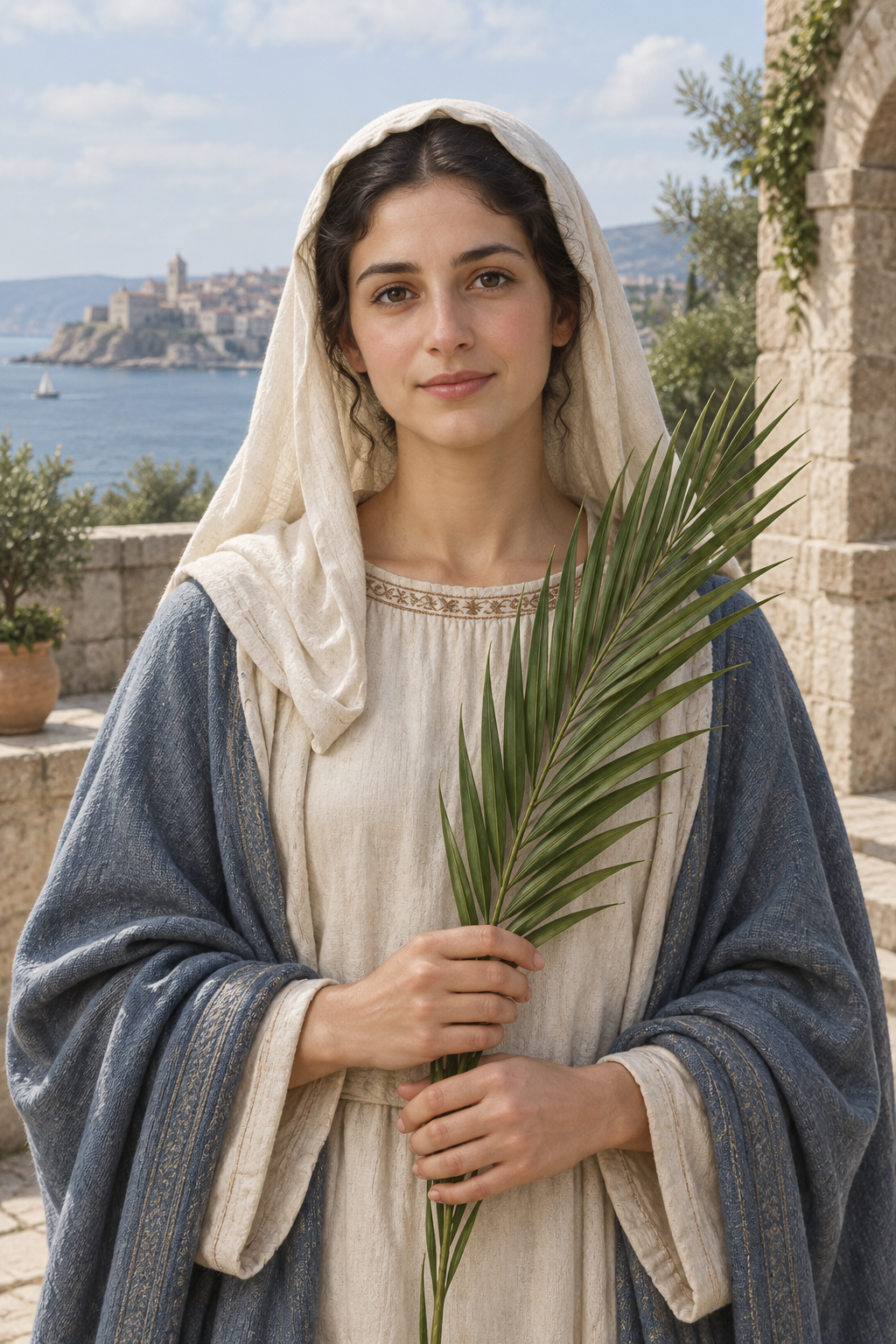
The catalog artwork is also a modern act of reception. It is AI-generated devotional imagery, not a historical portrait. The young woman's facial features, clothing, cross, landscape, and architecture cannot establish Bonosa's appearance, age, location, or manner of death. The caption states that limitation directly. The images remain linked to existing owner-provenance claims, while historical claims in the new captions are supported by the sources about Portus and the martyr tradition.
Bonosa remains significant because a fragmentary but tangible memorial preserved her name when most details of her life had disappeared. The inscription and archaeological discussion anchor her cult at Portus; the later passion shows how communities interpreted martyrdom through narratives of refusal and endurance; the diocesan feast demonstrates continuing local remembrance. Keeping those forms of evidence separate produces a smaller but more truthful life. Bonosa is not presented as a Portuguese martyr who died in Remiremont. She is the remembered martyr of Roman Portus, encountered through an ancient shared memorial, a legendary personal narrative, and a local tradition that continues to speak her name.
Wondering how to weigh the stories and sources? Learn how to read a saint biography.