Biography
Bruno of Cologne
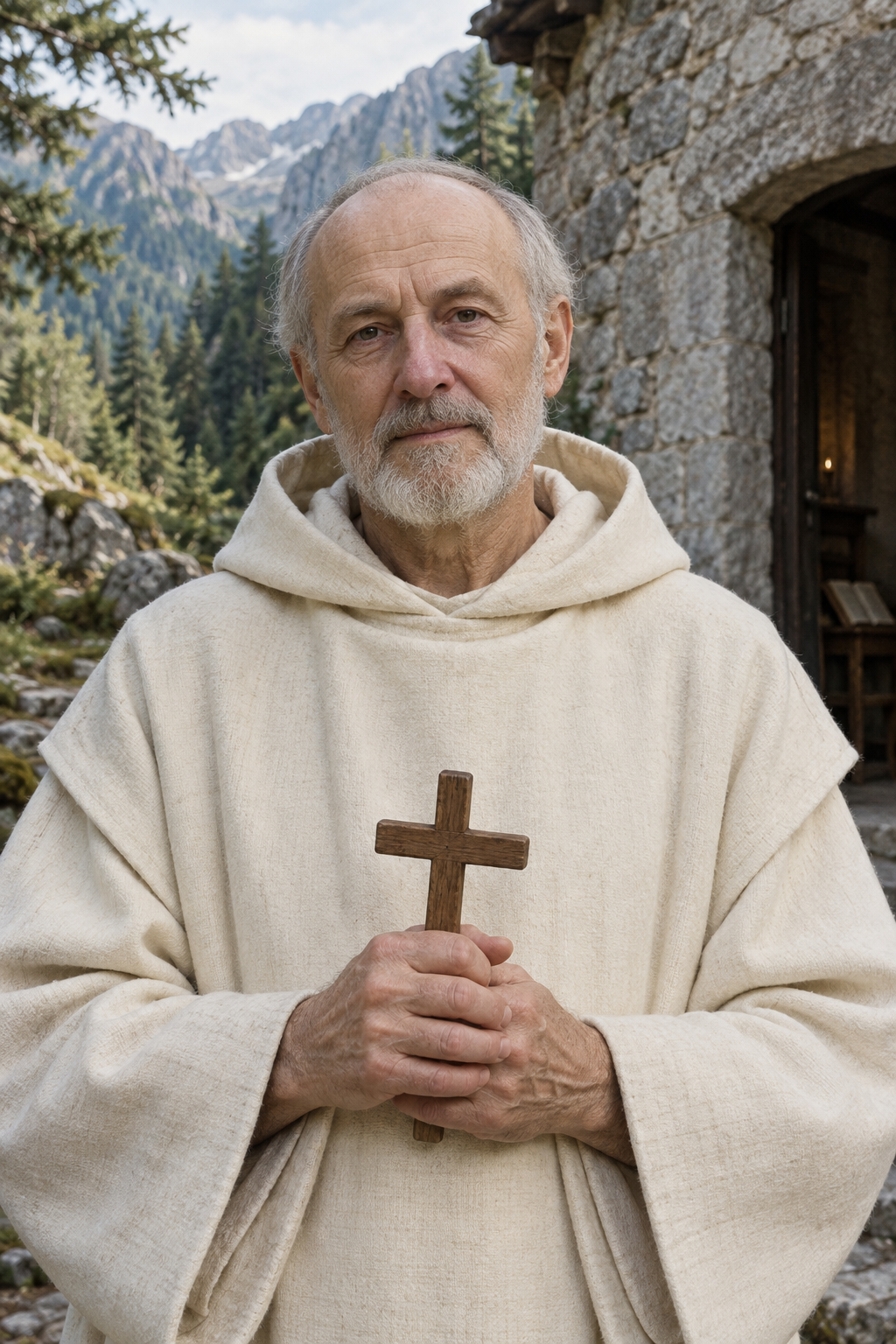
About Bruno of Cologne
Bruno's road to the Carthusian life began in a cathedral school, not in an isolated cell. Born at Cologne around 1030, he went to Reims as a young man to study. The Carthusian Order's history describes his education in theology and the liberal arts, his appointment as a cathedral canon, and more than twenty years directing the school's teaching. His reputation rested on learning and his care for students before he began the communities for which he is best remembered.
School leadership also brought Bruno into the government and conflicts of the local church. The Catholic Encyclopedia dates his appointment as chancellor to 1075. Alongside other canons, he opposed Archbishop Manasses de Gournai and carried complaints to the papal legate. The council at Autun suspended Manasses in 1077; the archbishop retaliated against his accusers by destroying their houses and confiscating property. The dispute continued until his removal in 1080. Bruno emerged from this crisis with another direction in view. Although he was considered for the vacant see, he sought a religious life outside the offices in which he had spent his career.
That search first brought him into contact with Robert's reforming monastery at Molesme. André Louf describes a period near the monastery at Sèche-Fontaine before Bruno and his companions moved toward the mountains of the Dauphiné. Their aim was neither a large common household nor a solitude that excluded other people altogether. In June 1084, Bishop Hugh of Grenoble led the group into Chartreuse. The six companions included scholars, a chaplain, and two laymen, Andrew and Guérin; the little group needed different kinds of service. They built their first wooden dwellings above the site occupied by the later monastery. Louf emphasizes the combination of solitary prayer and shared observances that took shape there. Bruno did not leave a written monastic rule. Guigo, a later prior, would write down the community's customs, describing its existing practice rather than presenting a rule composed by its founder.
The settlement's continuity was tested when Pope Urban II summoned Bruno to Rome in 1090. His departure initially scattered the brothers, and their land was transferred to the abbey of Chaise-Dieu. Ravier's biography reproduces a papal letter and a deed that show how the community recovered its property. Urban asked the abbot to restore the hermitage after the brothers regrouped. The abbot's deed returned his rights to Landuin and the companions under him. Bruno's physical departure therefore did not end the foundation; another prior could carry its life forward. The documents give this transition a practical setting of land, authority, and communal survival, beyond the familiar image of a hermit alone.
Bruno later refused the archbishopric of Reggio and obtained permission to resume a solitary life in Calabria. He settled at La Torre, in the diocese of Squillace, with support from Count Roger. Ravier places that foundation within a southern Italy where Norman rulers favored Latin institutions amid older Greek Christian communities.
His letters from Calabria reveal the friendships that solitude did not erase. Writing to Raoul, he recalled an earlier shared resolution to leave worldly occupations, urged his friend to act, and invited him to visit. He also requested a book, the Life of Saint Remigius, unavailable locally. The same letter enjoys the landscape's streams and orchards and recognizes that rigorous spiritual effort needs refreshment. To the brothers at Chartreuse, Bruno expressed delight at Landuin's report of their perseverance. He singled out the lay brothers' lived understanding, despite limited schooling. Concern for Landuin's recurring illness became a practical instruction: the community should insist on care, even if its prior resisted easing his observance.
Bruno died on 6 October 1101 at Santa Maria della Torre in Calabria. Nine centuries later, John Paul II described his willingness to leave his own foundation at the pope's request as an expression of service to the wider Church.
The remembrance began much earlier than formal recognition of his cult. Sita Steckel's study of Bruno's mortuary roll traces a messenger's journey through Italy, France, and England from late 1101 into 1102. At least 145 churches and religious houses contributed 178 entries. They offered prayers and commemorations, but also memories of Bruno's teaching, including contributions from former students. Steckel draws attention to the unusual prominence of the schoolmaster alongside the religious founder. In this setting, teaching included the formation of a Christian life as well as intellectual instruction. The roll preserves those overlapping expectations: people mourned someone who had taught in a cathedral school and someone who had shown companions another way to live. The original roll was later destroyed, but its transmitted entries retain this collective response to his death.
The Carthusian Order dates Leo X's authorization of Bruno's liturgical feast to 19 July 1514, describing it as recognition without the ordinary canonization process. The October observance now carries his memory into Catholic prayer through a collect asking for constancy amid the world's changes.
Wondering how to weigh the stories and sources? Learn how to read a saint biography.
Explore similar vocations
Prayers for Bruno of Cologne
Bruno: petition for constancy
grant, through his intercession, that amid the changes of this world we may constantly look to you alone.