Biography
Cadoc of Llancarfan
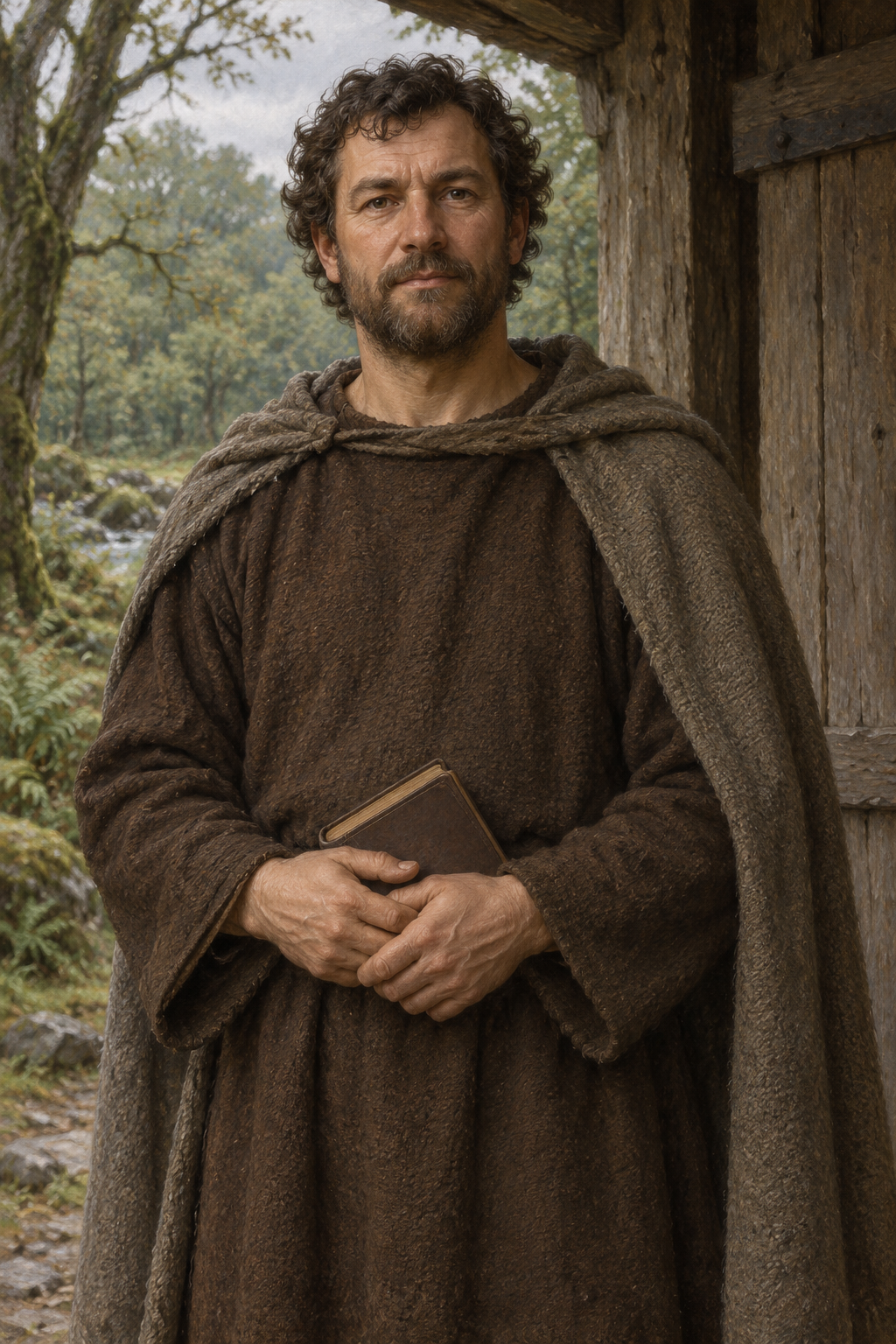
About Cadoc of Llancarfan
Cadoc of Llancarfan was a Welsh religious founder whose memory is especially strong in south-east Wales. His principal monastery stood at Llancarfan in Glamorgan. Churches and wells across the surrounding region carried his name, and later generations also knew him as Cadog or Cattwg. The evidence for this lasting devotion is much firmer than the chronology of his early life.
The surviving Lives were written centuries after the period in which he is thought to have lived. Aidan Breen dates the work attributed to Lifris to the years around 1100 and Caradoc’s shorter account to the first half of the twelfth century. They preserve valuable traditions, but cannot be read as eyewitness biographies. Their accounts connect Cadoc with Gwynllyw and Gwladys, a family remembered among the rulers and saints of southern Wales.
Within that tradition, his education begins with an Irish hermit named Meuthi, also called Tatheus, at Caerwent. His uncle Paul of Penychen later gives him the land associated with Llancarfan. The story makes religious learning, rather than succession to worldly power, central to his vocation. Breen also notes a serious chronological problem: the claim that Cadoc studied under Carthach at Lismore does not fit Carthach’s lifetime. Such details cannot provide secure dates for Cadoc’s travels.
Llancarfan became known as a place of learning. In the Dictionary of Welsh Biography, E. G. Bowen describes the later traditions that associate Cadoc with teaching and with journeys to Ireland, Cornwall and Brittany. Bowen also cautions that the long Life contains little securely recoverable personal history. Its accounts of miracles and distant journeys show the reach of Cadoc’s medieval reputation; they do not by themselves establish a reliable itinerary.
Even the destination assigned to his final years is uncertain. Both medieval Lives place his death at a place called Beneventana, interpreted by some as Benevento in Italy and by others as Bannaventa in Britain. Medieval communities also made competing claims about his remains. A reliquary was recorded at Llancarfan, while Glastonbury claimed part of his skull. These traditions should not be combined into a single documented account of his death and burial.
Modern scholarship helps explain why the stories travelled so widely. Caroline Brett examines an episode in which Cadoc builds a church and bridge on a Breton island. The island and church existed, but details in the Life closely resemble information connected with Quimperlé Abbey around the time Lifris was writing. A priest named Cadwaladr appears both in the story and in documents from that later setting. Brett treats this as evidence of contact between medieval religious communities, rather than straightforward proof of Cadoc’s personal journey.
Similar names require equal care. The Glasgow scholarly record treats identification with other saints called Cadoc as a question for investigation, not a settled fact. In particular, a shared or related name does not prove that a Scottish dedication, a Breton saint and the founder remembered at Llancarfan all refer to one person. The uncertainties belong in his story rather than being hidden behind precise-looking dates.
At Llancarfan, his name remains attached to a living church in the Church in Wales. That continuing dedication preserves the most stable centre of his remembrance: a community of Christian worship associated with learning and religious service.
Wondering how to weigh the stories and sources? Learn how to read a saint biography.