Biography
Cædmon of Whitby
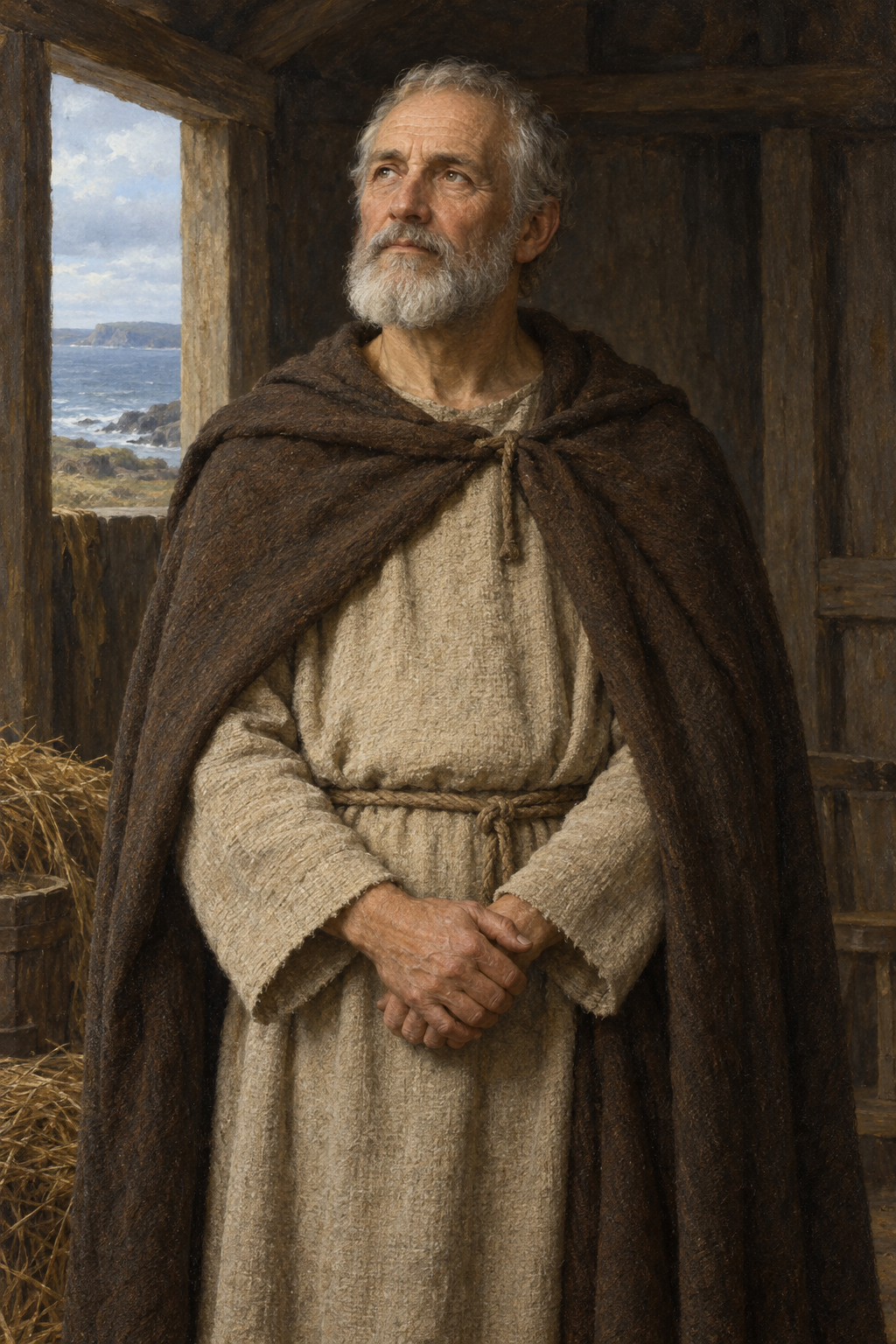
About Cædmon of Whitby
Cædmon of Whitby is remembered as a poet whose religious vocation began late in life. Bede describes a worker attached to Hild’s monastery who avoided singing, then unexpectedly received a gift for sacred poetry.
In Bede’s story, Cædmon leaves a gathering because he cannot take his turn with the harp. While sleeping in the cattle shed, he dreams that someone asks him to sing about creation. He wakes remembering the verses. His superior brings him to Hild, whose community tests his ability with another scriptural passage. She then receives him among the monks and arranges further instruction.
The setting matters. English Heritage places Cædmon in the early religious community at Whitby, where Hild led both women and men. The great ruined abbey familiar to visitors belongs to a later period. Archaeological traces of the earlier settlement instead include timber buildings. His story belongs to that first community, where practical work, teaching and worship formed parts of daily religious life.
Cædmon’s surviving Hymn praises God as creator of heaven and earth. Hugh Magennis explains how its traditional poetic language brings Christian subject matter into an established vernacular art. The poem uses alliteration and varied expressions for God rather than the forms of a modern rhyming hymn. Its importance lies partly in that meeting of spoken poetic tradition and Christian learning.
Bede’s narrative has therefore also invited literary interpretation. Magennis discusses it as a story of beginnings for English Christian poetry, while recognizing the questions surrounding its transmission. Bede gives the poem’s meaning in Latin; manuscripts preserve Old English forms that differ from one another. The relationship between those texts and the song described in the story requires scholarly judgment, rather than an assumption that a single modern edition reproduces an untouched original.
One very early witness survives in the Moore Bede at Cambridge University Library. The library dates the manuscript to about 737. Its final folio contains the Hymn in Northumbrian Old English, followed by an attribution to Cædmon. This is a medieval copy associated with the transmission of Bede’s history, not a manuscript written by Cædmon himself. It preserves evidence of how soon readers wanted the English poem alongside the Latin account.
Research continues to change the picture. In 2026, Trinity College Dublin announced that Elisabetta Magnanti and Mark Faulkner had identified another early copy in Rome. The manuscript was made at Nonantola between 800 and 830 and places the Old English poem within the main Latin text. The researchers interpret that placement as evidence that readers valued the vernacular poem and deliberately restored it to the account they were copying.
The longer biblical poems once assigned to Cædmon need a different treatment. The University of Texas scholarly introduction explains that modern scholarship no longer accepts the old attribution of works such as Genesis, Exodus and Daniel to him. The short Hymn is the surviving poem generally accepted as his. A reputation for composing much more, preserved in Bede’s account, does not establish his authorship of every later poem on the same subjects.
Bede closes with a peaceful death after a short illness: Cædmon receives the Eucharist and makes sure that he and his companions are reconciled. Later Catholic tradition honours him as a saint, although the historical account does not supply a formal canonization. His remembrance rests on sacred poetry in the language of his community and a story in which an overlooked worker becomes a teacher through song.
Wondering how to weigh the stories and sources? Learn how to read a saint biography.