Biography
Camilla Battista da Varano
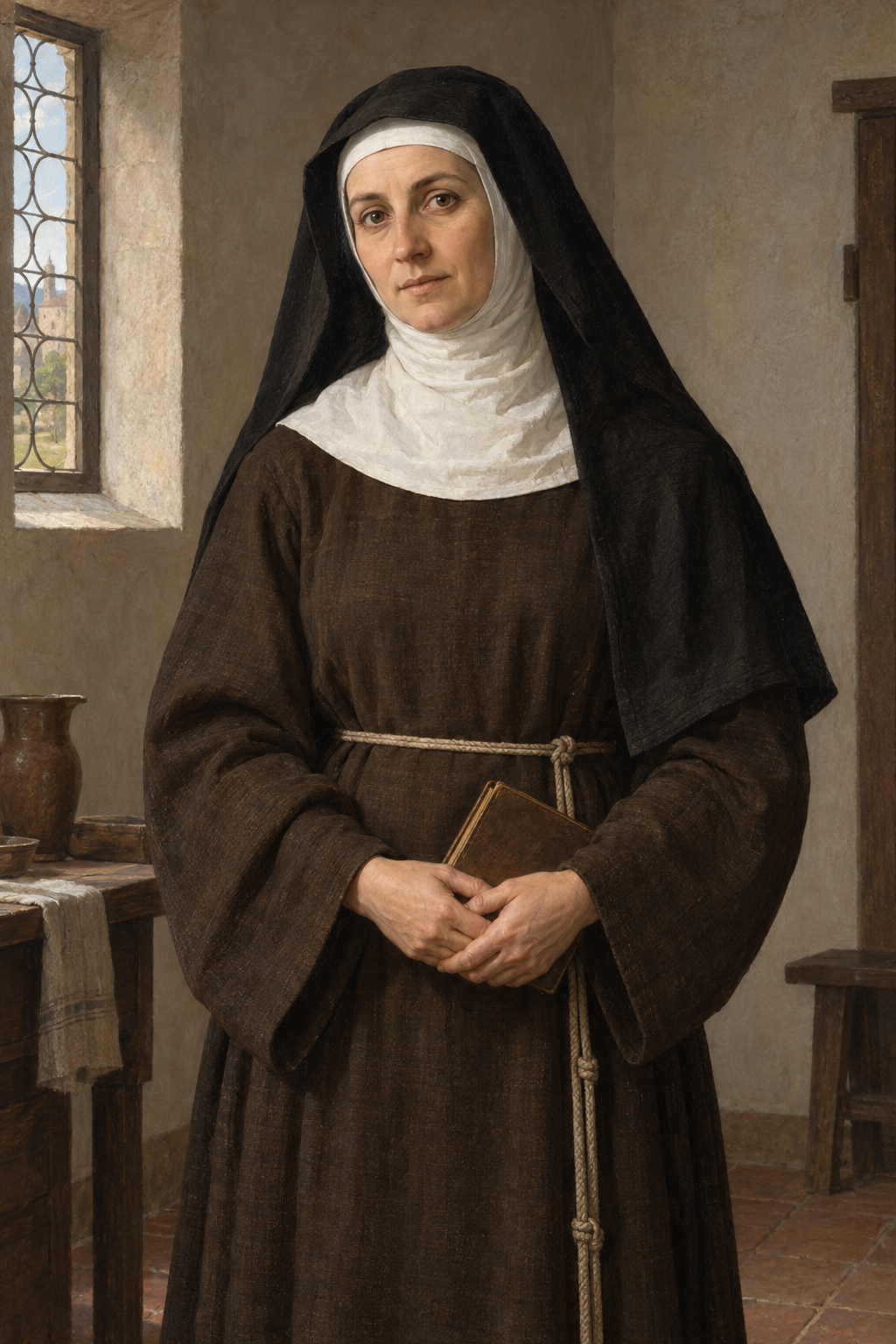
About Camilla Battista da Varano
Camilla Battista da Varano was a Poor Clare nun, abbess and writer whose religious life grew out of the world of an Italian Renaissance court. She was born at Camerino on 9 April 1458, the daughter of Giulio Cesare da Varano and Cecchina di Maestro Giacomo. Raised in her father’s household under the care of his wife, Giovanna Malatesta, she received an education in arts and letters. Those early opportunities later helped her describe religious experience with unusual literary skill.
Her writings recall a childhood response to a sermon about Christ’s Passion. She resolved to meditate on his suffering each Friday. The practice continued as she grew older, but her decision to enter a convent came through a longer period of uncertainty and resistance. The canonization decree describes a struggle between the life available to her at court and the religious vocation she eventually chose. Her resolve did not emerge as an effortless rejection of everything she had known.
On 14 November 1481 she entered the Poor Clare monastery at Urbino and took the name Battista. In 1484 she returned to Camerino with eight companions. Her father had acquired a former Olivetan monastery for the community, but support from her family did not remove every disagreement. Michele Camaioni explains that her commitment to strict poverty resisted the plan to give the convent permanent revenues and benefits. The practical form of religious life mattered as much as the decision to enter it.
Her writing developed within that community. In The Mental Sufferings of Jesus during His Passion, she considered Christ’s inward suffering as well as the visible events of the Passion. She first presented the experiences in the third person, as those of another nun, and later acknowledged them as her own. This literary choice is part of the history of the work; it should not be read as independent testimony from a second visionary.
In 1491 she composed The Spiritual Life, an account addressed to the Franciscan Domenico da Leonessa. Historian William Hudon emphasizes that it is a deliberately shaped spiritual autobiography. It follows her devotion from childhood to adulthood but ends amid anxiety and difficulty rather than with an uncomplicated victory. Reading it as her own account of belief and experience preserves its force without treating every vision as an independently verifiable event.
Hudon finds both gratitude for their guidance and criticism when help was absent. In Instructions to a Disciple, written about a decade later, she herself gives direction to a male religious. She belongs within Franciscan religious tradition while also speaking with authority, and her surviving voice resists an account that makes her merely passive before the men around her.
Her advice also reaches into ordinary community life. In the Instructions, as discussed and translated by Hudon, she discourages hasty judgments of fellow religious and connects prayer with practical tasks, including cleaning and care for others. This attention to daily conduct accompanies the more demanding language of mystical union. The person who wrote about extraordinary experiences also considered how people should live together when irritation and disappointment arose.
Her broader literary work includes poetry, letters, prayers, accounts of other religious figures and commentary on convent rules. The modern Iter edition places these different forms alongside the autobiographical works. Its description notes her use of Scripture, Church Fathers, popular literature and proverbs. Her education was therefore more than an ornament remembered from childhood: it supplied resources for teaching, interpretation and counsel to readers with different needs.
Political violence interrupted this life. In 1502, after Cesare Borgia’s forces invaded Camerino, Battista found refuge at Atri. Her father and three brothers were killed. The canonization decree recalls this exile alongside the spiritual desolation she had described in earlier years. They were different kinds of suffering: one arose within her life of prayer, the other from the destruction of close family ties during a struggle for power.
She returned to Camerino after the political reversal of 1503. Later responsibilities took her to Fermo to help form a community of Poor Clares and to San Severino Marche to assist another community. She repeatedly served as abbess. Her leadership thus included the formation of other women as well as the writing for which she is remembered.
The Treatise on Purity of Heart explores the relationship between inward disposition and love of God. The Fondazione Lorenzo Valla’s account of the work highlights a threefold concern for purity toward God, other people and oneself. Its language draws on the Song of Songs and the Franciscan tradition. Alongside her more personal writings, it shows her effort to turn spiritual experience into instruction that others could consider and practise.
Battista died at Camerino on 31 May 1524. Her long-standing cult received papal confirmation in 1843, and Benedict XVI canonized her in 2010. Her writings preserve a demanding religious voice shaped by learning, community responsibilities, family conflict and hope for renewal within the Church.
Wondering how to weigh the stories and sources? Learn how to read a saint biography.