Biography
Candida Jeong Bok-hye
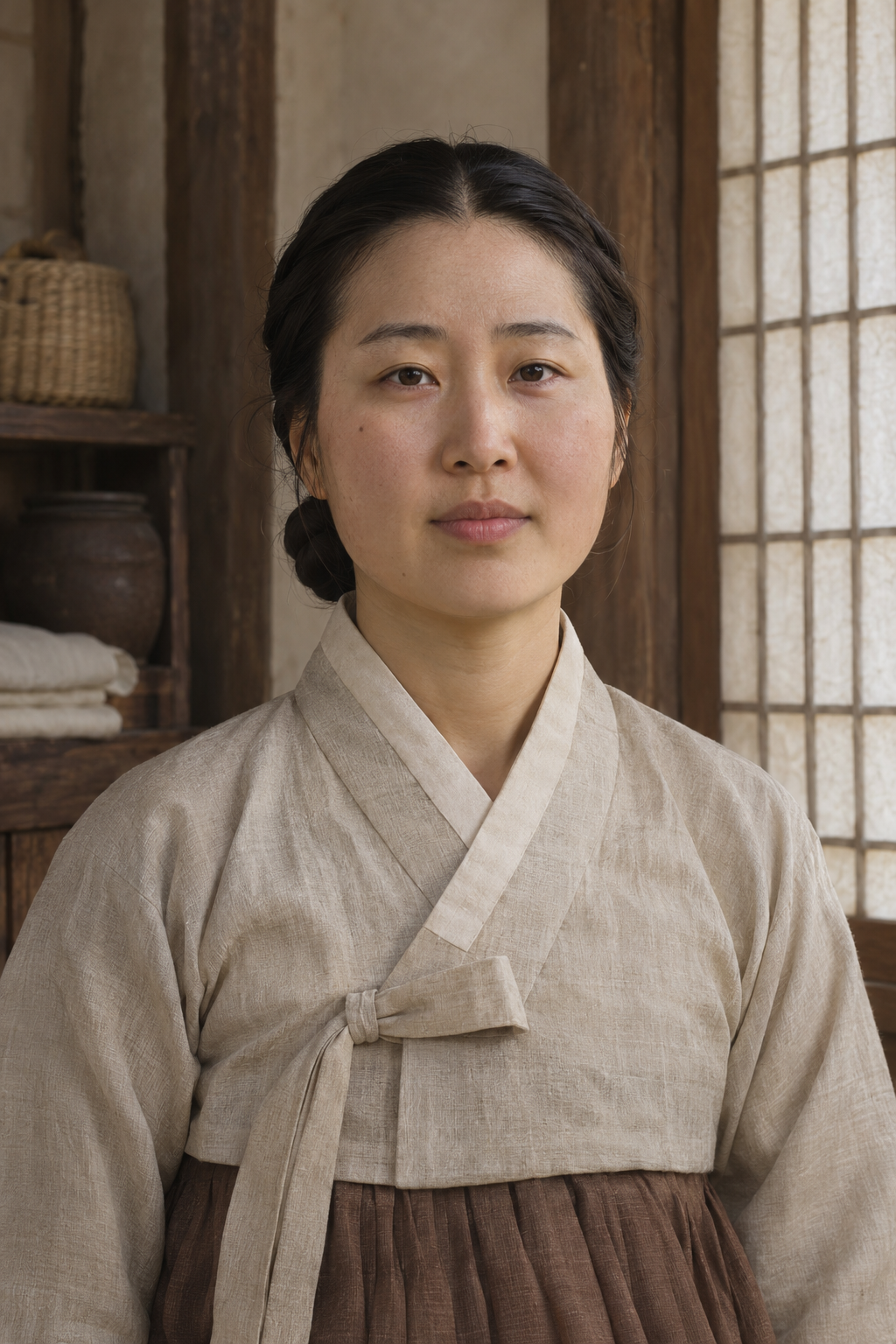
About Candida Jeong Bok-hye
Candida Jeong Bok-hye was known among Catholics as the widow Jeong. She came from a commoner family near Hanyang and continued to live in the capital after marriage. Around the year 1790 she met Yi Hap-gyu, learned Catholic doctrine from him and received baptism. Her husband’s name and the year of her birth are not known.
Records also call her Ganjidae, an older rendering of the name Candida. Jeong Min identifies her with the Small West Gate community and proposes a division of teaching work: Barnabas Jeong instructed men, while Candida taught women.
The Catholic Encyclopedia gives a more precise account of her movements: she had lived at Jeonnongdong outside the East Gate before marrying into a household at Sallimdong. She began teaching within her own family, bringing her elder brother Jeong Myeong-bok and her son Yun Seok-chun to Catholicism. Her faith also affected family ritual. According to the entry, she declined to participate in the memorial ceremony for her father.
A recollection attributed to her son’s police questioning gives a personal reason she offered for joining the Church. When he asked what benefit it brought, she described believers helping one another like family even when they had previously been strangers. She urged him to consider this fellowship because he had no brothers or sisters. The exchange survives here through a later published excerpt of his testimony.
After her husband died in an epidemic, she became an active intermediary among Catholic households. Hong Yeon-ju describes how her daughter-in-law’s employment as a wet nurse in the household of the official Yi Gi-yang gave her opportunities to visit aristocratic women. Candida used those contacts to teach Catholicism.
Han Sin-ae asked Candida to find teachers for the enslaved people in her home. Candida introduced Yi Hap-gyu and Barnabas Jeong Gwang-su, bringing male instructors into a household where she already had close connections. The Catholic Encyclopedia also identifies Choe Seol-ae as someone she brought to the faith and then directed to Yi for further teaching. Her task could involve making an introduction and finding a suitable teacher, as well as giving instruction herself.
Jeong Min’s reconstruction traces a wider circle around her. Her brother and his wife moved from Jeonnongdong to the vicinity of the Small West Gate in 1798. Their son-in-law Kim Deok-jung attended instruction at Columba Kang’s home. Candida’s own daughter-in-law cared for Yi Bang-eok, linking her to another branch of Yi Gi-yang’s family. These were particular routes through which she could maintain the contacts needed for religious work.
Her work included carrying books. A Catholic in Deoksan, identified by the surname Song, encouraged her to sell handwritten Korean catechisms. She joined Han Sin-ae and Lucy Yun Un-hye in maintaining contact among believers, visited other Catholics and took part in gatherings for religious instruction.
When persecution began in 1801, Candida gathered Catholic books and devotional objects from her own family home and those of other believers. She took them to Han Sin-ae’s house, seeking to protect the materials and the people associated with them. Hong Yeon-ju records that her name nevertheless became known through arrested Catholics. Soldiers found her in February and took her to the Ministry of Punishments.
The inventory associated with Han’s house included a picture-printing block, three hanging pictures and six small pouches containing hair, wood fragments and powder described as connected with martyrs’ relics. It also named a book about a holy woman called Candida. These are recorded objects, not recovered possessions inspected today.
The named books also included a pocket daily office, a Mass book, guides to meditation and confession, and a catechism with the Ten Commandments. Some titles circulated in Korean, while the list distinguished both Chinese and Korean versions of a meditation guide.
One of the Korean books Candida collected was Gyoyo seoron. Seo Jong-tae’s study of the title identifies its author as the Jesuit Ferdinand Verbiest and explains that it covered central doctrines, the Ten Commandments, the Creed, prayers and baptism. The entry specifically records a Korean copy among the books buried at Han’s house and subsequently discovered and burned. Verbiest published the work in Beijing in 1670. Later editions and its inclusion in the imperial Siku quanshu compilation in 1781 preceded the Korean copy that Candida helped preserve. Seo uses her collected copy as evidence that a Korean translation was circulating before 1801.
The officials moved Candida from the ministry to the police bureau for questioning and then brought her back. They demanded that she abandon her religion. The present Church biography does not describe uninterrupted confidence: under punishment her resolve briefly weakened, but she regretted it and openly acknowledged her religious activities. She was condemned and beheaded outside the Small West Gate on May 14, 1801. Her brother and son survived by renouncing Catholicism and were exiled, respectively, to Jangseong and Gijang.
Wondering how to weigh the stories and sources? Learn how to read a saint biography.