Biography
Cándida María de Jesús
About Cándida María de Jesús
Cándida María de Jesús was born Juana Josefa Cipitria y Barriola at Berrospe in Andoain, Guipúzcoa, Spain, on May 31, 1845. The says her life began there and ended in Salamanca on August 9, 1912. The profile should preserve both the Basque birthplace and the Salamanca foundation.
She was the firstborn of Juan Miguel, a weaver, and Maria Jesus. The same day as her birth, she was baptized in the parish church of San Martin. She received Confirmation on November 5, 1848, and made her First Communion at ten in the parish of Santa Maria in Tolosa.
The source gives special weight to that First Communion, describing lasting joy in meeting Jesus. This detail should be used with restraint. It supports the profile's spiritual line, but the final page should not over-quote devotional language or turn her childhood into an invented interior narrative.
Her condition was simple, with little formal preparation, few economic resources, and scant material help at the beginning of the foundation. The Dicastery profile presents these limits as evidence that trustful correspondence to God's call made her a fitting instrument for the mission entrusted to her.
This emphasis also guards the page from making her influence depend on social advantages she did not have. The source presents her poverty and limited resources not as obstacles erased by success, but as part of the way her trust in God's call became visible through an educational work that outgrew its first means.
On December 8, 1871, in Salamanca, Juana Josefa began the foundation of a new congregation as Mother Cándida María de Jesús. The congregation was dedicated to Christian education of childhood and youth and to the promotion of women. This educational mission belongs at the center of her profile.
The foundation date should remain linked to Salamanca. The official profile presents the city as both the beginning of the congregation and the place where her life ended. The page can therefore use Salamanca as the stable setting for her public mission without inventing details about individual school buildings.
The Daughters of Jesus opened schools for children and girls of all social classes. The source notes that such integration could seem utopian in that period. They also opened Sunday schools for working women and domestic servants, placing education within the pastoral needs of nineteenth-century Spain.
This range of students is one of the strongest supported claims. It lets the profile show Cándida's concern for girls, children, workers, and domestic servants in concrete form. The draft should not add modern terminology, but it can say that education and women's promotion were inseparable in her work.
That detail helps keep the page concrete. Cándida's work was not only founding an institution; it was education for children, girls, workers, and domestic servants who needed Christian formation and human promotion. The profile should avoid generic praise when the source gives these specific groups.
Her spirituality drew nourishment from the Spiritual Exercises of Saint Ignatius. With the collaboration of Father Herranz, S.J., she wrote the constitutions for her religious family. Ignatian language should be used only where the source supports it, not as a broad label for every decision she made.
Father Herranz belongs in the biography because the source names his collaboration on the constitutions. That support is enough to show Jesuit and Ignatian influence, while still leaving unsourced spiritual-direction details out of the profile. The stronger claim is that the constitutions and spirituality grew from an Ignatian setting.
Seeking stability for the work, Mother Cándida went to Rome to obtain pontifical approval. Pope Leo XIII granted that approval on September 18, 1902. This event can stand as a featured moment because it shows the congregation receiving formal support after decades of service.
The official profile also frames her vocation with the phrase "only for God." The final page can mention this theme in paraphrase, but it should not rely on long direct quotations. Her life is better shown through the concrete pattern: foundation, education, Ignatian formation, Roman approval, and perseverance.
Cándida María de Jesús died in Salamanca on August 9, 1912. The source records her beatification by John Paul II on May 12, 1996, and canonization by Benedict XVI on October 17, 2010. Her memorial is August 9.
Her profile should emphasize humble beginnings, trust in God's call, Christian education, women's promotion, and Ignatian spiritual formation. It should avoid current institutional statistics and should not import unsupported modern biographical side details loosely about domestic service, schools, or Basque local history beyond the source.
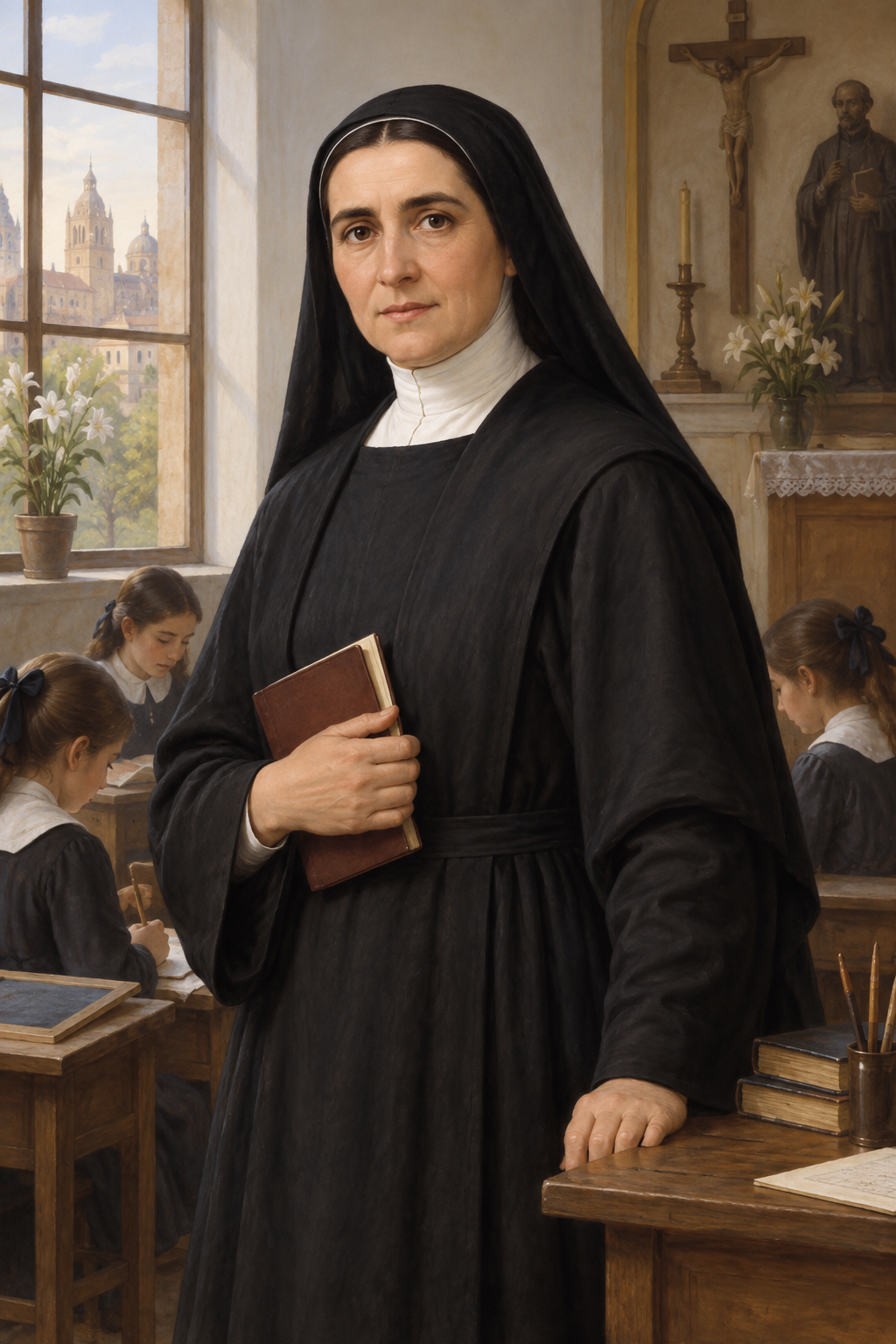
Artwork should show a Spanish or Basque foundress in a simple black habit with a white coif or collar, holding a book or teaching notebook in a modest Salamanca classroom or convent-school setting. Avoid rendered text, modern classroom objects, ornate convent fantasy, and any claim to historical portrait likeness.
Wondering how to weigh the stories and sources? Learn how to read a saint biography.