Biography
Carolina Santocanale
About Carolina Santocanale
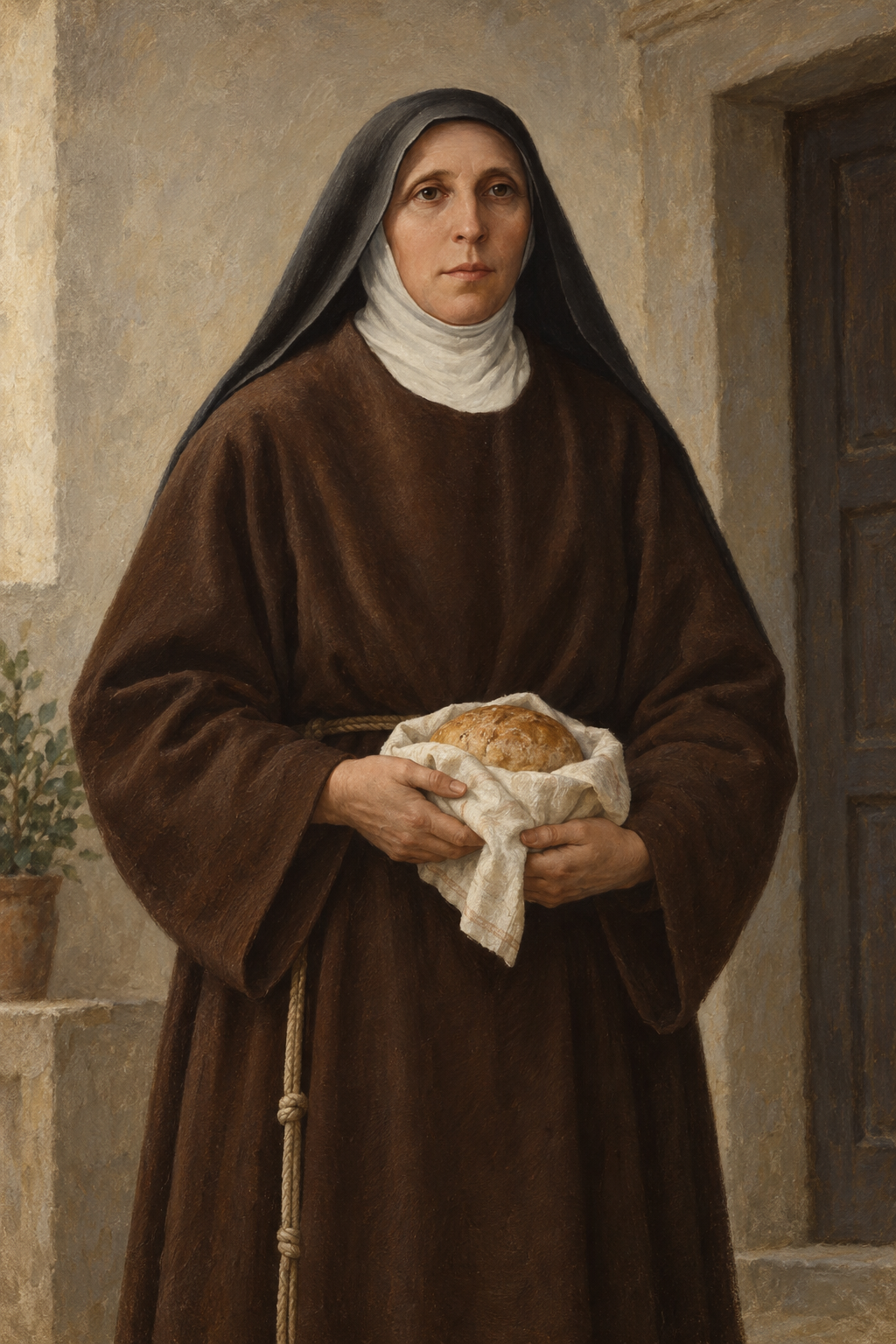
Carolina Santocanale was born in Palermo on 2 October 1852 into a family of the Sicilian nobility. Her education included music and French, but her later vocation led her away from the social position her family expected her to occupy. She wished to become a religious sister, despite her father’s opposition. For years she led the Daughters of Mary at the parish of Sant’Antonio Abate. That responsibility placed her within parish life before she founded a community of her own.
Her desire for prayer at the monastery of Santa Caterina existed alongside a growing concern for people living in poverty at Cinisi. The congregation’s account remembers her distress at the circumstances of sick and disabled people and girls without family protection. It presents her eventual Franciscan vocation as a way to bring contemplation and practical assistance together. This account also recalls her collecting food from house to house and helping prepare meals, including food sent privately to people reluctant to ask for help.
A long illness interrupted her plans. In 1887 she took the habit of a Franciscan tertiary and the religious name Maria di Gesù. Her work developed with companions, and in February 1891 they moved into her grandparents’ house. The foundation later provided an orphanage and other forms of care and instruction for children. Its religious identity took more definite shape with help from the Capuchin Giovanni Maria Schiavo, who assisted with constitutions and the institute’s connection to the Capuchin order.
Carlo Calloni, the postulator of her cause, relates this development to the religious teaching she had absorbed as a young woman. Drawing on her autobiographical recollections, he describes the effect of sermons about the Samaritan woman and the Canaanite woman. He also records an unsuccessful attempt to establish a work connected with Giacomo Cusmano’s Boccone del Povero at Cinisi. Her eventual foundation therefore emerged through choices and proposals that did not all succeed, rather than from a single plan carried out without interruption.
The children’s work answered specific pressures on family life. Calloni describes the nursery as a help for mothers who needed to earn a living, in a community affected by male emigration. He also records disagreements with her earlier spiritual director, Mauro Venuti, before Schiavo helped provide a firmer religious structure. These difficulties belong to the history of the foundation. They show that its development involved relationships, authority and practical arrangements as well as Carolina’s personal conviction. His account of the 1917 visitation includes the archbishop’s requirement that the institute’s property be secured for the community, making its future an administrative concern as well as a spiritual one.
The First World War brought further hardship. The official canonization biography says that the institute lacked adequate means of support, and the archbishop of Monreale required the novitiate to close. Carolina’s health also deteriorated, and she spent time with her brothers in Palermo before returning to Cinisi. On 24 January 1923 the archbishop sent authorization to reopen the novitiate and a decree confirming the institute. She died three days later, on 27 January. This final recognition came after a period of serious uncertainty for the community.
Her sisters remember care for vulnerable people as a central part of the inheritance she left them. Their description of the congregation’s mission includes education, assistance to children in difficulty, visits to sick people, care for older women and support for people with disabilities. These are the continuing commitments of the institute, and should not all be treated as separate institutions Carolina personally opened. They express how her successors understand the connection between Franciscan simplicity, religious life and attention to their neighbours.
Writing before her canonization, Capuchin minister general Roberto Genuin placed Carolina within the wider Franciscan family. He emphasized her response to the needs of poor people and orphaned children in Sicily. His letter also asked the communities remembering her to recover the inspiration behind inherited practices, rather than merely repeat those practices. In that reading, the importance of a founder lies partly in the renewed attention she can call forth from later generations facing different circumstances. He recalled the institute’s affiliation to the Capuchins on 8 December 1909, an enduring connection within the wider Franciscan religious family.
Archbishop Michele Pennisi likewise connected her remembrance with both material assistance and Christian teaching. In the announcement of her forthcoming canonization, he recalled her work at Cinisi as service to people at the margins, joining human care with the Word of God and the Eucharist. The churches of Monreale and Palermo thus remembered a life rooted in particular communities whose influence continued through the sisters she founded.
Francis beatified Carolina on 12 June 2016, as recorded in the apostolic letter for that celebration. She was canonized on 15 May 2022. Her formal recognition honours the religious founder remembered at Cinisi as Maria di Gesù.
Wondering how to weigh the stories and sources? Learn how to read a saint biography.