Biography
Catherine of Alexandria
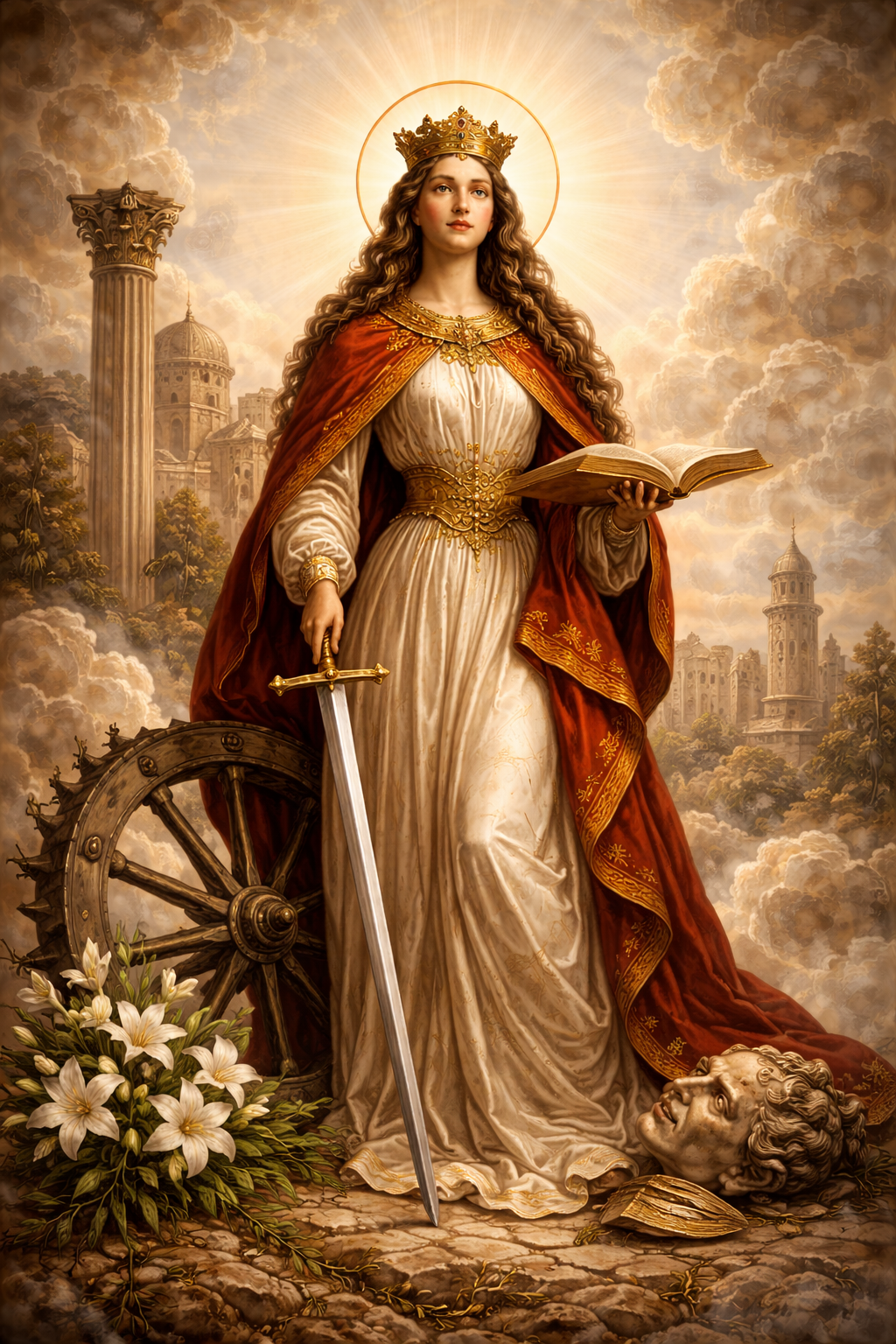
About Catherine of Alexandria
Catherine of Alexandria is honored across several Christian traditions as a learned virgin who resisted an emperor and died for her faith. Yet the surviving evidence does not establish a fourth-century woman matching the received story. Christine Walsh's study of Catherine's early medieval cult concludes that the Passion supplies no evidence that Catherine existed as a historical person. The familiar biography appears centuries after the period in which it is set. A responsible account must therefore begin with the evidence gap, leave her birth and death dates unset, and describe the life narrative as tradition rather than late-antique documentation.
The Orthodox Church in America preserves a detailed form of that tradition. It calls her Katherine, makes her the daughter of a governor of Alexandria, and presents her as exceptionally educated in philosophy, literature, rhetoric, medicine, music, mathematics, and astronomy. Suitors seek marriage, but she says she will marry only someone who surpasses her in every quality. Her secretly Christian mother brings her to an elder, who teaches her about Christ. Visions then lead to baptism and a mystical betrothal. These episodes shaped Catherine's identity as a learned virgin, but none is independently confirmed.
The received life next places Catherine before Emperor Maximian during a pagan festival at Alexandria. She protests the sacrifices and argues that political rank should not shelter error. Impressed by her learning, the emperor summons fifty learned men to answer her. The story says Catherine defeats their arguments and that the men accept Christianity. When the emperor orders them burned, Catherine encourages them and assures them that their suffering will serve as baptism. The debate is the legend's defining intellectual scene. It expresses medieval admiration for reasoned witness, but it is not a transcript of an imperial hearing.
The story then turns from debate to coercion. The emperor tries to win Catherine through status and marriage; after she refuses, he orders her stripped, beaten, and imprisoned without food. While he is away, his wife Augusta and the commander Porphyrius visit Catherine with soldiers. The tradition says they convert after speaking with her. Catherine is offered marriage again and again refuses. This portion of the legend joins threatened sexual domination to state violence. Her resistance should not be softened into a polite philosophical disagreement, and the converted visitors should not be asserted as independently documented people.
An official proposes breaking Catherine on spiked wheels. According to the passion, an angel destroys the device before it can kill her, and fragments strike bystanders. Augusta publicly denounces her husband and is tortured and beheaded; Porphyrius and two hundred soldiers then confess Christianity and are also executed. Catherine herself is beheaded after refusing a final demand. The breaking wheel became her most familiar emblem even though the story says it failed. This account preserves multiple executions and severe bodily violence; it should be told plainly, without devotional embellishment or the claim that the mechanism is historically verified.
The passion says angels carried Catherine's body from Alexandria to Mount Sinai. Medieval devotion later associated relics at the Sinai monastery with her, and the institution eventually became known by her name. Walsh's research traces this process as cult history: the Passion created an expectation of a Sinai burial, relics offered a focal point, and Catherine's prominence gradually overtook the monastery's earlier identity. This documented development does not verify angelic transport or establish a physical route from Alexandria. The packet therefore records Alexandria and Sinai as distinct places of received memory and does not draw a journey between them.
Catherine's cult gathered force slowly rather than appearing in contemporary records of the persecutions. Walsh's study of calendars, hymns, Greek versions of the Passion, and Sinai concludes that by the late tenth century the cult had achieved official standing in the Eastern Church after about two centuries of development. Her public debate with learned men gave the legend a distinctive appeal, while the relic tradition tied her memory to a celebrated pilgrimage center. Later Western communities adopted her widely, and the wheel connected her name with scholars, crafts, institutions, and images. These are facts about reception, not evidence for each life episode.
Modern calendars preserve both common ground and jurisdictional difference. The Roman Martyrology commemorates Catherine as virgin and martyr at Alexandria on November 25 and notes veneration of her relics at the Sinai monastery. The Orthodox Church in America commemorates Great Martyr Katherine on November 24. A Vatican account of Byzantine liturgy likewise explains that Catherine is kept on November 25 in one usage and on November 24 in the Russian Church. These dates document worshiping communities' observance; they must not be converted into a historical anniversary of her death.
John Paul II's visit to Sinai in 2000 observed that Catherine's fame lives in Christian devotion and in churches around the world. That carefully limited statement fits the evidence: whatever judgment is made about her historicity, the cult is historically consequential. Catherine became an enduring figure through a story that joins learning, public argument, resistance to coercive power, solidarity with fellow prisoners, and death under persecution. Her significance does not require presenting legend as archival fact. It lies also in how generations used her narrative to imagine that intellectual seriousness and moral courage could belong together.
Wondering how to weigh the stories and sources? Learn how to read a saint biography.