Biography
Catherine of Bologna
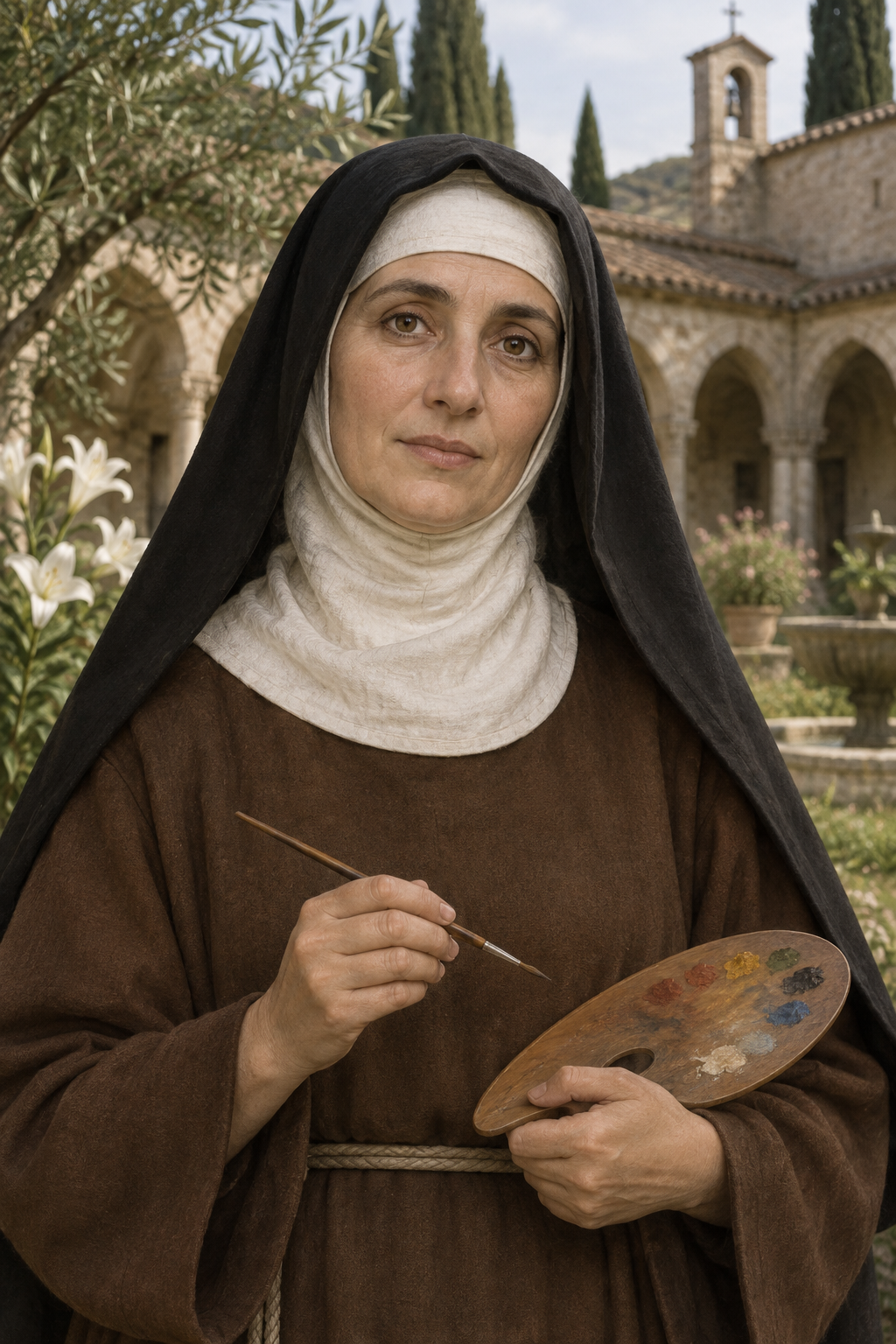
About Catherine of Bologna
Catherine of Bologna grew up between two cities and carried the learning of a court into the work of a convent. Born in Bologna in 1413, she spent her early childhood there before moving with her mother to Ferrara. Her father served the Este family, and Catherine became a companion to Margherita, the daughter of Niccolò III d’Este. Court life gave her opportunities to study Latin, develop a fine handwriting, illuminate manuscripts and learn music. Around 1426 she left that setting for a community of devout women in Ferrara. Her religious life began among women still deciding what shape their common life should take.
The community was divided over its future, and Catherine supported a Franciscan direction. This was a gradual change, not simply an entrance into an already settled institution. Historian Dominic Monti places its adoption of Clare’s Rule in 1435. Catherine became responsible for introducing novices to religious life, although she was herself still young. That responsibility would remain important to the way she taught and wrote. She also continued to take part in ordinary community tasks, so instruction was joined to the shared work of the household. Music, art and writing remained part of her life rather than being abandoned with her courtly education.
The Catholic account presented by Benedict XVI remembers Catherine washing clothes, making garments, baking bread and tending animals. These jobs placed her beside the other sisters in the practical business of keeping a monastery alive. She did not regard a humble assignment as incompatible with a life of prayer. When she was made responsible for receiving visitors at the grille, however, she found the interruptions difficult. The account preserves that difficulty rather than suggesting that every duty came easily to her. Her service involved learning to respond to people who arrived while she would have preferred to remain at prayer.
Her best-known book, The Seven Spiritual Weapons, speaks to women entering religious life. Its opening chapters offer practical guidance, arranged around the image of spiritual combat. Later sections become more personal as Catherine describes disturbing visions and the struggle to understand them. She writes about an inner life marked by conflict, not an uninterrupted succession of consolations. The work therefore preserves both a teacher’s guidance and the difficulties from which that guidance emerged. Its readers encounter a woman trying to distinguish what strengthened her faith from what unsettled it, while helping other sisters navigate their own religious commitments.
Illuminata Bembo, a sister who knew Catherine, remembered the warmth of her teaching in conversation. In Bembo’s account, other sisters wished that they could love God as Catherine did. Catherine answered gently, smiling so that they would not be discouraged. She encouraged self-examination, acknowledging their failings and God’s goodness. Awareness of the shortness of life belonged within that same conversation: time was an opportunity to love and act, not something that could be recovered after it had passed. Bembo’s recollection presents instruction as a personal exchange between women, with attention to the feelings of those asking for help.
In July 1456 Catherine went to Bologna with a group of sisters to establish another Poor Clare community. The sanctuary’s account includes her mother Benvenuta among those accompanying her. Catherine became the abbess of the new foundation, also called Corpus Domini. Returning to the city where she had been born meant taking responsibility for another household and its growing community. She spent the remaining years of her life there. The same account remembers her continuing to give herself to the sisters and records her death on 9 March 1463, with the name of Jesus on her lips.
After her death, the sisters helped preserve and circulate her writings. Copies of The Seven Spiritual Weapons passed beyond the monastery, and the work reached print in the fifteenth century. Her breviary also survived, preserving personal notes and miniature paintings associated with her hand.
One surviving witness to that circulation is a fifteenth-century Italian manuscript now catalogued by the British Library as Additional Manuscript 10767. It contains Catherine’s treatise alongside other devotional material, in a volume combining several originally separate parts. Such a surviving copy gives a concrete glimpse of how her teaching could travel without its author. The book belonged to the handwritten world in which religious instruction was copied, assembled and passed from one reader to another. Its pages also preserve Italian verse and Latin devotional texts.
Catherine was canonized in 1712. In recalling her centuries later, Benedict XVI emphasized the connection between her authority and her willingness to serve. The abbess and the woman doing household work were the same person.
Her memory remained closely attached to Corpus Domini, where her community continued its spiritual life and her remains became a focus of devotion. She is remembered there as a teacher whose learning, artistic practice and care for other women belonged together.
Wondering how to weigh the stories and sources? Learn how to read a saint biography.
Explore similar vocations
Prayers for Catherine of Bologna
Catherine of Bologna — artists petition
Make artists learn lessons from you and use their talents to the full.