Biography
Catherine of Palma
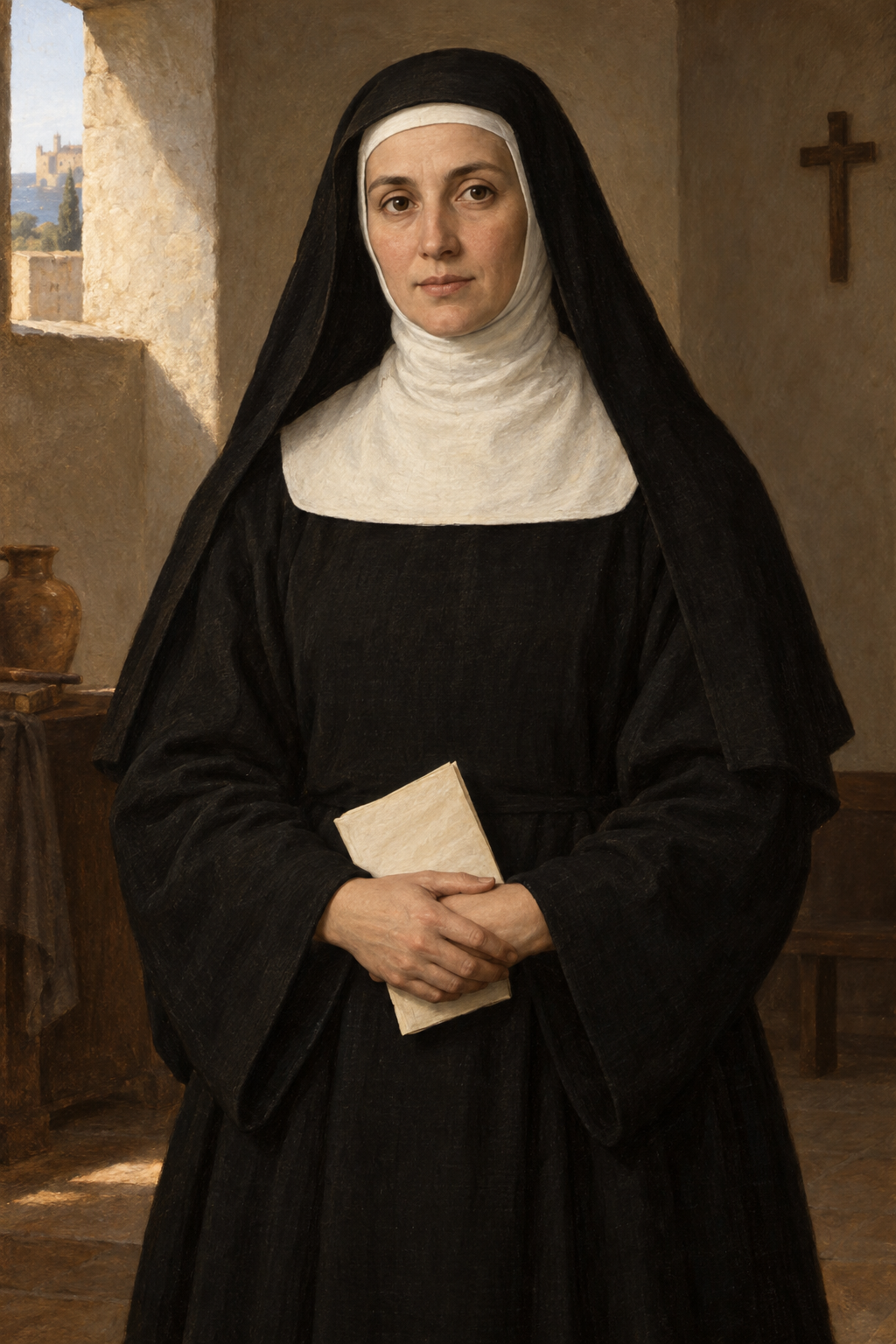
About Catherine of Palma
Catherine of Palma, known in Mallorca as Catalina Tomàs, was an Augustinian canoness whose counsel reached beyond her enclosed monastery. She came from Valldemossa, where she lost her parents while still a child. The account published by the Dicastery for the Causes of Saints describes her caring for livestock in her relatives’ household and finding ways to pray during her work. It also remembers the help of Antonio Castañeda in pursuing her wish to enter religious life.
Her birth is usually placed in 1531, although the canonization document also records 1533 as an alternative. That uncertainty makes an exact age at each stage of her life misleading. The same document identifies her community as the canonesses regular of Saint Augustine at Santa María Magdalena in Palma. It remembers her diligence in the monastery and her refusal of an offer to govern the other sisters. These details belong to the Church’s formal account of her life, written long after her death.
According to the Dicastery’s biography, she was received into the monastery in 1553 and made her profession on 24 August 1555. Her reputation for prayer became known outside its walls, and the bishop of Mallorca sought her advice. The account describes experiences of mystical ecstasy. Those experiences form part of the religious testimony about her; they should not be turned into an independent medical diagnosis or treated as a complete explanation of her character.
Her correspondence provides a less spectacular and especially valuable way of approaching her. Art historian Concepció Bauçà de Mirabò discusses two surviving letters to the Carthusian Vicenç Mas, associated with 1572, alongside Catherine’s profession document. These records are held at Santa Magdalena. An exhibition reproduced them to draw attention to her intellectual life, rather than present only the familiar stories of wonders. They show a woman remembered as someone capable of offering serious counsel within the religious world of her time.
Bauçà cautions that later portrayals could make Catherine seem childlike and overly simple. In her reading, the letters reveal moral and intellectual authority that such pictures conceal. This distinction does not require dismissing popular devotion; it asks readers to distinguish the historical woman from the many stories and images through which later communities came to know her.
The writer Llorenç Vidal likewise draws attention to the two Spiritual Letters. He identifies their language as literary Mallorcan and explains that Mas preserved them in his autobiography. Vidal discusses several later editions and argues for reading the letters as literature as well as religious counsel. His interpretation belongs to Vidal, but the transmission he describes helps explain why these brief writings remain accessible beside much longer accounts of Catherine’s life.
Among the editions Vidal identifies are a booklet produced by Santa Magdalena in 1974 and the letters included in Pere Llabrés’s 1980 biography. He distinguishes that more restrained biography from the traditional material in the anonymous account published in 1792. The letters thus circulated within books that approached her life in different ways.
In the excerpts Vidal prints, Catherine urges her correspondent to meet changing circumstances through love of God and to entrust himself to God’s care. Peace and freedom are presented as fruits of that trust. The advice is personal and direct, addressed to someone trying to live his religious vocation. It preserves her voice more closely than a later report of what she might have said during an extraordinary experience.
Montserrat’s remembrance of Catherine also emphasizes prudence, service and the people who sought her help. Its account joins her reputation as a mystic to the more ordinary work of offering counsel. That combination matters: her religious life was remembered not only for inward experiences but for what others received from speaking or corresponding with her. The abbey continues this remembrance in its own account of the saints celebrated on 28 July.
Catherine died on 5 April 1574. She was beatified in 1792 and canonized by Pius XI on 22 June 1930. The canonization decree places her among the Church’s saints and recalls the earlier examination of her virtues. These acts explain her formal recognition; the long interval also separates her lifetime from the institutional narrative preserved in that decree.
Her local remembrance has a visible place in Valldemossa. The Pureza de María retreat house describes devotional tiles at house entrances and the small chapel made from her birthplace. It also points to places associated with her memory, including a fountain and the Molinet. These are witnesses to continuing devotion in her home village, not proof that every story attached to them is contemporary with her.
At Santa Magdalena in Palma, the diocesan account of her July celebration describes the community of canonesses singing at the Eucharist and visitors approaching her tomb. It names her the city’s secondary patron. The local liturgical celebration is held on 28 July, preserving a communal remembrance alongside the April anniversary of her death.
Wondering how to weigh the stories and sources? Learn how to read a saint biography.