Biography
Catherine of Saint Augustine
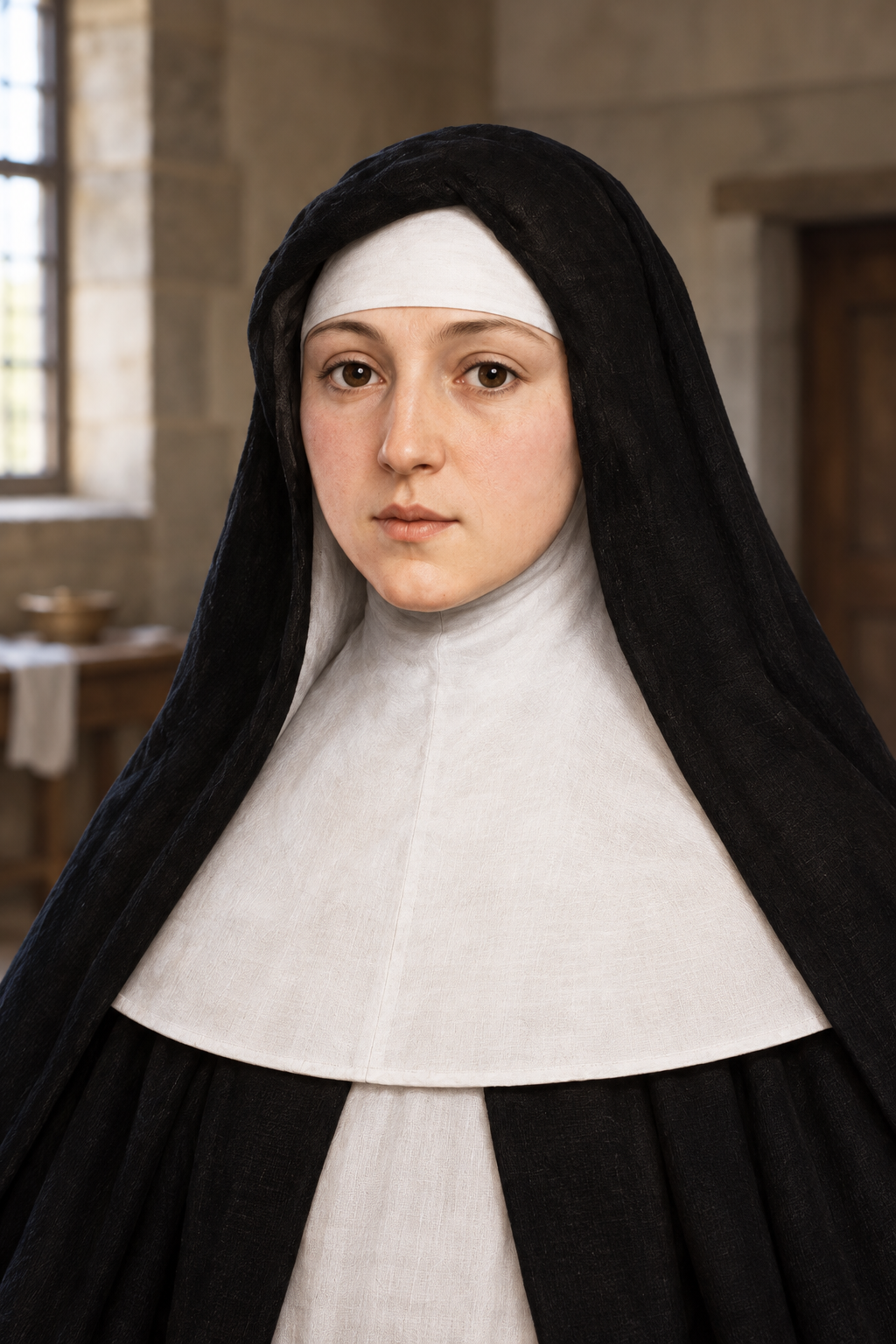
About Catherine of Saint Augustine
Catherine of Saint Augustine grew up largely in the care of her maternal grandparents, whose home welcomed poor and sick people. The Canadian bishops’ biography presents this household as an early influence on her vocation to care for others. At twelve, she chose to enter the hospital community at Bayeux, directed by the Augustinian Hospital Sisters of the Mercy of Jesus.
Leaving France meant parting from close family ties. In her account written after Catherine’s death, Mother Marie de Saint-Bonaventure recalled that Catherine’s father had tried to prevent the journey through a petition to the courts. He eventually consented, while Catherine persisted in the vocation she believed God had given her.
Born at Saint-Sauveur-le-Vicomte in Normandy on May 3, 1632, Catherine entered the Bayeux community in 1644 and received the religious habit two years later. She volunteered for its Canadian mission. Her superior’s account places her religious profession at Nantes, during the journey to the port of departure. After a difficult Atlantic crossing, she reached New France on August 19, 1648, and joined the sisters at the Hôtel-Dieu in Québec.
The hospital had already been established in 1639, nine years before Catherine arrived. She joined an existing community of caregivers and spent the remaining twenty years of her life serving in Canada. Her responsibilities eventually included directing hospital care, training novices and managing finances. The community’s remembrance places her service to patients alongside the less visible work needed to sustain the religious household and its hospital.
Catherine entered a hospital that served both Indigenous people and French settlers. Historian Timothy Pearson places her nursing within the upheavals following the destruction of the Huron confederacy in 1649. He cites a letter from the hospital superior describing wounded French soldiers filling its small ward in 1650, while Huron refugees camped outside its gates. These accounts describe the demands facing the community rather than identifying every patient Catherine herself treated. Her daily responsibilities also included helping newcomers from France learn about life in Canada. Pearson records her election as treasurer in 1654 and again in 1659, placing this administrative work alongside her nursing and missionary responsibilities.
Her work continued through recurrent difficulties with her own health. She began learning languages of the First Nations people and cared for those who came to the hospital. In 1654 she renewed her commitment to remain in Canada. Her prayer followed the liturgical seasons and included particular devotion to the Eucharist.
Her superior remembered care shaped by attention to different people’s needs and dispositions. The circular letter praises Catherine’s management of the hospital and her readiness to offer consolation. It also describes her taking on unpleasant tasks within the household. This testimony comes from a member of her own community who admired her, and presents practical work within an explicitly religious account of her virtues.
The Jesuit Paul Ragueneau served as her spiritual director. Because his work took him away from Québec, he asked her to record her spiritual experiences so that he could continue advising her through correspondence. Those writings were intended for spiritual guidance rather than publication. After her death, he drew on her life and writings for a biography published in 1671. Accounts of her mystical experiences therefore reach later readers through the work of a director and religious biographer.
Historian Marie-Emmanuel Chabot notes that Catherine’s journal has disappeared. Ragueneau’s account therefore requires critical examination; it cannot simply be compared with the original journal to establish how he selected and presented her experiences.
Catherine died at Québec on May 8, 1668. The official notice of her beatification recalls both her responsibilities within the community and her ability to encourage and console the sick.
Mother Marie’s circular letter also recounts Catherine’s final illness and the sisters’ care for her. It remembers her gratitude for their help and her request that the community sing the Te Deum with her shortly before her death. The superior also reported requests for objects Catherine had used, evidence of the devotion already forming around her memory.
Her reputation was recorded before Ragueneau’s book appeared. Pearson identifies a September 1668 letter from Marie de l’Incarnation and the hospital superior’s circular letter the following month. He distinguishes these early testimonies from the hospital annals compiled decades later, whose account drew heavily on Ragueneau. The surviving accounts therefore preserve several voices, but their repetition does not always provide independent confirmation of the same story.
Pope John Paul II beatified Catherine on April 23, 1989. In his homily he described her devotion to Christ and Mary, her hidden spiritual trials, and her patient nursing. He placed her among the founders of the Canadian Church, remembering her contribution to its early life through charitable service. This recognition joined her interior religious life with the demanding duties she undertook for others, rather than treating her mystical experiences as the whole of her story.
Wondering how to weigh the stories and sources? Learn how to read a saint biography.