Biography
Catherine of Sweden
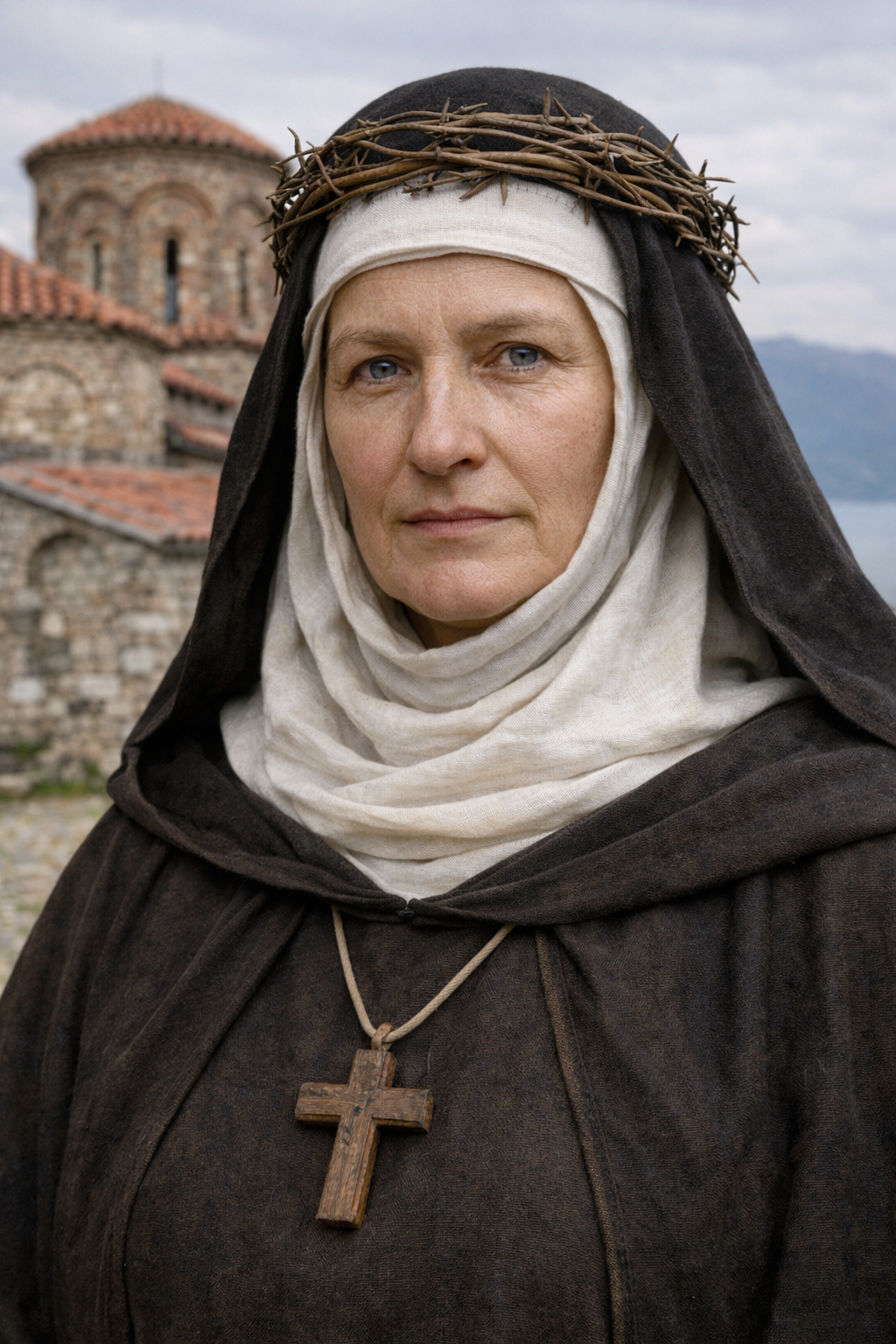
About Catherine of Sweden
Catherine of Sweden helped turn her mother's religious foundation into a working community, carrying its concerns between Vadstena and Rome. Born around 1331, she was one of Bridget's eight children, growing up in a Swedish family. Her later medieval Life places her childhood education with the nuns at Riseberga and describes a marriage in which she and Eggard van Kyren agreed to remain chaste. These intimate details belong to the tradition about her, rather than to a surviving personal account of her childhood.
Catherine and Eggard's home was at Eggardsnäs, near Nyköping in Södermanland. The local church at Halla is associated with their married life, although suggestions about how they traveled there remain conjecture. Her adult life extended well beyond this setting: she came to know both Latin and Italian.
In 1350 Catherine traveled to Rome, joining Bridget during the jubilee pilgrimage. There she learned that her husband had died and remained with her mother instead of returning to married life in Sweden. The devotional accounts remember the women sharing an austere household, visiting churches and caring for people in need. They also describe Catherine's reluctance to remain abroad and her struggles with homesickness, but those stories cannot supply a modern diagnosis of her feelings.
Catherine accompanied Bridget on the journey to the Holy Land in 1372, traveling through Naples and Cyprus before visiting Jerusalem and Bethlehem. When her mother became ill after returning to Rome, Catherine was with her during her final illness. Bridget died in July 1373, leaving the task of bringing her remains to Sweden to her children and companions.
Catherine and her brother Birger left Rome on December 2, 1373, with the two priests who had served as Bridget's confessors. Their journey was also part of the effort to gather testimony about Bridget: at Montefalco, a bishop opened an inquiry while the traveling party was there. Catherine reached Vadstena with the remains on July 4, 1374. She now had responsibilities to the people already gathering around the foundation, as well as to the memory of its founder.
The community she helped organize was to include women and men living in separate enclosures, with the brothers providing worship and pastoral care. Its shared church also had to accommodate lay worshippers without dissolving the boundaries of monastic life. Catherine worked on the foundation's practical and spiritual needs during her months at Vadstena. She was called abbess during her lifetime, although the surviving record does not show a formal election or consecration to that office.
Her commitment included property as well as leadership: on entering Vadstena in March 1375, she assigned estates in several Swedish provinces to the monastery. The foundation thus received material resources from her own holdings before she left Sweden again.
In 1375 she returned to Rome to seek stronger recognition for the order and advance the request for Bridget's canonization. She brought a collection of reported miracles, authenticated in Sweden, to support the case. That collection did not satisfy all the procedural requirements, and further examination and supplementary testimony followed. Her work therefore involved more than presenting a family's wish: the application had to pass through a prolonged process of inquiry.
The mission also needed financial support from home. A letter assigned to 1376 shows Archbishop Birger Gregersson discussing money for Catherine while she was in Italy promoting her mother's cause. Catherine's own correspondence also concerned church appointments, showing her participating in decisions beyond the immediate household at Vadstena.
Success came unevenly. The order received papal confirmations, but Bridget's canonization remained unfinished as divisions within the papacy disrupted the proceedings. Two papal bulls issued in 1377 addressed leadership elections and protection of the monastery itself. Catherine remained in Italy for approximately five years before returning to Sweden. She had secured recognition for the community even though she would not live to see all the results of her work for her mother.
Back in Sweden, Catherine showed interest in the practical tools of written communication. In an undated letter, probably from 1380 or 1381, she asked Archbishop Birger about an alphabet he had shown her brother Gudmar. The request survives, but its outcome does not: it cannot establish that Catherine introduced a new style of handwriting at Vadstena. It nevertheless records a specific inquiry of her own, separate from the miraculous episodes through which later writers often remembered her.
Catherine died at Vadstena, probably in March 1381; the commonly given day is March 24, although the witnesses do not agree on the exact day. Later supporters sought recognition of her sanctity, and papal permission for her veneration preceded the ceremonial elevation of her remains in 1489. This was not a completed formal canonization. Her lasting contribution was the work of a community builder and advocate who carried Bridget's foundation through the years after its founder's death.
Wondering how to weigh the stories and sources? Learn how to read a saint biography.
Explore similar vocations
Prayers for Catherine of Sweden
Catherine of Vadstena: collect excerpt
Deus qui largiflue bonitatis consilio ecclesiam tuam beate Katherine tibi dilecte preclare vite meritis decorasti, et gloriosis letificas miraculis