Biography
Channing Moore Williams
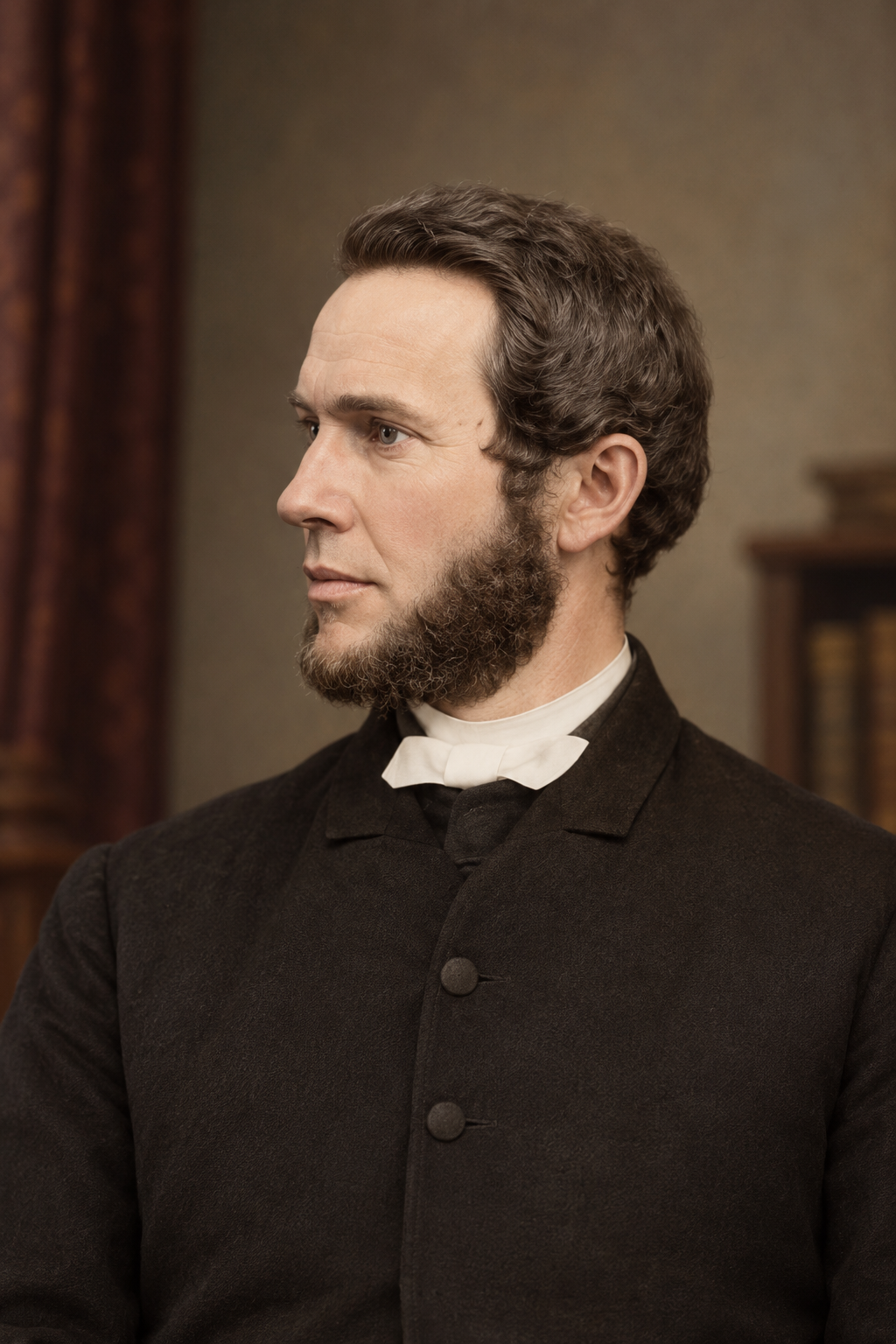
About Channing Moore Williams
Channing Moore Williams left a Virginia upbringing for a ministry that helped establish Anglican churches and schools in Japan. Born in Richmond on July 18, 1829, he grew up under the care of his widowed mother. His Japanese biographer, Motoda Sakunoshin, records Williams’s recollections of her insistence on prayer, Scripture, and attendance at worship. As a young man, he worked in a store in Henderson, Kentucky, before pursuing his education and a vocation to ordained ministry. Motoda records his memory of learning a verse from the Psalms each day, a practice his mother maintained into his youth. He also recalled accompanying her to Sunday school and church. These stories were preserved as his later recollections, rather than contemporary records of his childhood. His eventual decision to seek ministry came while he was still employed in the Kentucky store.
His education took him to the College of William and Mary and Virginia Theological Seminary. After completing seminary in 1855, he was appointed to missionary work in China. He subsequently went to Nagasaki in 1859, while restrictions on Christianity still constrained missionary activity. His later educational work would include opportunities for girls as well as boys, rather than a single institution serving every purpose.
The Episcopal Church’s later mission handbook describes the difficulty of these early years. Williams studied Japanese, while a colleague’s illness reduced the small mission’s strength. The American Civil War diverted attention and support from overseas work. In 1866 he was consecrated bishop with responsibility for both China and Japan. The handbook also places his first baptism of a Japanese convert in that year. Its account records slow beginnings, rather than immediate public acceptance or a rapidly expanding congregation.
On February 3, 1874, he opened a small school in Tokyo’s Tsukiji district. Rikkyo’s archives preserve uncertainty about whether its first pupils numbered five or eight. The institution began with English and Bible lessons, and many pupils boarded there. It was the beginning of Rikkyo’s educational work, not a university already possessing the scale and organization of its later successor. Fires forced moves and interrupted its early operation.
Books were part of the school’s practical needs. Rikkyo Library’s historical exhibition describes letters Williams sent to New York in February 1874 asking for donations. One request concerned books that could be lent to Japanese friends through the Yedo Mission Library. Another named materials for the Osaka boys’ school, including English grammar, readers, mathematics, and philosophy. The exhibit draws attention to education through access to books as well as classroom teaching. The original letters are known here through that published archival account.
In 1877, Williams and the Blanchet couple opened a girls’ school in a house in Yushima. Its institutional history records six pupils at the beginning. The school moved first to Kanda Awajicho and then to Tsukiji. This was a separate undertaking from the boys’ school, with its own development and staff. Its later history records that it had become largely financially independent of the American mission by 1902. Remembering the collaborators and the school’s subsequent growth avoids making its history solely the work of one founder.
The school associated with Williams also changed as Japanese educational requirements and expectations developed. Rikkyo’s archives describe a period of American-style college education, followed by reforms better suited to the Japanese setting. An earthquake destroyed its brick building in 1894.
Church organization likewise required cooperation. American and British Anglican missions had initially worked separately. According to the 1934 handbook, Williams and Bishop Edward Bickersteth called a conference in 1886 to address the resulting difficulties. A provisional constitution and canons were prepared, and the first General Synod of the Japanese church met in Osaka in February 1887. The formation of the Nippon Sei Ko Kai therefore involved consultation and shared structures, rather than merely an individual missionary’s decision.
Williams resigned his episcopal responsibilities in 1889 and continued missionary work in the Kansai region. He returned to the United States in 1908. His later years thus included both continued service after retirement from oversight and a final return to his country of birth.
He died in Richmond, Virginia, on December 2, 1910. Japanese Anglicans subsequently arranged a memorial and the biography through which many accounts of his life have been preserved. Motoda’s book appeared in 1914, after the commemorative project had brought together researchers, translators, and contributors.
His connection with Richmond remained visible more than a century later. In March 2025, students and teachers from Rikkyo visited his grave in Hollywood Cemetery. The Diocese of Virginia reported their music and prayers, including a hymn sung in his Japanese translation. That visit linked the city of his birth with people educated in institutions descended from his work. His legacy includes those continuing relationships across languages and countries, as well as the schools and church structures he helped establish.
Wondering how to weigh the stories and sources? Learn how to read a saint biography.