Biography
Charbel Makhlouf
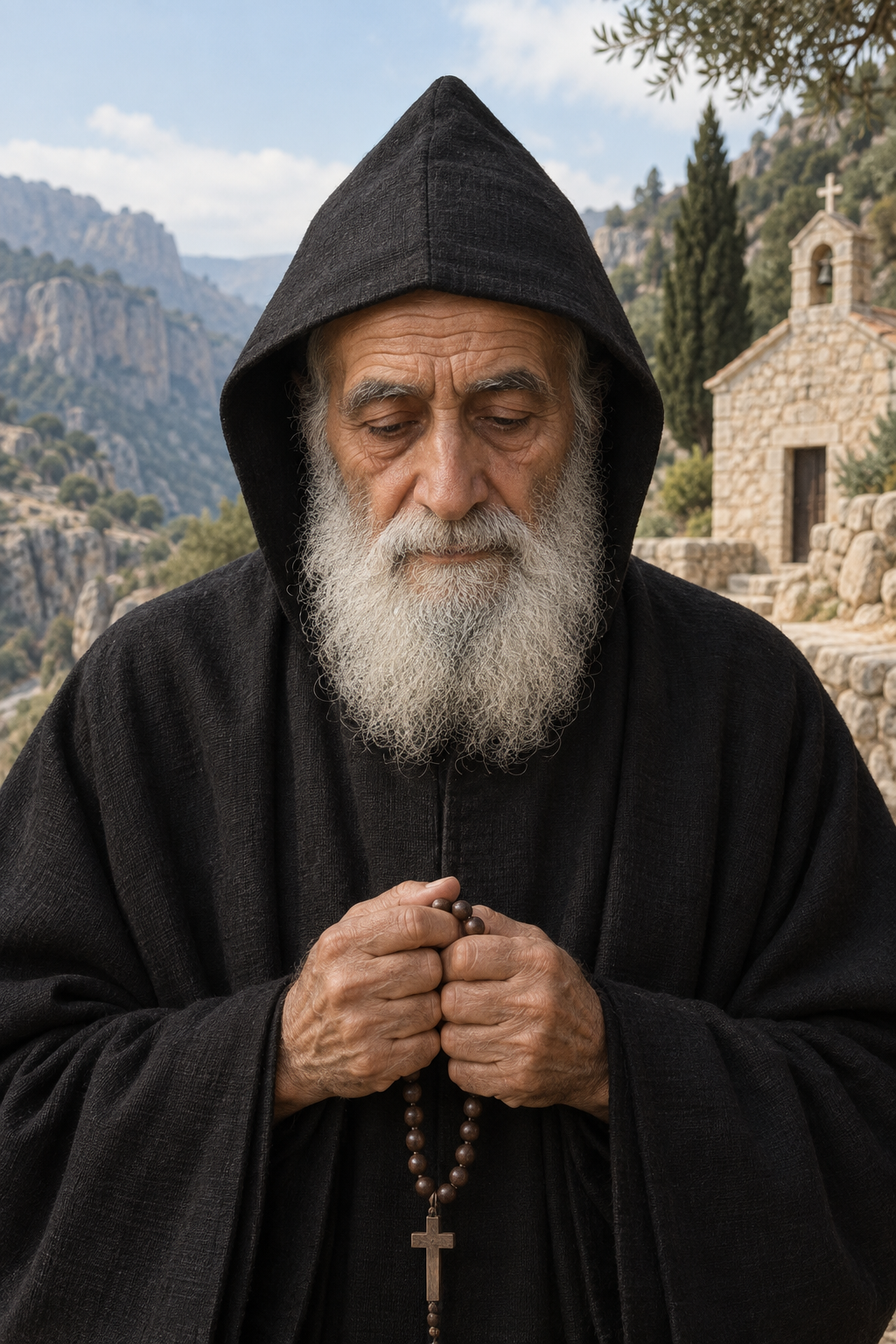
About Charbel Makhlouf
Charbel Makhlouf was a Maronite monk and priest whose life joined prayer with the work of a Lebanese monastery. Born Yousef Antoun Makhlouf at Bkaakafra on May 8, 1828, he entered monastic life in 1851. He professed his vows at Annaya in 1853 and was ordained in 1859.
His childhood included work and family loss. The parish account of his life relates that his father died after being required to transport produce under forced labor. His mother, Brigitta, supported the family through silk weaving. After her remarriage, the boy assisted his stepfather at the parish liturgy, attended the village school and tended the family's cow. He also sought a quiet place for prayer in a nearby cave. These were the routines of a rural household, not the beginning of a public career.
Leaving home meant a painful separation from his mother. Paul VI's account of their parting presents her accepting her son's vocation despite her sorrow. Charbel began his formation at Our Lady of Mayfouk before continuing at Saint Maron of Annaya. He subsequently studied theology at Saint Cyprian's monastery in Kfifane, preparing for the priesthood within the Lebanese Maronite Order.
At Kfifane his teacher was Nimatullah Al-Hardini, a monk who taught moral theology while maintaining the common life of his community. The Vatican biography of Nimatullah places Charbel among his students from 1853 to 1859 and records his attendance at his teacher's death and funeral in 1858. That education brought him into contact with a teacher remembered for combining demanding standards for himself with gentleness toward others. Charbel's preparation for ministry thus took place through both formal study and the daily example of another monk.
Ordination did not release Charbel from ordinary labor. Accounts collected from witnesses describe him working in the fields, cutting wood and baking bread, although a priest could have been excused from such tasks. He wore used clothing and accepted food left over by others rather than asking for better provisions. When someone gave him money, he passed it to his superior instead of keeping it for himself. These remembered actions show what monastic poverty meant in practical terms: how he worked, what he ate and what he did with a gift. They also place his learning beside his willingness to undertake unremarkable jobs.
His priestly work extended beyond the monastery. The Abbey of Clairval's account describes him assisting neighboring parishes and hearing confessions. It preserves a confrère's recollection that Charbel was especially willing to serve in the confessional. In another remembered episode, he answered a mother's request to visit her dying son, gave the man water and heard his confession. The account also recalls that fellow monks could tease him and that he sometimes answered with a joke. Such episodes reveal the human contact within a life often described only in terms of silence: parishioners seeking help, a family at a sickbed and brothers sharing ordinary conversation.
He did not begin as a solitary. After years in community, he undertook the hermit's life under the direction of his superiors. Paul VI described the center of that life as the celebration of Mass and silent prayer before the Blessed Sacrament.
In 1875 he moved to the hermitage of Saints Peter and Paul, dependent on Annaya. He died on December 24, 1898.
When the Catholic Church beatified him in 1965, his quiet vocation became the subject of a public ceremony at the close of the Second Vatican Council. Paul VI placed the contemplative monk beside the recently beatified missionary martyr Jacques Berthieu. Rather than treating active service and prayer as competing paths, the pope presented Charbel's life as a reminder that the Church's outward work also needed communities devoted to intercession.
Paul VI canonized him on October 9, 1977. The ceremony included Maronite, other Catholic and Orthodox representatives, as well as a Lebanese civil delegation. With Lebanon suffering conflict, the pope prayed that Charbel's remembrance might help his compatriots seek reconciliation.
His name also became part of the life of Lebanese Christians abroad. In Windsor, Ontario, Antonine monks established a Saint Charbel monastery and parish in 1977 to serve a community that included people displaced by the war in Lebanon. The parish describes its work as both pastoral and concerned with the community's cultural life and integration. It keeps its patronal celebration on the third Sunday of July.
At Annaya itself, pilgrims continue to gather around his tomb. During a visit on December 1, 2025, Leo XIV prayed there in silence and offered a lamp to the monastery. He spoke of the pilgrims who come on the twenty-second of each month and entrusted to Charbel's intercession the needs of families, church communities and Lebanon. The visit carried forward a public remembrance centered not on writings left by the hermit, but on the life of prayer associated with him and the people who continue to seek help at his tomb.
Wondering how to weigh the stories and sources? Learn how to read a saint biography.
Explore similar vocations
Prayers for Charbel Makhlouf
Charbel Makhlouf: petition
Ô saint Charbel, prie pour moi.