Biography
Charles Lwanga
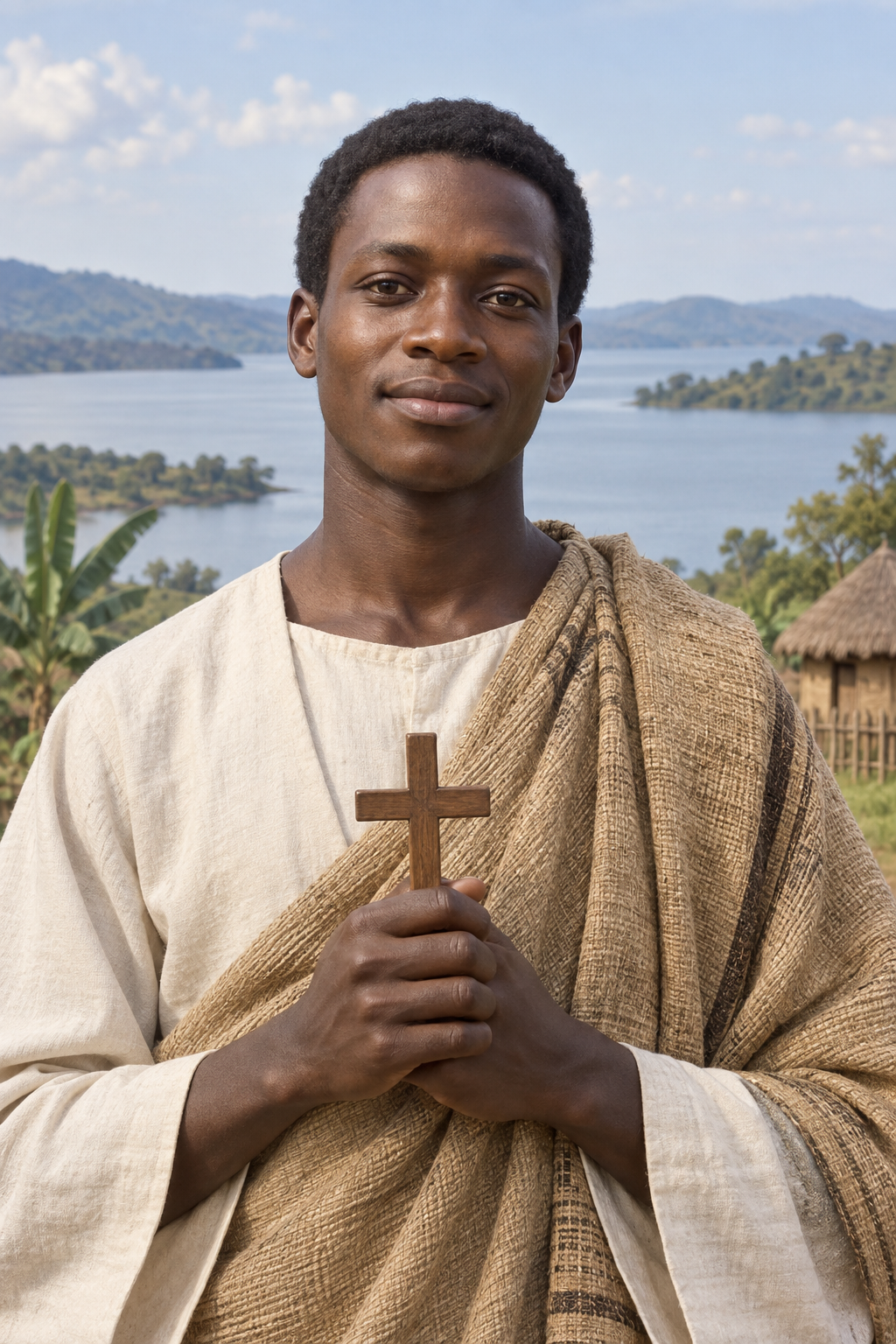
About Charles Lwanga
Charles Lwanga was a Ganda Christian who served at the court of Mwanga, king of Buganda. Born around 1860, probably in Buddu, he came from the Ngabi clan. Historian Louise Pirouet notes that little is securely known about his parents. His early working life took him into the service of Mawulugungu, a chief whom he accompanied on journeys to the capital. There, contact with other pages introduced him to Christian instruction. His conversion developed through these relationships before he became a leader among the royal pages himself.
He entered Mwanga's service in 1884 and became responsible for pages in the audience hall. Joseph Mukasa, his superior, relied on him to guide and instruct the younger servants. Lwanga's responsibilities were not confined to religious teaching: he also oversaw excavation of the king's lake near Rubaga Hill. Shorter describes him as trusted with practical work and others' care. These responsibilities placed him close to a ruler whose power over the household could expose its members to grave danger.
The danger became unmistakable when Joseph Mukasa was killed in November 1885. Lwanga sought baptism that night. Franciscan Media's account emphasizes his refusal of Mwanga's sexual demands and his efforts to protect fellow pages from coercion. He continued encouraging their faith when they were imprisoned. This part of his story concerns the abuse of royal power over vulnerable people, not simply a disagreement over private belief. In the Church's remembrance, his protection of others belongs alongside his own refusal to surrender his convictions.
In May 1886, the confrontation reached a crisis. Pirouet records that Lwanga baptized five catechumens on the morning of May 26, aware that their lives were in danger. When the Christians were ordered to identify themselves before the king, he led the group that stepped forward. Their declaration brought condemnation rather than protection. They were sent toward Namugongo, an established place of execution. Lwanga was burned there on June 3, on a separate pyre before the other prisoners. His death was therefore part of a shared persecution, but not an identical event for every martyr.
Shorter describes a period of confinement at Namugongo while preparations for the executions continued. The prisoners prayed together, and Catholic and Anglican missionaries tried unsuccessfully to obtain the king's intervention. His account preserves Lwanga's final appeal to God as reported speech. It is a later historical account, not a transcript made at the pyre. The distinction matters when remembering a death that has often been retold in devotional language: the record of execution is firmer than any claim to reproduce every word or physical detail of his final moments.
Catholic recognition eventually brought Lwanga and twenty-one companions together in a single canonized group. Benedict XV beatified them on June 6, 1920, and Paul VI canonized them in the Vatican basilica on October 18, 1964. In his homily, Paul explicitly remembered Anglican Christians who had also been killed for Christ. He placed the new saints alongside earlier African martyrs, including Cyprian, Felicity and Perpetua. The ceremony honored a new generation of African witnesses; it did not mark the beginning of African sainthood.
The memory of the martyrs remained rooted in Ugandan communities as well as in ceremonies at Rome. Writing for the sixtieth anniversary of their canonization, missionary Richard Nnyombi described the circulation of relics associated with Lwanga and Matia Mulumba through Kampala's parishes. He also recalled the Uganda Martyrs' Guild, established to continue their evangelizing work and support Catholic family life. His appeal was for devotion that continued throughout the year, rather than disappearing after the large annual celebration. This is evidence of their later reception, not additional testimony about the executions. Nnyombi identifies Namugongo as a place where the Missionaries of Africa continue to bear responsibility for the martyrs' memory, linking care for a historical site with service to the living Church.
John Paul II visited Namugongo as a pilgrim in February 1993. His homily spoke directly to lay people and catechists, recognizing the importance of African teachers in the growth of Christianity. He remembered the martyrs as recent converts who had already begun sharing their faith. That emphasis gives Lwanga a place in the history of lay responsibility, not only in a list of deaths. The shrine's continuing pilgrimage also joins local remembrance with visitors from beyond Uganda.
When Francis celebrated Mass at Namugongo in November 2015, he again named Lwanga and Joseph Mkasa as teachers who passed on what they had received. He drew attention to the younger boys entrusted to their care and remembered the Anglican martyrs alongside the Catholics. In this continuing remembrance, Lwanga's significance rests on concrete acts: learning, teaching and protecting others under threat. His story preserves the contribution of a young African layman whose responsibility for companions remained central even when the royal household became a place of persecution.
Wondering how to weigh the stories and sources? Learn how to read a saint biography.
Explore similar vocations
Prayers for Charles Lwanga
Uganda Martyrs litany excerpt
Holy Martyrs of Uganda most firm and faithful to Christ and his Church, Pray for us.