Biography
Charles of Sezze
About Charles of Sezze
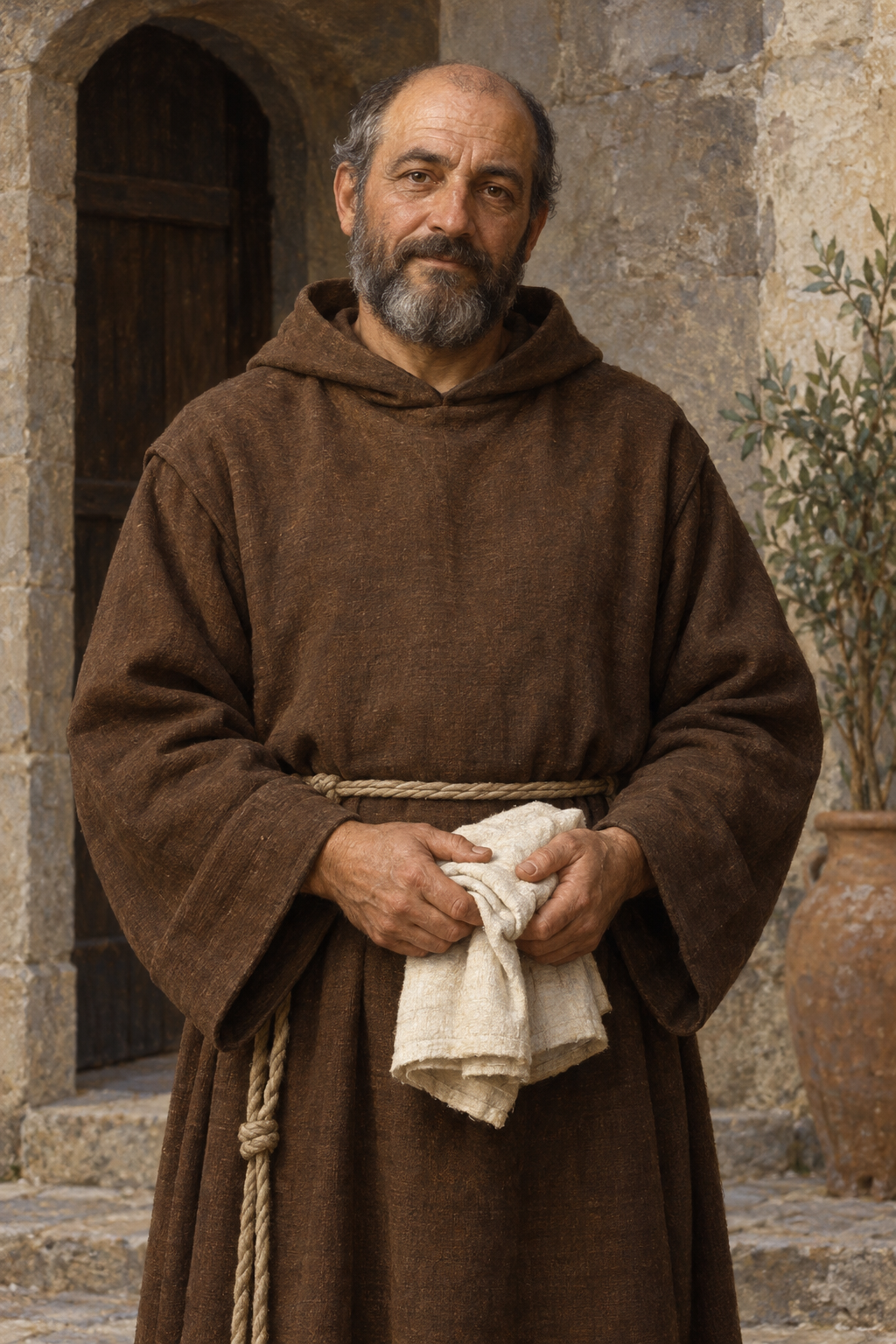
Charles of Sezze was a Franciscan lay brother whose spiritual writings grew out of a life of ordinary work. He was born Giancarlo Marchionne at Sezze in 1613. The cathedral archive gives 22 October as his birth date and 27 October for his baptism, citing the surviving baptismal register. His parents, Ruggero Marchionne and Antonia Maccione, were farming people. After difficulties at school, he worked in the fields and tended animals. He later chose to enter the Franciscans as a brother, despite relatives who hoped he would become a priest.
His autobiography names his parents and recalls the moral teaching he received at home. Abbenda’s account also describes Charles’s forceful temper and difficulties at school. These recollections present religious growth as involving correction and change, rather than suggesting that his later habits were fully formed in childhood.
He entered the Reformed Franciscans in 1635 and made his profession the following year. His assignments took him through several houses in Lazio, where he undertook work such as gardening, serving at the door and caring for the sacristy. These were the duties of a lay brother, rather than a priest’s public ministry. The movement between friaries became the setting for both practical service and an increasingly intense life of prayer.
Carlo Luigi Abbenda’s account, drawing on the published autobiography, follows Charles through Morlupo, Ponticelli, Palestrina and Carpineto Romano. At Carpineto, he helped sick people during an epidemic in 1645. The same account describes struggles within the community and periods of severe inward conflict. In 1646 he moved to Rome. These episodes place his service among the pressures of shared life, illness and changing responsibilities, rather than in uninterrupted religious tranquillity.
One episode concerns the killing of his uncle. Abbenda relates that Charles struggled with a desire for revenge and eventually went to the killers’ relatives to offer forgiveness. The episode belongs to the autobiography’s account of his inward life, and should be read as his remembered struggle. Its force lies in the difficulty he acknowledged: forgiveness was a response he had to choose in the face of anger, not an absence of feeling about what had happened.
Charles became a spiritual writer despite his limited formal education. R. Brown’s New Catholic Encyclopedia account names works on meditation and the inward life, including the Trattato delle tre vie della meditazione, Camino interno dell’anima and Settenari sacri. Brown describes their style as comparatively clear and simple. Between 1661 and 1665 Charles also wrote his autobiography, Le grandezze delle misericordie di Dio. The title directs attention to God’s mercy, rather than presenting the author’s achievements as the centre of the story.
The writings have value beyond devotional reading. Reviewing Raimondo Sbardella’s collected edition in 1969, Henri Chirat emphasized their interest for biography, religious history and the history of Italian. He noted popular pronunciation, words drawn from Lazio dialects and Roman speech, and older meanings preserved in the vocabulary. The works thus retain traces of the language through which a brother without advanced schooling described an elaborate spiritual life. Chirat also distinguished the works already printed from others still awaiting publication; the surviving literary record was broader than a single autobiography.
The collected edition reviewed by Chirat also shows the range of his interests. Its first volume contains five books of the autobiography; the second continues that account and includes a record of a journey to Loreto, La Verna, Assisi and Rieti. The third brings together the treatise on meditation, spiritual songs and novenas. These different forms of writing offered ways to describe personal experience, teach prayer and give devotion a poetic voice. The edition allows readers to distinguish those forms instead of treating every work as a memoir.
Accounts of Charles’s prayer include an experience during Mass in 1648, understood in his religious tradition as a wound of divine love. Brown reports that a bodily mark observed after his death later entered the beatification proceedings as a claimed miracle. These descriptions belong to the history of his mystical reputation and the Church’s judgment of his cause; they should not be presented as an independently established medical explanation. His life also included spiritual counsel sought by people of different social standing.
Charles died in Rome on 6 January 1670. The Diocese of Latina–Terracina–Sezze–Priverno remembers him as a brother who combined humble tasks with care for others. Its calendar observes him on 7 January.
John XXIII canonized him on 12 April 1959. Addressing pilgrims the next day, the pope emphasized Charles’s humility and hidden service. He set the former shepherd beside Joaquina de Vedruna, canonized at the same ceremony, to show how different circumstances could lead to a life devoted to God and neighbour. The comparison directs attention toward the quality of daily service, rather than public distinction. Charles’s continuing remembrance at Sezze honours a local brother whose work and writing reached well beyond his birthplace.
Wondering how to weigh the stories and sources? Learn how to read a saint biography.