Biography
Charles Yi Gyeong-do
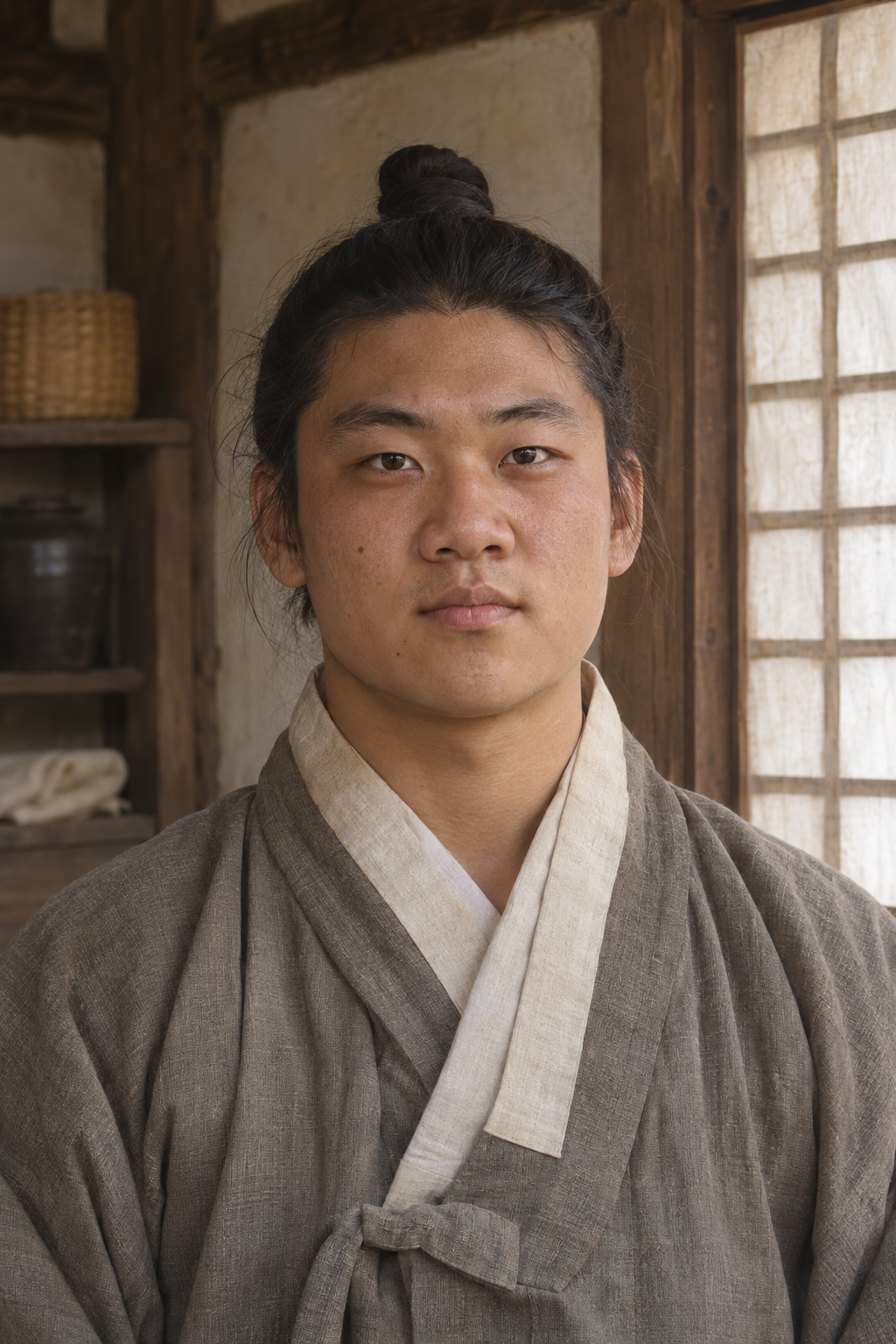
About Charles Yi Gyeong-do
Charles Yi Gyeong-do grew up in Seoul in a house where learning mattered. Born in 1780, he was known to his family as O-hui when he was small. The scholar Yi Ga-hwan gave him the name Gyeong-do. His father, Matthew Yi Yun-ha, knew a circle of young scholars who took an interest in Catholicism. His mother belonged to the Kwon family of Yanggeun. Her brother Francis Xavier Kwon Il-sin was among the first Koreans to teach the Catholic faith.
His father had studied in the tradition of Yi Ik, a scholar whose work influenced several early Korean Catholics. Matthew studied Catholic doctrine with his brothers-in-law Kwon Cheol-sin and Kwon Il-sin and with Yi Seung-hun. When officials seized religious articles at a gathering in Seoul in 1785, Matthew went with Kwon Il-sin to recover them from the Ministry of Justice. Charles was still a child when his family first had to face the consequences of practising its faith in the capital.
Accounts disagree about precisely when Charles became a Catholic. Son Suk-gyeong places his entry into the Church with his family in 1791. In her account he married at seventeen and his father died three months later. What the different accounts have in common is the difficulty he faced as eldest son. Relatives expected him to carry out customary rites when his father died. Some criticized the young man for the way he tried to honour his father while keeping his Catholic commitments.
Church historian Cha Gi-jin places Matthew’s death earlier, in 1793. Cha says Matthew had held to Catholicism through the controversy over ancestral rites in 1791 and that Charles observed the customary three years of mourning for him. In Cha’s chronology, Charles married a woman from a Catholic family after losing his father. He spent much of his time at home reading and took responsibility for teaching other members of the household.
One of the people who visited Charles was Jo Sin-haeng, a man of the same social class who lived in Seoul. The two met often to discuss religious teaching. Jo also belonged to one of the six gatherings of the Myeongdohoe, an association for the study of Catholic doctrine. His group met in the home of Hwang Sa-yeong. The surviving account names Charles as someone with whom Jo spoke regularly, even though it does not list him among the members who gathered at Hwang’s house.
Charles also studied with Thomas Choe Pil-gong and Protase Hong Jae-yeong. In 1797 a question about faith came to him within his family. His younger sister Lutgarda wished to marry John Yu Jung-cheol of Jeonju on the understanding that the two would remain celibate. Charles discussed the marriage with his mother and gave his consent. Some of their relatives objected when word of the couple’s decision reached them.
Officers arrested Charles during the persecution of 1801. The encyclopedia dates his arrest to the eleventh day of the ninth lunar month. He was twenty-two by the time he died. His younger brother Paul would live for another quarter century and would also write to the family from prison.
Charles was questioned first at the police bureau and also at the Ministry of Justice. The officials wanted the names of other Catholics and the whereabouts of their books. The bishops’ account says he told them he knew no believers and that the books had been burned. He kept the names and locations to himself. After signing the sentence that condemned him to death, he wrote to his mother.
There was much he still wanted to say to her. He regretted the times he had failed her and knew that another day would put it beyond his power to care for her. He asked his brothers to obey her and looked forward to seeing her again in heaven. He also wrote a farewell to his elder sister and her husband and addressed the servants of the household. Towards the end he turned to his son, Gwibi. He wanted the boy to stay close to the rest of the family. He closed by asking his mother to look after her health in her grief.
Charles was beheaded in Seoul on January 29, 1802. Cha names Barnabas Jeong Gwang-su and Gervase Son Gyeong-yun among the Catholics taken out with him. He places the execution outside the Small West Gate.
Charles’s letter survived alongside writings by his sister Lutgarda and brother Paul. A handwritten collection came to light in 1965 in the home of descendants of a Korean martyr. The dates kept with the letters distinguish Charles’s farewell, written in January 1802, from Paul’s prison correspondence of 1827.
In 2002 the Honam Church History Institute published a modern Korean edition prepared by two scholars, Yang Hui-chan and Byeon Ju-seung. The book devoted a separate chapter to Charles’s letter to his mother. Through that letter readers can still hear the eldest son who once took charge of the household asking his brothers to care for the mother he was about to leave.
Wondering how to weigh the stories and sources? Learn how to read a saint biography.