Biography
Christopher
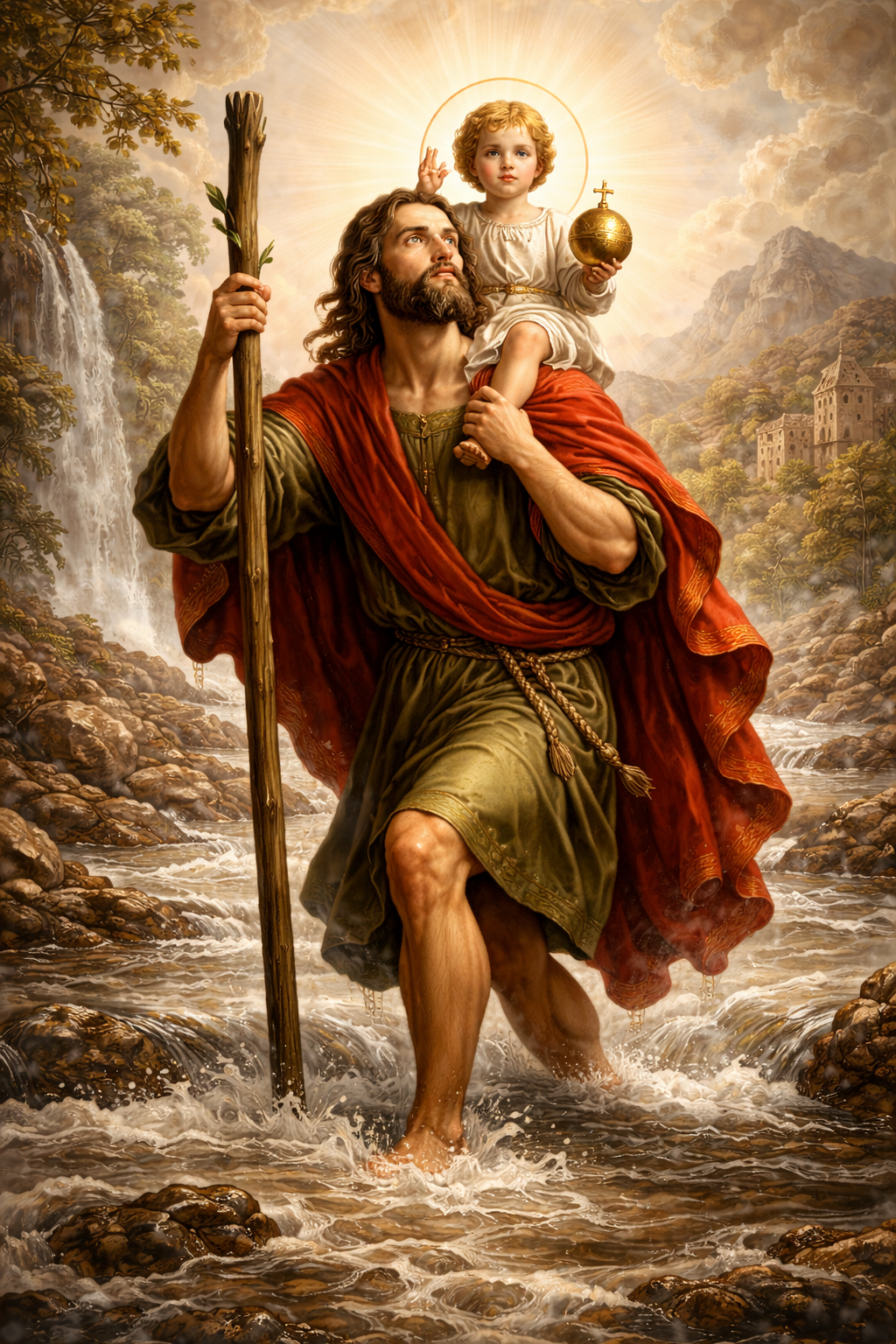
About Christopher
Christopher is an early Christian martyr whose ancient cult is clearer than his life. Late-antique evidence gathered by the University of Oxford's Cult of Saints project records churches, inscriptions, and commemorations dedicated to a martyr named Christophoros in the eastern Mediterranean. Such evidence shows that Christians honored him centuries before the best-known Western story took shape. It does not identify his parents, birthplace, occupation, age, or exact year of death. Christopher's biography must therefore begin with an established history of veneration and a very small biographical core, rather than treating every later episode as one continuous eyewitness account.
The Greek name Christophoros means ‘Christ-bearer.’ Early witnesses associate a martyr of that name with Asia Minor, but surviving traditions disagree over Lycia and Pamphylia and over the circumstances of his death. A once-common date around 250 places the martyrdom under Emperor Decius, yet no contemporary act establishes the year. The catalog consequently removes its former January 1, 251 death date. January 1 was only database filler, and even the year should remain a traditional approximation rather than appear as a documented anniversary. Martyr is retained as the central received status, while birthplace and death place remain unset.
Eastern tradition preserves an elaborate passion. In the Orthodox Church in America's account, a very strong man first called Reprebus confesses Christ, submits without resistance to soldiers, and receives baptism from Babylas of Antioch. The story says a staff blossoms, food is multiplied, and soldiers convert. It later places Christopher before Decius, where Callinika and Aquilina are sent to tempt him but instead become Christians and are violently killed. Christopher survives fantastic tortures before being beheaded in Lycia. These scenes express steadfastness and conversion through a martyr narrative; they are not independently corroborated third-century reporting.
Another Eastern strand produced the striking dog-headed Christopher familiar in some icons and manuscripts. The language may reflect stories about distant peoples, confusion around ethnic names, or deliberate hagiographic transformation. It cannot be read as a physiological description. The same tradition also describes exceptional size and strength. Modern readers sometimes combine every element—Canaanite ancestry, a monstrous appearance, handsome features, soldier, preacher, and giant—as though one source supplied a stable portrait. The sources instead show a legend changing across languages and communities. The artwork on this page follows modern devotional convention and makes no claim to reconstruct his appearance.
The most influential Western narrative appears in the medieval Golden Legend. There Christopher begins as a giant determined to serve the greatest ruler. He leaves a king who fears the devil, then leaves the devil when he learns that the devil fears Christ. A hermit teaches him that his strength can become service. Christopher settles beside a dangerous river and carries travelers across. The sequence is a moral tale about redirecting power, not a recoverable itinerary. It supplies no river that can responsibly be mapped, and its rulers and journey cannot be joined to the older cult evidence as documented stages of one life.
In the legend's central scene, a child asks to cross during the night. The burden grows so heavy that Christopher fears both will drown. On the far bank, the child reveals himself as Christ and explains that Christopher has carried the world's creator and its weight. A staff planted in the earth flowers as a sign. This episode gives visual form to the saint's name and made him a beloved protector of travelers. It is also medieval sacred storytelling. Calling it legendary does not mock its devotional meaning; the label prevents a symbolic narrative from being presented as verified geography, childhood history, or an encounter recorded near Christopher's lifetime.
The Western passion continues with preaching, imprisonment, attempted coercion, the conversion of women sent against him, brutal executions, failed methods of killing Christopher, and eventual beheading. Violence is integral to the story and should not be softened into a vague claim that he ‘faced hardship.’ At the same time, spectacular invulnerability and mass conversions are hagiographic motifs. No responsible reconstruction can calculate an execution site, date, or number of converts from them. What the tradition consistently seeks to honor is refusal to abandon Christian allegiance under lethal pressure and the use of physical strength for protection rather than domination.
Christopher's cult became widespread in eastern Christianity. The Orthodox Church in America commemorates him with Callinika and Aquilina on May 9 and records traditions of prayer during epidemic disease. The observance documents a living tradition, not a death anniversary. It also preserves the connection between Christopher's reception and appeals for protection. Such patronage belongs to reception history; it does not prove that he historically worked as a ferryman or that a particular epidemic can be linked to his lifetime.
Western Christianity also developed a wide cult around Christopher. Vatican News lists Christopher the martyr on July 25, the long-standing Roman date. Medieval and later Christians especially associated him with safe travel, drawing on the river-crossing legend and its image of a dangerous passage completed under protection. The calendar date and patronage do not establish his death anniversary or occupation. They show how communities received the ancient martyr through stories that connected his name with carrying Christ and his strength with service to people exposed to danger.
No words can be attributed to Christopher with historical confidence. A short line from the Golden Legend, ‘I seek the greatest lord,’ is included only as speech assigned by that medieval work. The distinction matters because quotation marks can otherwise make a literary character's words resemble testimony. Likewise, the virtues attached to Christopher are actions inside received narratives: he carries vulnerable travelers, submits rather than attacks his escorts, and refuses coercion in the passion. They are traditional models formed around an ancient martyr's memory, not psychological findings about a documented individual.
Christopher remains significant because his reception joins a historically early martyr cult to a transparent symbol: strength becomes meaningful when it bears another person's danger. Careful editing does not require choosing between credulity and dismissal. It can affirm the antiquity of his veneration, acknowledge that a martyr probably stood behind it, preserve the river story as a powerful medieval legend, and refuse fabricated certainty. The resulting portrait is smaller than popular retellings but more honest: an early martyr remembered across traditions, surrounded by stories that taught courage, service, endurance, and protection on uncertain roads.
Wondering how to weigh the stories and sources? Learn how to read a saint biography.