Biography
Chromatius of Aquileia
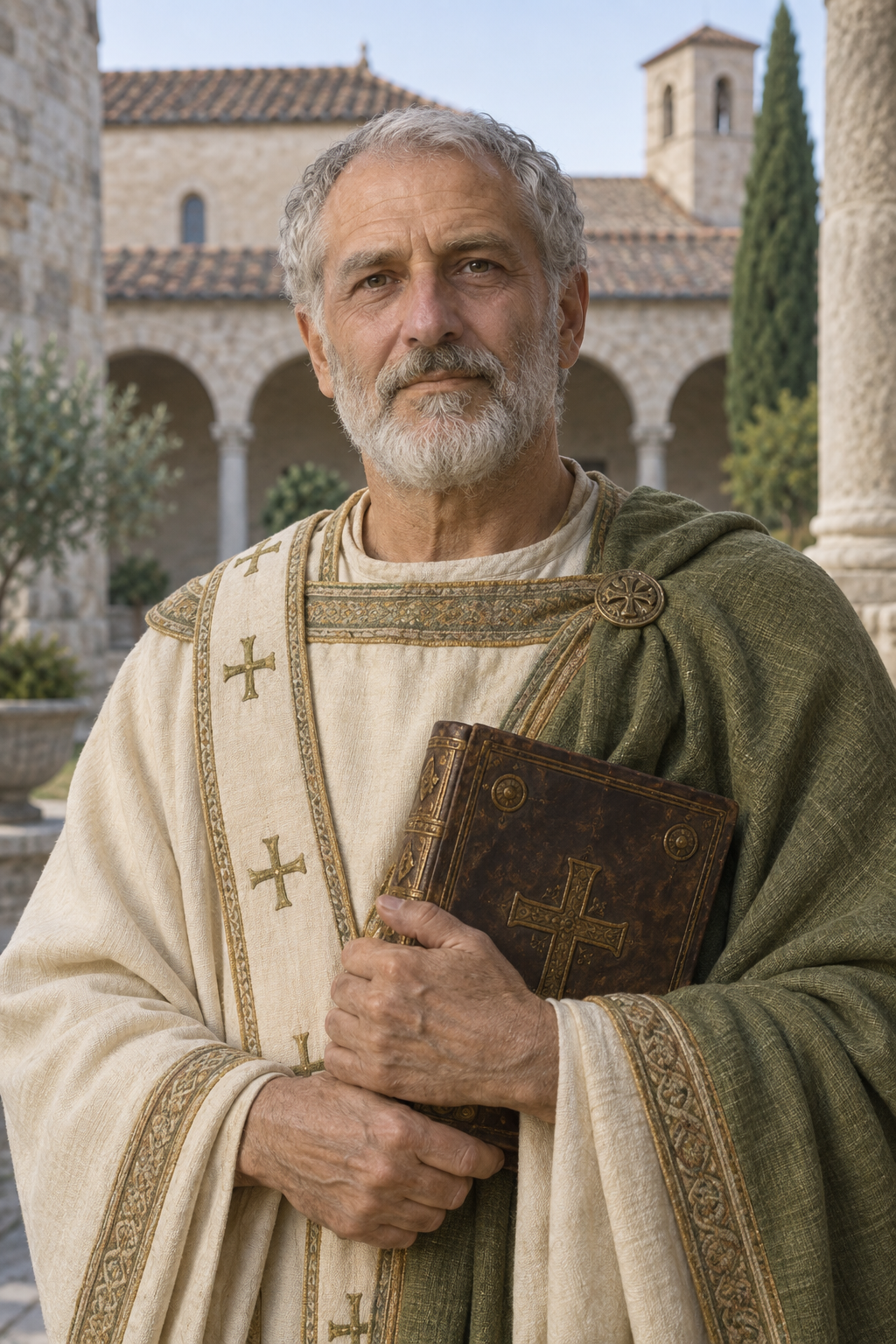
About Chromatius of Aquileia
Chromatius grew up in Aquileia, where he was born around 345. His Christian household included his widowed mother, his brother Eusebius and his sisters. Jerome remembered the family with affection, praising their shared religious commitment. Chromatius and Eusebius belonged to the circle of friends whose letters sustained Jerome after he had travelled east. Their friendship joined a common faith to the ordinary desire to hear news from people far away.
Aquileia was also where Rufinus began his Christian life. Looking back, he named Chromatius among the clergy connected with his baptism and early formation. He appealed to those men as witnesses who knew his faith before later controversies made it a subject of public accusation. Their relationship was therefore older than the books that Rufinus would eventually translate for the bishop, and older than the quarrel that divided Rufinus from Jerome. Rufinus recalled their teaching about the Father, Son and Holy Spirit as a faith he still professed.
By September 381, Chromatius was a priest assisting Bishop Valerian at the Council of Aquileia. He spoke during the proceedings against Palladius, whose teaching the assembled bishops opposed. The surviving record places him in a contentious hearing, where arguments about belief were entangled with questions about who could judge whom. Palladius wanted independent observers; Ambrose resisted the prospect of clergy being judged by laymen. Chromatius joined the discussion, although the wording of his intervention is partly damaged. His presence is clear even where the precise force of his words is not.
After Valerian's death, Chromatius became bishop, conventionally dated to 388. Ambrose ordained him. He now took responsibility for the church in which his own friendships and religious life had developed. His ministry joined public teaching to the less visible work of encouraging other writers. Rather than producing every book himself, he pressed scholars to make important works available to readers who could not use their original languages.
Jerome's prologue to Tobit shows what such encouragement could mean in practice. Chromatius and Heliodorus asked him to translate the book into Latin, and persisted until he undertook it. Jerome admitted that the task answered their wishes more than his own interests. He described working through an interpreter who rendered the source into Hebrew while he dictated Latin to a scribe. His claim to have finished in a day belongs to his own account, but the bishops' repeated request is unmistakable. Chromatius helped bring a difficult translation into being by continuing to ask for it.
He also turned to Rufinus when war threatened his community. In the preface to his version of Eusebius's Church History, Rufinus recalled Chromatius asking for a Latin translation during the Gothic danger in Italy. The bishop wanted troubled people to have something worth hearing, so that reading could occupy minds burdened by fear. Rufinus initially protested that long years away had weakened his Latin, but accepted the commission. He translated the history and continued its narrative into a later period. For Chromatius, a substantial book could serve an immediate pastoral need as well as future readers.
His old friendships did not spare him conflict. When Jerome and Rufinus attacked one another over Origen, Chromatius asked Jerome to stop. Jerome acknowledged the request but continued his reply, fearing that silence would be taken as an admission of guilt. Chromatius had tried to restrain the exchange without being able to command its outcome. The surviving statement does not establish that he made the same request to Rufinus.
Nor did he stop supporting Rufinus's work. Rufinus's preface to the homilies on Joshua names Chromatius as the person who requested the translation of Origen's sermons. Michael Hanaghan argues that this continuing patronage makes the familiar picture of an entirely neutral peacemaker inadequate. The interpretation remains a scholarly judgement, but it draws attention to a concrete choice: Chromatius continued to encourage a writer whose work was being challenged.
In his own preaching, Chromatius guided listeners through the Gospels. His introduction to Matthew insisted that four books conveyed one Gospel, rather than four competing messages. He worked through the different beginnings of the evangelists and connected their accounts with earlier Scripture. He also noticed the demands he was making on his hearers: after a long explanation he acknowledged that he had spoken at greater length than intended and returned to Matthew. The surviving prologue preserves both the teacher's careful argument and the preacher's awareness of a listening congregation.
During danger he urged his people to pray together, placing their hope in God's mercy rather than their own merits. His surviving appeal asks for protection from enemies and fear, bringing public distress into the congregation's prayer. He probably died around 407, perhaps in exile at Grado after leaving the threatened city. His teaching survived beyond that disruption, although many works circulated under other authors' names before modern scholars recovered them.
Wondering how to weigh the stories and sources? Learn how to read a saint biography.
Explore similar vocations
Prayers for Chromatius of Aquileia
Chromatius of Aquileia: sourced prayer excerpt
May he protect us