Biography
Clare of Assisi
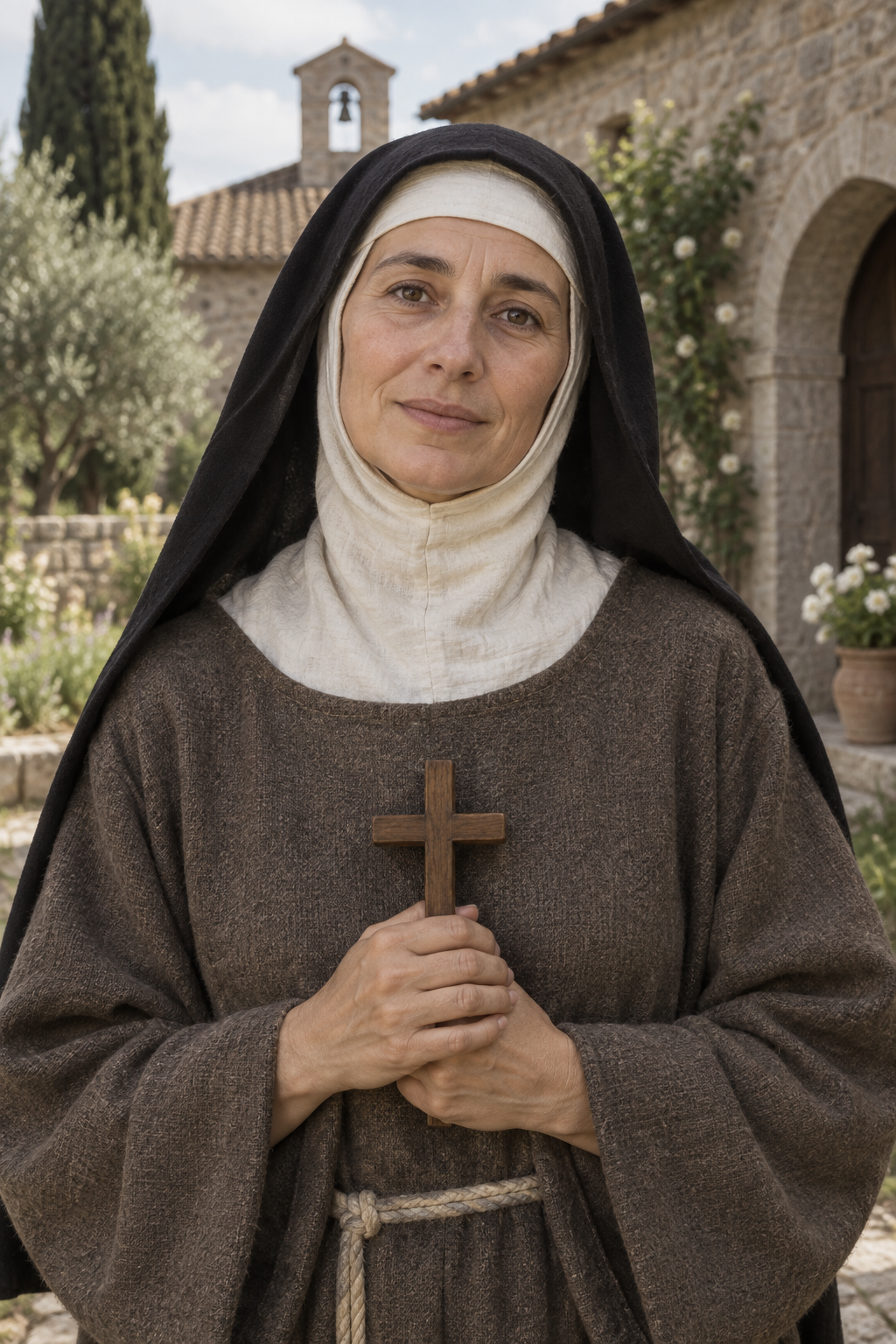
About Clare of Assisi
Clare of Assisi exchanged the security of an aristocratic household for a community shaped by prayer, poverty, and shared work. Born around 1193, she grew up in Assisi and encountered the preaching of Francis, whose way of following the Gospel offered a different future from the marriage expected of her. She chose to join that religious movement while still a young woman. Francis received her at the Porziuncola, cut her hair, and gave her a religious habit: public signs that she had committed herself to a new life.
Her departure from home is placed between 1211 and 1212. It brought resistance from relatives who tried to take her back. The transition required more than a single dramatic evening: she first stayed with the Benedictine community of San Paolo delle Abbadesse, then at Sant'Angelo in Panzo, before settling at San Damiano. Francis helped arrange these places of refuge. In time, members of her own family followed her into religious life, including her mother, Ortolana, and two sisters. The community therefore grew out of both a difficult break with family expectations and renewed family connections.
At San Damiano, Clare defended a form of common life without landed wealth to support it. A surviving letter from Pope Gregory IX, dated 17 September 1228, records the sisters' request not to be compelled to accept possessions. The pope granted that request, recognizing their decision to distribute their goods to people in need. This privilege made a practical difference to the community's future: an offer of property could not simply override its chosen poverty. Clare's commitment had become a matter of written protection, not only a personal promise.
Her rule also gives unusually concrete access to the decisions that ordered the sisters' days. The abbess was to lead by example, comfort those in distress, and avoid favoritism. The sisters were to gather in chapter every week and discuss matters affecting the monastery together. Clare directed the abbess to seek the counsel of all, since a younger sister might see what others had missed. Elected advisers shared responsibility for important decisions. The rule joined obedience to consultation and made care for the community part of the superior's ordinary work, rather than a privilege attached to her office.
Clare sustained this commitment through correspondence as well as decisions within the monastery. In her second letter to Agnes of Prague, she encouraged a woman facing pressures over her own community's religious life to persevere in her original purpose. She urged Agnes to distinguish between respectful attention to advice and surrendering the commitment she had made. She also pointed her toward the counsel of Brother Elias. The letter ends by asking for mutual prayer. Clare was offering support across a considerable distance, combining practical advice about whom to consult with affection for another religious leader.
That firmness did not mean demanding the harshest possible discipline in every circumstance. Agnes asked about fasting, and Clare's third letter answered with distinctions rather than a single rule for everyone. She explained exemptions for sisters who were weak or ill and the different observance appropriate to certain feast days. She then addressed Agnes personally, warning her against excessive fasting and asking her to moderate it. The exchange shows Clare using a letter to respond to a particular person's needs. Bodily frailty was something to take seriously within religious discipline, not a reason to disregard the person keeping it.
Her fourth letter, written in 1253, begins with an explanation for a long silence. Reliable messengers had been scarce, and travel was dangerous; the delay did not mean that her affection had diminished. She invited Agnes to contemplate Christ's poverty, humility, and love, moving from his birth through his life to the cross. The letter also attends to the people carrying these words. Clare commended the messengers Amato and Bonaugura to Agnes and asked for prayers for herself and her sisters. The practical difficulty of delivering a letter remained part of sustaining their friendship and common religious purpose.
Illness limited Clare's strength for much of her later life, but it did not end her contribution to others. John Paul II recalls her embroidering corporals from her sickbed and sending them to poor churches in the Spoleto valley. These cloths served the celebration of the Eucharist. The work joined her community's material simplicity to care for worship beyond its walls. Her common life also continued to attract other women: by 1228, the pope notes, there were at least twenty-five monasteries associated with the movement.
The written settlement of Clare's rule came near the end of her life. Papal approval followed on 9 August 1253, and she died at San Damiano on 11 August. The community she had helped form survived her, as did the writings that show her governing, advising, and praying. Her final years brought the long defense of her chosen life into an approved rule that other sisters could continue to follow.
Later generations remembered Clare in settings she could never have encountered. A papal letter published in 1958 named her patron of television. It treated the medium as capable of both benefit and harm, particularly within family life, and called attention to its religious possibilities. This patronage belongs to the later history of her reception, not to the circumstances of medieval San Damiano.
Wondering how to weigh the stories and sources? Learn how to read a saint biography.
Explore similar vocations
Prayers for Clare of Assisi
Clare: closing petition from the Blessing
May the Lord be with you always and, wherever you are, may you be with Him always. Amen.