Biography
Clare of Montefalco
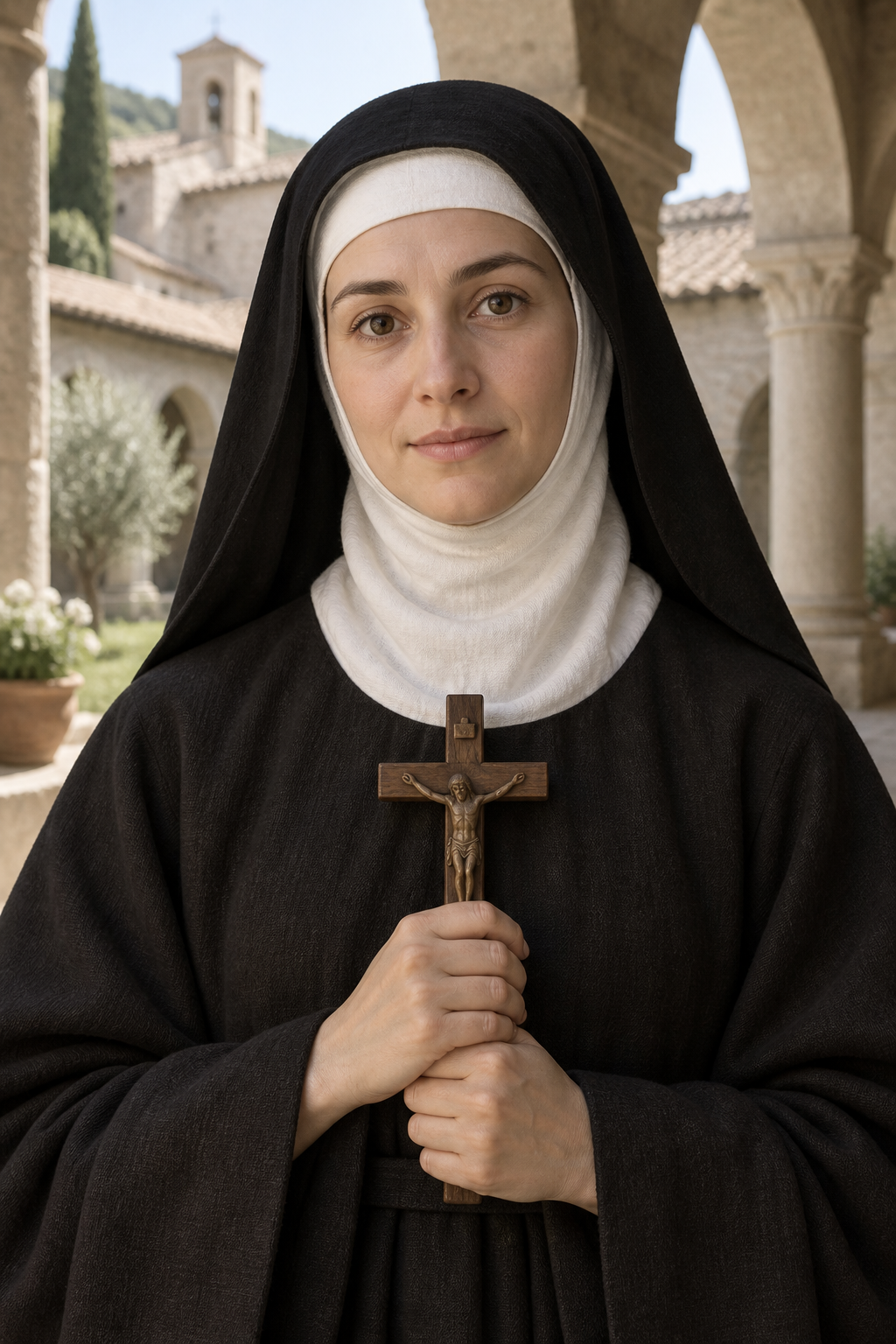
About Clare of Montefalco
Clare of Montefalco grew up within a small community of women devoted to prayer. Born in Montefalco around 1268, she joined her older sister Giovanna while still a child. Their father, Damiano, had built the dwelling in which Giovanna lived with another young woman. The Augustinian account remembers Clare as lively and intelligent, as well as committed to the demanding life the women shared.
As more women joined them, the original dwelling became too small. The monastery's history dates the building of a larger house to 1280. In 1290 the community obtained permission to adopt the Rule of Saint Augustine. The decision placed their growing community under an approved rule rather than informal association. The growing household was becoming a formally organized monastery, with a common pattern of life that would outlast its first members.
The transition also helps explain why later writers disagreed about Clare's religious affiliation. The older Catholic Encyclopedia describes an early Franciscan way of life followed by the adoption of an approved Augustinian rule. It distinguishes informal religious association from a community whose members professed vows under episcopal authority. The account preserves an important question about the women's beginnings, although it should not make their later Augustinian observance disappear from the story.
Giovanna died in 1291, and Clare was elected abbess in her place. Leadership meant serving as teacher and spiritual guide, not merely holding an office. The Augustinian biography records that people outside the convent also sought her counsel. A woman with little formal education had become someone to whom visitors from different walks of life brought their questions. Her influence reached people who came to speak with her.
Her lack of formal schooling did not mean that she could not read. Historian Giulia Barone notes evidence that Clare read the breviary and taught her companions to read. She also discussed religious questions with learned visitors. Around 1306 she challenged the teaching of Bentivenga of Gubbio, rejecting the idea that God could be responsible for human wrongdoing. Barone also cites canonization testimony crediting Clare with helping a truce between Trevi and Montefalco. Her religious convictions thus drew her into disputes whose consequences reached beyond the monastery.
Family ties remained part of Clare's life after she became abbess. Her younger brother Francesco entered the Friars Minor and received an education that differed from her own. In the testimony examined by Margaret Elizabeth Klotz, Clare valued his humility and prayer more than learned status. She prayed for him in distress and wanted him near her during her last illness. Those recollections show her speaking as a sister as well as a religious superior, concerned with the kind of life he led rather than simply the position he held.
The spiritual tradition surrounding Clare includes a long period in which prayer brought her little comfort. The monastery describes eleven years of inward struggle, during which she felt abandoned by God. Its account places her vision of Christ carrying a cross within that difficult period. These are reports of her religious experience, not events that can be verified in the same way as a building or an election. In the community's memory, perseverance through desolation belonged beside the more striking stories of visions.
Clare's care for others took practical forms as well. R. Sala's account describes her sending poor and sick people whatever the community did not strictly need. He also records her acquisition of Roman breviaries and her instruction of the sisters in praying the divine office. Her attention moved between the needs at the monastery's door and the common worship inside it. In this portrayal, contemplation was not a reason to ignore either the women in her charge or their neighbors.
In 1303 Clare built the oratory of Holy Cross. The Vatican Museums identifies it as the place where her remains were laid after her death. The oratory was subsequently incorporated into a larger church. The building provides a material connection with the community she led, even though the surrounding architecture changed over the centuries. It also shows how her devotion to Christ's Passion found expression in a shared place of worship, as well as in the experiences reported by her companions.
Clare died in her monastery on 17 August 1308. Soon afterward, reports circulated that the sisters had found shapes resembling the instruments of Christ's Passion in her heart. These reports became part of the testimony surrounding her reputation for holiness. They belong to the history of devotion to Clare, without establishing an independent medical explanation for the preserved relics.
Berengario of Saint-Affrique gathered testimony about Clare and became an advocate of her cause. Formal canonization came only in 1881, centuries after the first investigation. Her public memory remained connected with the monastery and the place where she was buried. The surviving accounts preserve both a leader responsible for a community and a woman whose inward religious life became an enduring subject of Christian devotion.
Wondering how to weigh the stories and sources? Learn how to read a saint biography.
Explore similar vocations
Prayers for Clare of Montefalco
Clare of Montefalco: sourced prayer excerpt
May we too draw strength from this passion, and be renewed always in your likeness.