Biography
Clelia Barbieri
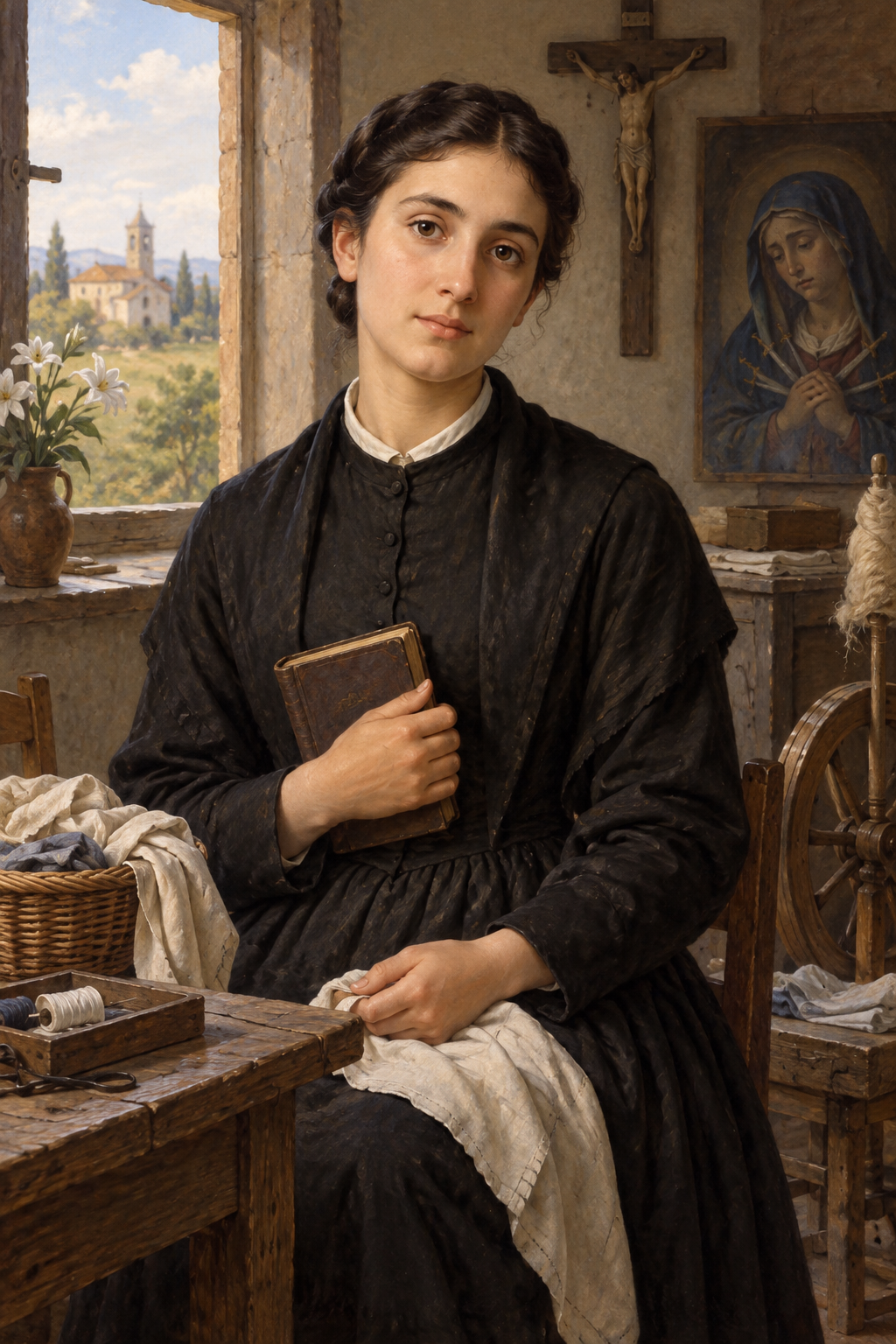
About Clelia Barbieri
Clelia Barbieri was born on February 13, 1847, in the rural district commonly called Le Budrie, civilly part of San Giovanni in Persiceto and ecclesiastically within the Archdiocese of Bologna. The names her parents as Giuseppe Barbieri and Giacinta Nannetti.
Her parents came from different social conditions. The official profile says Giuseppe came from one of the poorest families of Le Budrie, while Giacinta came from a more prominent family. Their household, however, is presented as built on faith and Christian practice rather than status.
Clelia was baptized the same day she was born and received the names Clelia, Rachele, and Maria. Her mother taught her early to love God and desire holiness. The page should keep this childhood material simple, avoiding sentimental scenes beyond the source.
She also learned the ordinary rural skills of sewing, spinning, and weaving hemp, the characteristic product of that countryside. This work belongs in the profile because it connects her spirituality to the daily labor of girls and poor families in Le Budrie.
The work details also protect the portrait from becoming abstract. Clelia's world was not a large institution but a rural parish, home labor, and young companions who needed formation. The final page should let the sewing and hemp work signal that setting without making poverty picturesque.
When Clelia was eight, her father died during the cholera epidemic of 1855. By the generosity of a physician uncle, her mother, Clelia, and her younger sister Ernestina moved to a more welcoming house near the parish church. The source says her days became more sanctified there.
Anyone looking for Clelia could find her either at home sewing or spinning, or in church praying. She was admitted to First Communion on June 17, 1858, at only eleven, earlier than was customary, because of her catechetical and spiritual preparation.
The profile links that First Communion with a decisive spiritual experience and with devotion to the Crucified Christ and Our Lady of Sorrows. The final page can mention this connection, but it should avoid long quoted prayer or deathbed-prophecy material unless separately reviewed.
Clelia’s spirituality had both contemplative and active lines. The official profile says she could be absorbed in prayer before the tabernacle, while at home she was an older companion to girls forced to work. Work became her first way of relating to them.
That contemplative-active balance is the safest way to handle the source's more devotional language. Clelia prayed intensely, but she also went toward girls, poor people, and those needing catechesis. The page should show that movement without exaggerating mystical details.
In the Bolognese Church there were Workers of Christian Doctrine, and Clelia wanted to belong to them. At Le Budrie, her participation renewed catechesis and drew other young women of similar spirit. She began humbly, then showed gifts that made even older people learn from her.
After refusing proposals of marriage, Clelia and the group of young women around her began imagining a small community of contemplative and apostolic life. Their service would flow from the Eucharist and include instruction for peasants and laborers in the area.
The idea could not be realized immediately because of local and political conditions after Italian unification. It began on May 1, 1868, when Clelia and her companions withdrew to the house where the Workers of Christian Doctrine had met. This was the humble beginning of her religious family.
The beginning was small and practical. The source says the group had little by way of organization or resources, but it had prayer, creativity, and missionary desire. That helps explain why the profile should avoid institutional grandeur and emphasize a young founder's small, durable start.
The superiors later called the community the Sisters Minims of Our Lady of Sorrows. The source says poor people, sick people, boys, and girls needing catechesis and instruction gathered around the group. Despite being only twenty-two, Clelia came to be seen as a guide and mother in faith.
Tuberculosis, already present, became violent only two years after the foundation. Clelia died on July 13, 1870, at age twenty-three. The official page records prophetic words at her death, but this draft treats them cautiously and keeps the public profile on documented life, foundation, and witness.
The Dicastery page records her beatification by Paul VI on October 27, 1968, and canonization by John Paul II on April 9, 1989. Her page should emphasize youthful holiness, rural work, catechesis, Eucharistic prayer, care for poor girls, and the humble beginning of the Sisters Minims of Our Lady of Sorrows.
Artwork should show a very young Italian woman, not an elderly foundress, in a simple rural dress or early community attire with a catechism book, sewing or hemp-spinning tools, and a Crucifix or Our Lady of Sorrows cue. Avoid illness spectacle, deathbed prophecy scenes, modern objects, and historical-likeness claims.
Wondering how to weigh the stories and sources? Learn how to read a saint biography.