Biography
Conrad of Constance
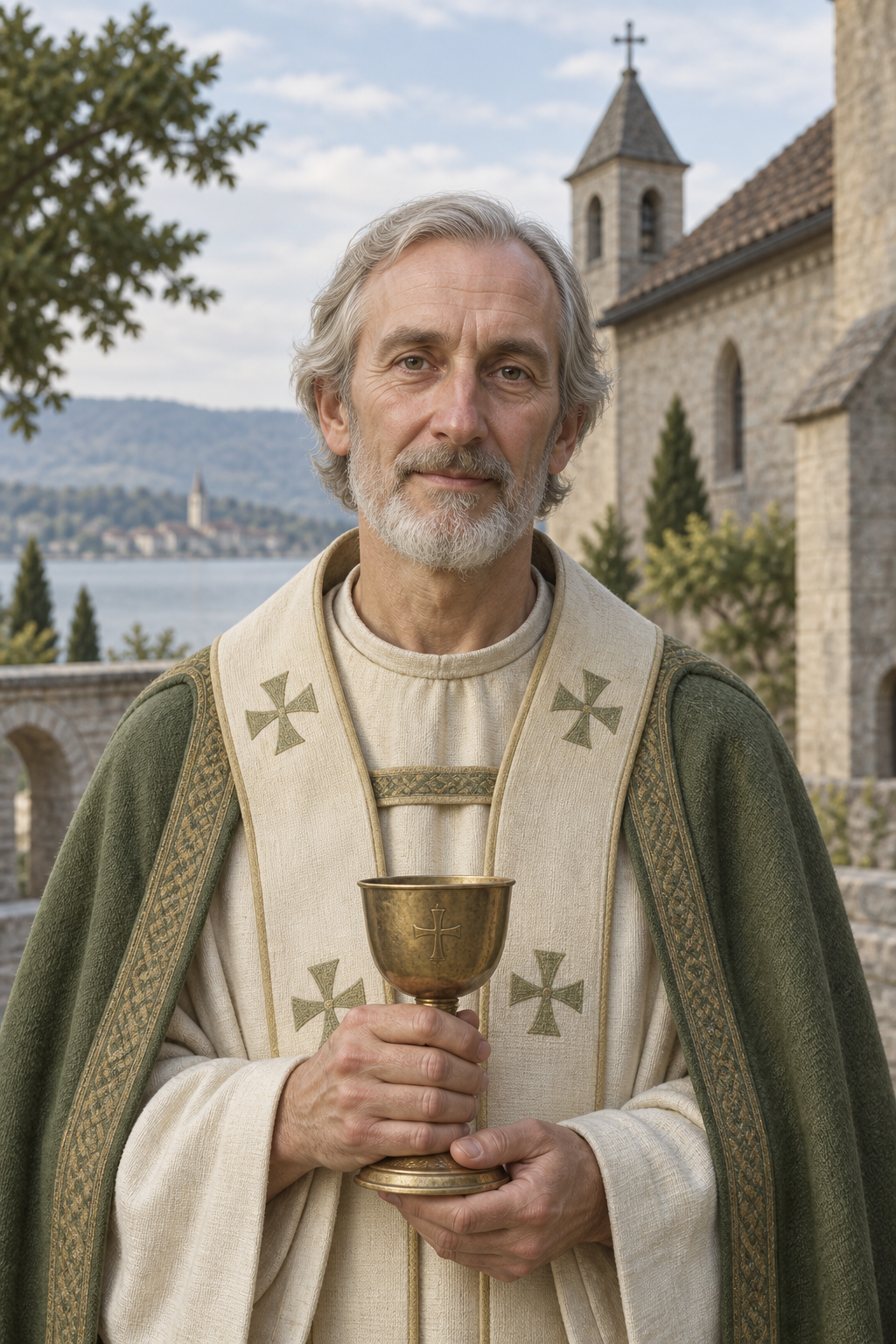
About Conrad of Constance
Conrad of Constance was a tenth-century bishop whose work reshaped the city around its cathedral. Born around 900, he belonged to the Welf family. A cathedral-school pupil and provost, he became bishop in 934. Ulrich of Augsburg, his friend, recommended him. His long episcopate combined pastoral care with the building of churches and a hospital for poor people and pilgrims.
Even the date of his election requires care: the Swiss historical lexicon gives November 934, whereas the NDB gives December. Both accounts place the beginning of his episcopate in the same year.
Udalschalk's later Life describes the responsibilities that prepared Conrad for this office. People seeking relief from oppression reportedly found him approachable: he represented their interests without charging them. These are the claims of a saint's biographer, not a surviving record of individual cases. He establishes a house within the city to feed twelve poor residents continually, while also providing for others who arrive.
His episcopate also brought him into contact with royal government, although Helmut Maurer's study finds him only occasionally beside Otto I. Conrad attended the royal assembly at Frankfurt in January 947, the synod at Ingelheim in June 948, and the assembly and synod at Augsburg in August 952. The meetings addressed political disputes and church discipline; they place him within the public responsibilities of a bishop, not outside them. In 962 Otto granted him property in the Breisgau for his lifetime, with the cathedral canons to receive it after his death. The grant requested their prayers for the emperor and included remembrance of Conrad and Otto's parents. When Otto visited Constance with his son in August 972, Conrad intervened on behalf of Rheinau abbey. Maurer distinguishes these contacts from the much more continuous royal service undertaken by some other bishops. The estates lay at Buggingen, Ihringen and the Mauracher Berg near Denzlingen, and came from confiscated property.
His church-building plan drew on Rome and Jerusalem. Saint John's and Saint Paul's recalled Roman churches. Three Holy Land pilgrimages informed the Mauritius chapel's resemblance to the Holy Sepulchre. Its dedication also connected the city with Ottonian royal patronage.
The surviving architecture makes this interest in Jerusalem tangible without supplying a complete record of his building works. The Badisches Klosterbuch describes Saint Maurice as a round church with three rectangular annexes. Its scale recalls the earlier Holy Sepulchre in Jerusalem at about one third of the size. Yet the structure now seen inside it should not be mistaken for Conrad's own monument. The painted, twelve-sided sandstone Holy Sepulchre dates from around 1260. The distinction matters: a building associated with a tenth-century bishop continued to be reshaped by later worshippers. The reference work also cautions that no contemporary written account survives for the original foundation. The agreement of later narratives therefore does not turn them into eyewitness testimony.
The biographical tradition remembers him using inherited resources for churches, hospitals and monasteries. He remained bishop for decades and died on 26 November 975. His body was first buried at the church of Saint Maurice and was later transferred to the cathedral. These memories center on his service as bishop, not a final career as a retired hermit.
A later legend tells of a spider falling into Conrad's chalice during Easter Mass. He supposedly swallowed it, and it later emerged alive. The spider became his artistic attribute.
Veneration developed after his death, and the movement of his remains around 1089 strengthened it. He was canonized in 1123.
The texts preserving his reputation also had purposes of their own. As Simon Maier explains, Udalschalk, a monk from Augsburg who had taken refuge in Constance, wrote his Life for Bishop Ulrich of Constance's campaign for canonization. This Ulrich was a later bishop, not Conrad's friend Ulrich of Augsburg. The work begins with a petition to the pope and seeks to establish Conrad's holiness through his conduct and reported miracles. A second, anonymous Life reworks the material and gives separate attention to the ceremonial transfer of his remains. These accounts preserve medieval interpretations of his service rather than an unfiltered contemporary biography. His relics also had a later history: Maier records Bishop Hugo of Hohenlandenberg's removal of them to Meersburg in 1526 during the Reformation. After reaching Prague, the head was returned to Constance on 6 December 1605 through negotiations by the vicar general Johannes Pistorius. Maier also records an arm relic in Meersburg's parish church.
The charitable foundation outlived its founder, but its later development should not be credited to Conrad personally. Anton Hopp's account of Kreuzlingen connects the renewal of Conrad's hospice with the canonization campaign. In 1125 Emperor Henry V authorized its restoration, and Bishop Ulrich moved it from the city to his church of Saints Ulrich and Afra. Pope Honorius II confirmed the Augustinian rule for the community and hospice that year and permitted the free election of its superior. Conrad's tenth-century provision for people in need thus belonged to the background of a later religious community, not to a monastery he founded in 1125.
Wondering how to weigh the stories and sources? Learn how to read a saint biography.
Explore similar vocations
Prayers for Conrad of Constance
Conrad of Constance: sourced prayer excerpt
Lass uns aus ihrem Geist leben und ihre Hilfe erfahren.