Biography
Conrad of Parzham
About Conrad of Parzham
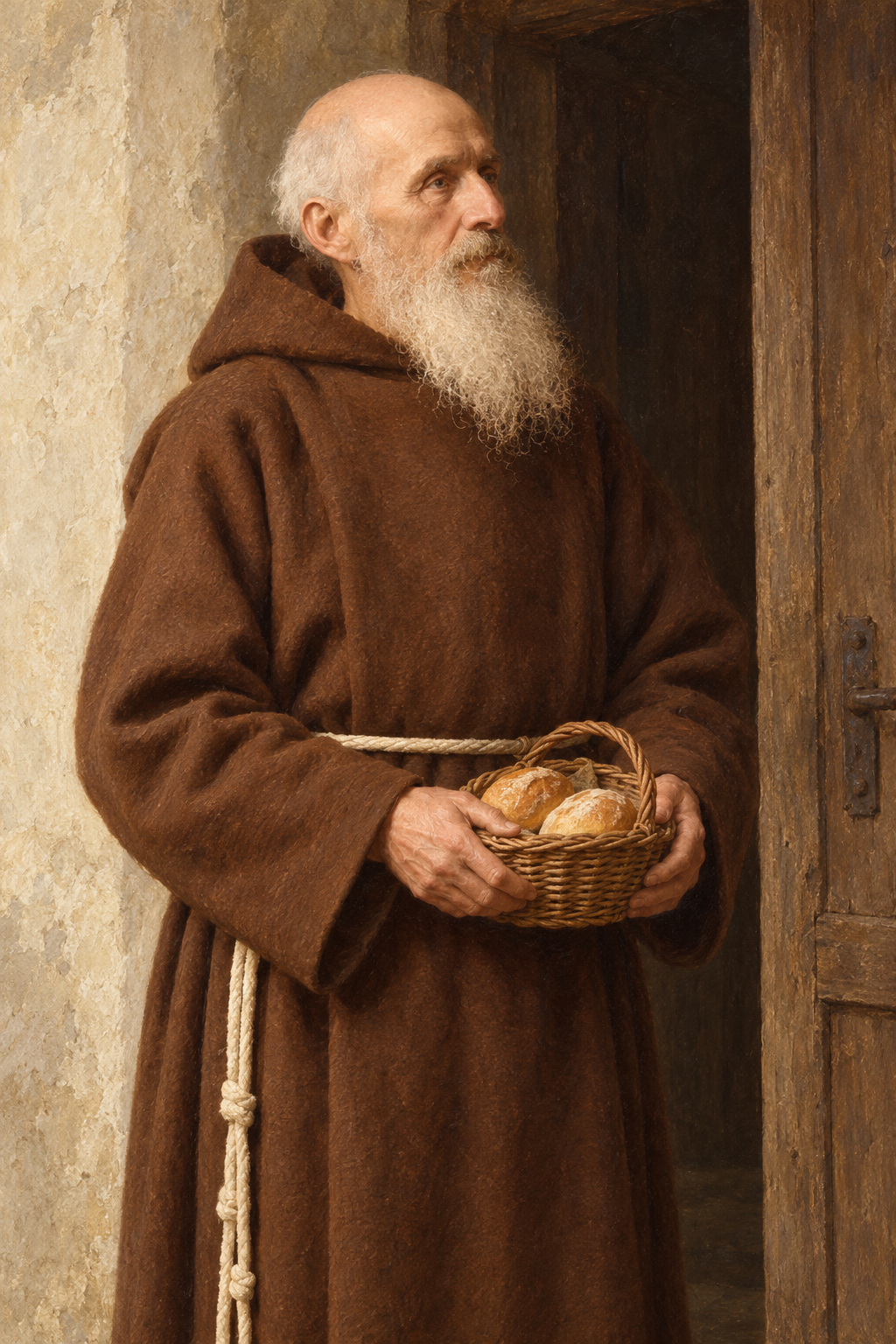
Conrad of Parzham spent more than forty years answering the door of a Capuchin friary. Visitors to Altötting came with practical needs, questions and burdens they wanted someone to hear. His work was to receive them. He became known for giving food to people in need and for offering a kind word rather than dismissing them. The ministry that shaped his life was ordinary, repeated service at the threshold of a religious community.
He was born Johann Birndorfer on 22 December 1818 at the family farm in Parzham. He grew up among many brothers and sisters and worked on the land. The diocesan account remembers a household that welcomed poor people and travelling craftsmen. His mother died when he was fourteen, and his father two years later. Religious practice and the responsibilities of farm life thus belonged together in his early experience. The same account describes his prayer while working and his habit of walking to churches.
Choosing religious life took time. The diocesan biography describes his participation in a mission at Ering in 1838 and years of spiritual guidance from Franz Xaver Dullinger at Aigen. He eventually decided against taking over the family farm and went to the Capuchins in Altötting in 1849. His vocation developed through an extended period of reflection, rather than an abrupt rejection of all that had mattered to him before.
The Capuchins distinguish his arrival from the later beginning of his novitiate, when he received the name Conrad in 1851. He made his profession the following year. He entered as a lay brother, and his particular service centred on the friary entrance. The order’s account recalls that he was convinced of his choice. In a letter written in 1864, he described leaving what he loved because he believed that he must follow God’s call. The attachment he left behind was real, as was the commitment he made.
The porter’s work brought constant interruptions. Michael Glaß’s account in the diocesan Liebfrauenbote draws on remembered testimony about Conrad’s patience with visitors, including children. One recollection describes him encouraging children to pray and praying with them. The article also recalls his distribution of bread and his willingness to listen. These memories give the work a human scale: an arrival at the door became a meeting with someone who would pay attention, even while the next visitor might already be waiting. Glaß also reports Conrad’s recollection of the good example he had received in his family. He understood that influence as something that had helped set the direction of his own life, rather than treating his vocation as an isolated achievement.
Prayer was central to that readiness. The Capuchins describe the Alexius cell, a small space beneath a stair, where Conrad withdrew to pray in the time available to him. Their account connects his capacity to listen with his habit of turning his attention to God. His life held both activities together: receiving people at the entrance and returning to quiet prayer whenever his responsibilities allowed.
His own spiritual language was simple and demanding. In a letter from 1872, reproduced in Marinus Parzinger’s account, Conrad treats the cross as a source of instruction in patience, humility and gentleness. He looks to Christ to learn how to respond in the situations before him. The letter does not offer a programme for public achievement. It describes an inward discipline meant to shape the way he met difficulty and other people.
Parzinger also describes the eleven resolutions Conrad formed before his profession. They express a sustained choice of service and attention to God. His desire for a life of prayer did not remove the work assigned by his superiors. The same account places his patient encounters with pilgrims, poor people and children beside the prayer that sustained them. Holiness appears here through the relationship between devotion and the duties that repeatedly interrupted his solitude.
Conrad died at Altötting on 21 April 1894. The Capuchin church guide records his burial in the friars’ crypt three days later. His reputation continued to grow, and Pope Pius XI canonized him on 20 May 1934. The guide preserves the distinction between his original workplace and the later arrangements made to honour him: the old entrance and the room where he died survive within the rebuilt monastery. The church was renamed for him in 1953.
His memory remains connected with welcome and practical charity. The surviving places at Altötting allow visitors to encounter the scale of the work: a doorway, a small place for prayer, and a life spent responding to people. The guide presents these spaces as invitations to faith in daily life. They recall a brother whose ordinary duties became the setting for patient and sustained service. The church reopened after renovation on his feast in 2018, the bicentenary of his birth. Its continuing use keeps remembrance joined to worship.
Wondering how to weigh the stories and sources? Learn how to read a saint biography.