Biography
Cunigunde of Luxembourg
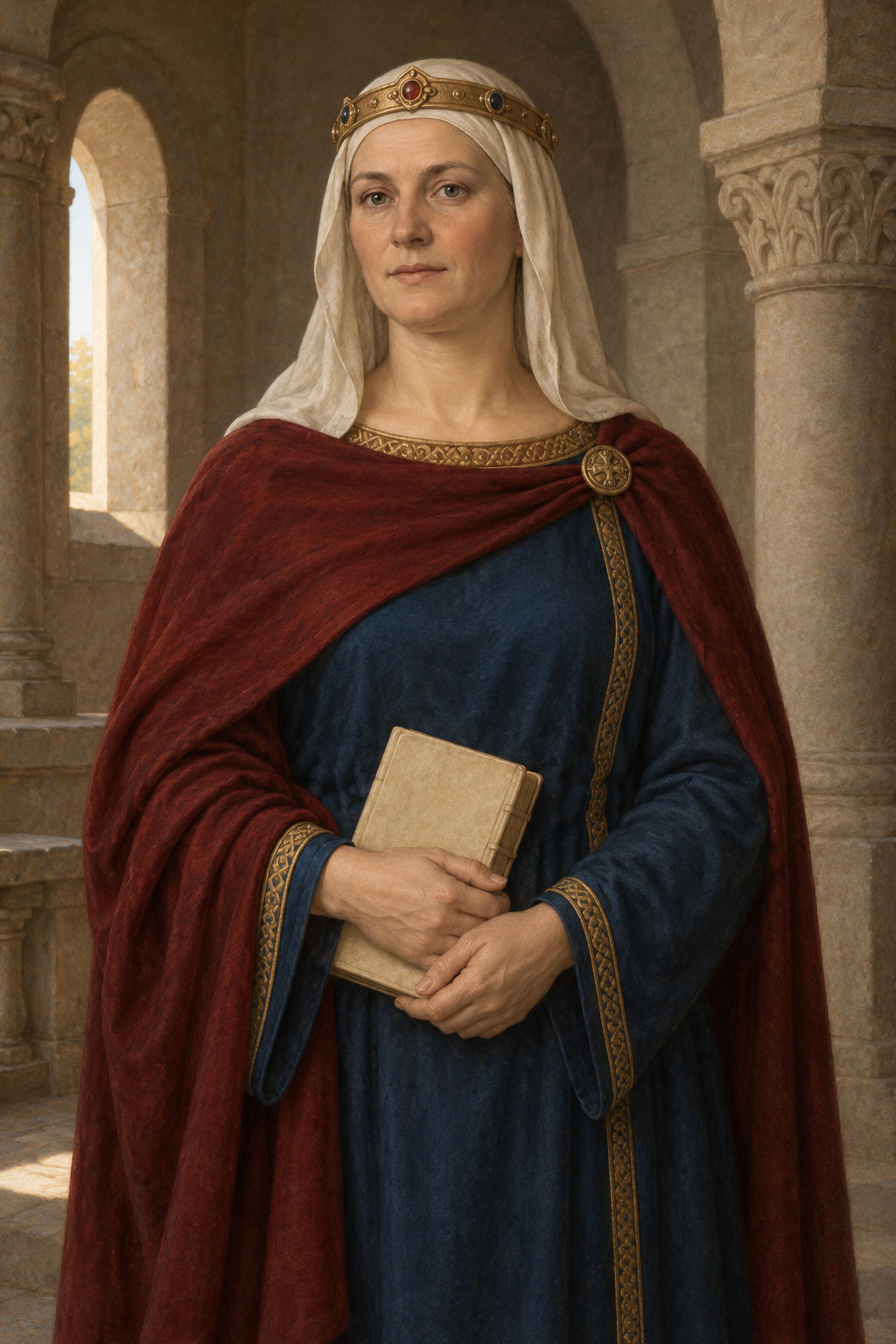
About Cunigunde of Luxembourg
Cunigunde of Luxembourg was an empress, a founder of religious communities and, in widowhood, a nun. She belonged to the family of the counts of Luxembourg, the daughter of Siegfried and Hadewig. Around the end of the tenth century she married the future Emperor Henry II. Her public life is better documented than her childhood: the surviving record reveals a woman who participated in government and religious patronage, not simply the wife of a ruler.
Henry became king in 1002, and Cunigunde received her own coronation at Paderborn from Archbishop Willigis of Mainz. In 1014, Pope Benedict VIII crowned the couple emperor and empress in Rome. Heinrich Appelt’s account emphasizes her influence over affairs of government, her interventions in important decisions and the occasions when she represented her husband. Her marriage placed her within the exercise of royal authority, with responsibilities extending beyond the household.
Karin Dengler-Schreiber gives concrete examples of those responsibilities. Cunigunde presided at judicial proceedings and helped organize the eastern defences in 1012 and 1016. She also worked to reconcile Henry with her brother, the duke of Bavaria, after conflict between them. The study records her frequent appearance in Henry’s surviving charters as an intermediary for petitioners. Access to the ruler mattered, and Cunigunde’s ability to bring requests before him formed an important part of how government worked.
Her public role unfolded within a travelling court. Dengler-Schreiber describes the royal household moving frequently from place to place, rarely remaining long in one location. Cunigunde joined Henry’s journey through the realm after his election, as he sought recognition from its leading political communities.
An imperial charter preserved in the Lower Saxony State Archives provides a small, direct example of the couple’s religious patronage. In a donation assigned to 1017, Henry names Cunigunde alongside himself when granting land at Gimte to the monastery of Hilwartshausen. The document also names Bishop Meinwerk of Paderborn as the petitioner. It connects her imperial title with a specific transfer of property, rather than with a later story about her sanctity.
Bamberg became central to the couple’s lasting memory. The archdiocese’s history describes Cunigunde’s participation in establishing and endowing the bishopric, founded in 1007. This involved property that Henry had given her in connection with their marriage. The foundation received gifts both near Bamberg and farther away, supporting a church whose worship and prayer would preserve the founders’ memory. Religious devotion, the ordering of territory and the desire for remembrance belonged together in such foundations.
Kaufungen was a foundation more closely associated with Cunigunde herself. The municipality’s history traces the transformation of a royal residence into a Benedictine convent in 1017. Existing buildings could accommodate the first nuns while the new church was under construction. The foundation provided an enduring centre of administration and education, as well as a place where Cunigunde could live if she survived her husband. Its provision for her widowhood was therefore built into its early purpose.
Henry died in 1024. Cunigunde helped maintain royal government during the transition to Conrad II, then entered Kaufungen the following year. The local history associates her entry with the dedication of the church of the Holy Cross on 13 July 1025, the first anniversary of Henry’s death. She remained at Kaufungen until her own death in 1033.
The later image of Cunigunde as a saint needs to be distinguished from this political history. Antonia Anstatt examines an early thirteenth-century text that presents her marriage as loving and voluntarily chaste, then portrays her clearing an accusation of infidelity through an ordeal. Such stories express medieval ideas about female holiness and authority. They do not provide contemporary evidence for the intimate life of a couple who had died almost two centuries earlier.
Anstatt also notes uncertainty about Cunigunde’s original burial: later tradition places her tomb in Bamberg, but Kaufungen remains a possibility. Even her contribution to Bamberg’s endowment requires nuance, since historians debate the effect of Henry’s use of her marriage property. The familiar image of an entirely harmonious saintly partnership should not erase these questions about property, power and the transmission of memory.
The magnificent shared monument in Bamberg Cathedral belongs to the later history of their veneration. Iris Kalden-Rosenfeld dates its commission to 1499 and its completion to 1513, in Tilman Riemenschneider’s workshop. It brought together relics previously kept separately. Its sculpted scenes include Cunigunde’s ordeal and a miracle about wages paid to builders: they show how later worshippers imagined the saints, rather than supplying portraits made during their lives.
On the monument, the emperor and empress appear in imperial dress, with the emblems of rule. Its reliefs draw on saints’ legends printed in the late fifteenth century. The images bring together royal dignity, miraculous protection and the hope of salvation, preserving the religious concerns of the people who commissioned and visited it.
Wondering how to weigh the stories and sources? Learn how to read a saint biography.