Biography
Daniel of Katounakia
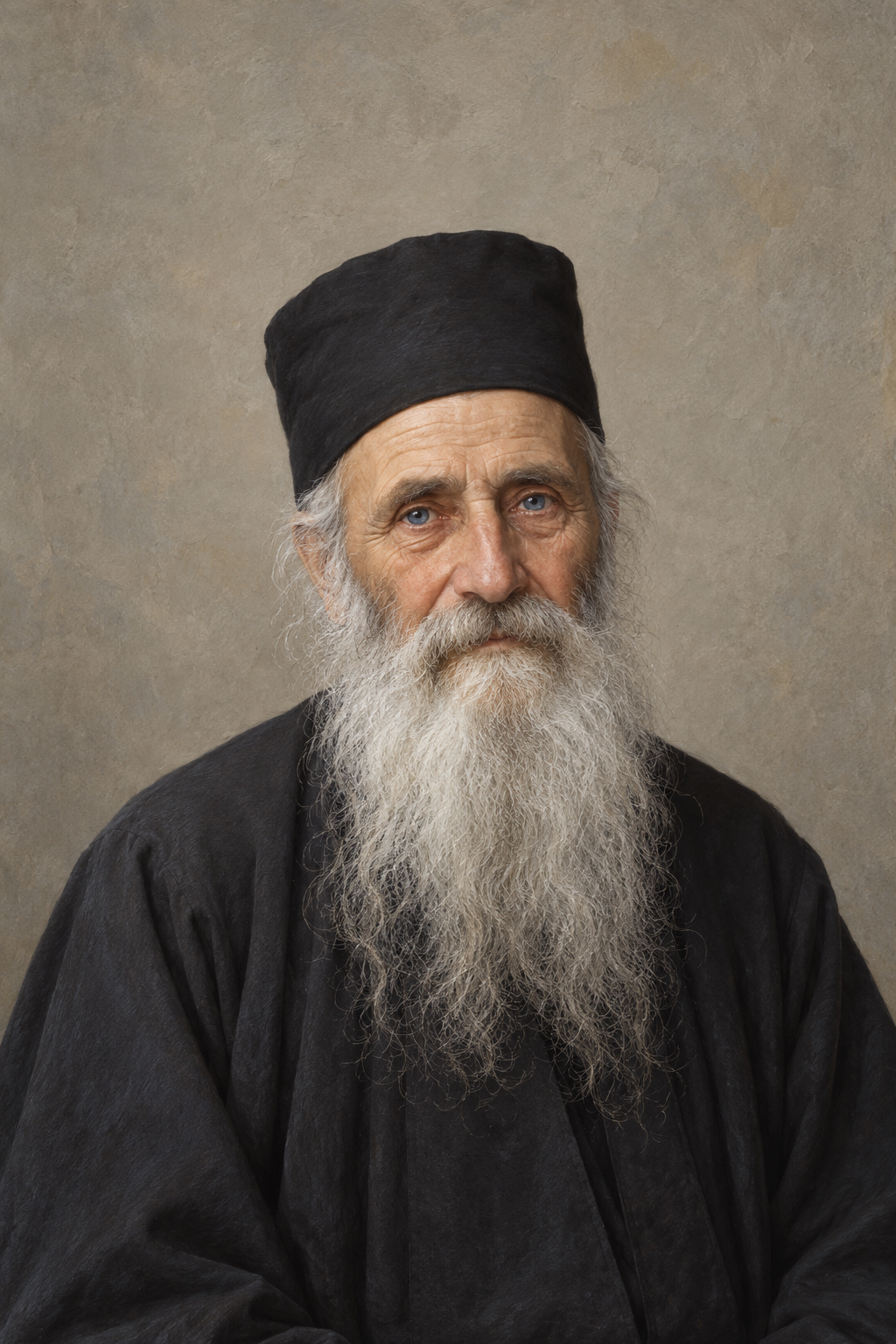
About Daniel of Katounakia
Daniel of Katounakia was an Athonite monk from Smyrna, known before his tonsure as Demetrios Demetriades. He studied at the city’s Evangelical School and sought out monastic teachers while still young. Arsenios of Paros directed him to Saint Panteleimon on Mount Athos, where he became a monk in 1866 and served as secretary.
His early monastic life included conflict and displacement. During a dispute between Greek and Russian monks over the monastery’s administration, the Ecumenical Patriarchate sent him into exile. He stayed at Saint Anastasia near Thessaloniki and later returned to Athos, living at Vatopedi.
At Katounakia, he combined solitude with hospitality and spiritual conversation. The writer Alexandros Moraitidis remembered a community where icon painting and reading the Fathers accompanied one another. Moraitidis particularly remembered his reading of John Climacus and Symeon the New Theologian, whose writings became subjects of conversation within the small community of monks and visitors.
Daniel’s relationship with Moraitidis also involved difficult personal counsel. As Konstantinos Koutoumbas recounts, the writer suffered a serious fall while visiting Mega Spilaio in 1907 and spent three months recovering in an Athens hospital. Moraitidis feared that a passing doubt about an icon of the Virgin had brought the accident upon him. Daniel’s reply, dated New Year’s Day 1908, rejected that explanation: the unwanted thought had been resisted, and the Virgin understood his faith. Yet Daniel also urged him to abandon journalism and fiction in favor of religious writing, advice that placed real limits on the writer’s work. Koutoumbas connects their friendship with Moraitidis’s later ascetic interests. He also records a loss that affects our knowledge of it: letters collected by the historian Ioannis Frangoulas burned with his house during the destruction of Skiathos in August 1944. Other letters survived at the Daniilei hermitage. Moraitidis subsequently translated and interpreted patristic writings and composed hymns, giving his literary skills a different purpose during this period of withdrawal.
Daniel corresponded with Nektarios of Pentapolis. At Nektarios’s request, he prepared spiritual instruction for the nuns at Aegina. Their correspondence also records a practical limit: Daniel could not arrange the purchase of an Athonite cell that Nektarios had hoped to obtain.
The theologian Theodoros Zisis describes how the Daniilei brotherhood preserved and published this exchange, with an introduction he supplied. His study identifies four letters from Nektarios and portions of another lost letter associated with the years 1903–1908. In the first, Nektarios comforts Daniel by considering the spiritual value of suffering. Daniel appears here as someone who needed consolation himself, as well as a teacher whom others consulted. The surviving exchange is incomplete: the published fragments do not provide a continuous record of everything the two men discussed. Even so, they preserve a relationship sustained through writing between two different monastic settings.
His counsel could restrain enthusiasm as well as encourage it. The diocesan account describes his advice to the young Joseph, later known as Joseph the Hesychast, and his companion Arsenios. Before pursuing their ambitious ascetic plans, he urged them to live under an elder’s guidance. In this remembrance, discernment required patience and a willingness to learn from another person.
His teaching reached beyond the hermitage through letters and treatises. The same account describes bishops, priests, monastics and lay Christians seeking help with spiritual and theological questions. His reputation rested not only on his withdrawal from ordinary life but on the care he continued to offer others.
A letter to the student Georgios Papageorgiadis, dated February 23, 1902, gives Daniel’s teaching a direct voice. He welcomed the young man’s seriousness but shared his concern about indifference among students preparing for church service. Theological learning, he argued, required a corresponding way of life. A teacher should practice the virtues he intended to teach and resist the pursuit of reputation, pleasure or personal gain. Daniel did not tell Georgios to abandon his studies; he urged him to continue, gathering what was useful while reading the Fathers for himself each day.
The same letter addresses discouragement. A conscientious student should not give up because others opposed him or because faithful workers seemed few. Daniel appealed to the apostles as an example of service that did not depend on wealth or worldly power. His advice was also firmly traditional: he warned against novel doctrines and prolonged quarrels, while insisting that conviction needed to be expressed through conduct. Basil and John Chrysostom served as further examples of students maintaining their convictions while pursuing an education.
Daniel died in 1929 after a final illness, surrounded by members of his community. The monastery account remembers his last counsels and blessings to his disciples. The Ecumenical Patriarchate formally entered him in the catalogue of saints on March 9, 2020, following an announcement the previous October. Its communiqué recalls his spiritual writings, friendship with Nektarios and leadership of the Daniilei brotherhood. His annual commemoration is September 7.
Wondering how to weigh the stories and sources? Learn how to read a saint biography.