Biography
Devasahayam Pillai
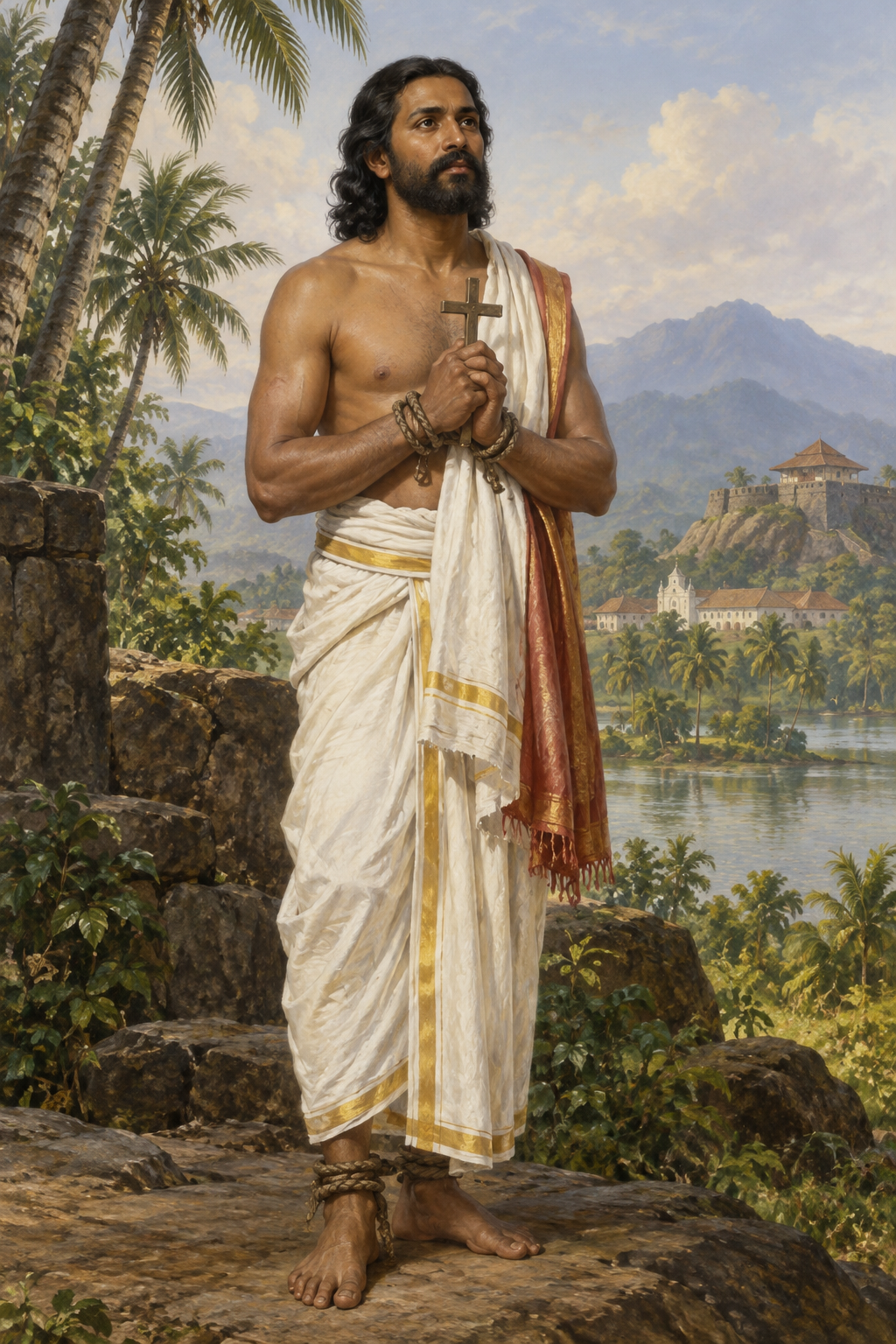
About Devasahayam Pillai
Devasahayam Pillai was born on 23 April 1712 at Nattalam in the Kingdom of Travancore, in the region now associated with southern India. The Holy See profile gives his birth name as Nilakandan and also records the name Nilam. He came from a Hindu family and entered public service, eventually working in the administration of the Travancore court. These details place his later conversion within a defined social and political setting rather than treating it as an isolated private event. [P1]
While serving at court, Nilakandan encountered Eustachius Benedictus De Lannoy, a Catholic soldier and adviser who had become influential in Travancore. The profile describes Christian instruction and conversations that led Nilakandan to seek baptism. He was baptized with the name Lazzaro, rendered in English as Devasahayam or Lazarus. The name change should be documented as a religious conversion and not confused with a change of ethnic identity or civil status. [P1]
The Holy See account connects his conversion with a new interpretation of suffering and providence. Devasahayam's Christian teaching challenged the assumption that social rank and material security were signs of divine favor. That message, together with his public adherence to Catholicism, brought him into conflict with people who considered the new faith incompatible with the social order of the kingdom. The final importer should link the conversion, public witness, and persecution as separate claims rather than treating a general statement about opposition as a complete event. [P1]
Devasahayam lost his position and was arrested. The profile describes a period of imprisonment and mistreatment that included public humiliation and movement from place to place. He was exposed to conditions intended to make him renounce his faith, but continued to profess Christianity. Because the short official profile compresses several episodes, the precise sequence, locations, and dates must be checked against the underlying cause documents before creating more than one or two narrowly worded featured events. [P1]
The account also presents Devasahayam's endurance as a source of encouragement for other Christians. That is an interpretation within the official cause narrative; the public profile may report it as the Church's reading of his witness, but should not convert it into an independently measured claim about the growth of Christianity in Travancore. Similarly, stories attached to places where he is remembered should not be entered as historical miracles without specific evidence and a separate claim classification. [P1]
Devasahayam was killed on 14 January 1752 at Kattadimalai, according to the Holy See profile. His death is treated as martyrdom. The location, date, and execution claim require separate citations in the normalized event and place records, and the modern place hierarchy should be verified rather than inferred from the historical kingdom label. [P1]
The Church later recognized Devasahayam through beatification and canonization. The final packet must distinguish the historical death from the later juridical acts and must identify the exact calendar jurisdiction for any feast date. The record should also retain his several names so that searches for Nilakandan, Nilam, Lazzaro, and Devasahayam resolve to the same person without implying that they represent different saints. [P1]
Devasahayam Pillai's significance lies in the cost of a public religious change within an ordered court society. A careful account can describe his conversion, loss of office, imprisonment, and death as a martyr while leaving unsupported details empty. It should respect both the Catholic tradition that venerates him and the historical limits of a short official biography, especially where later devotional retellings add precise scenes or speeches not established in the source ledger. [P1]
The court setting matters because it explains why the conversion affected more than one private household. Nilakandan held a position connected with public administration, and his contact with Christian teaching occurred through the networks of soldiers, advisers, and officials that linked Travancore to wider political worlds. The profile does not provide a complete institutional history of the court, so the catalog should use this setting to clarify identity rather than to make unsupported claims about policy or religious tolerance. [P1]
The name Lazzaro signaled a new Christian identity, but the historical record continued to preserve his earlier names. That dual naming is important for search, scholarship, and respectful presentation. A reader encountering Nilakandan, Nilam, Devasahayam, or Lazzaro should be led to the same record, and the biography should explain the relationship without treating one form as an error. The normalized name table can carry the variants while the primary name remains the catalog's chosen public form. [P1]
The persecution account should also avoid a simple opposition between one religion and another. Devasahayam's case unfolded within a court and social order where office, caste, patronage, and religious allegiance were connected. The Holy See profile presents his Christian confession as the reason for loss and punishment, but the exact motives of every official or accuser should not be inferred. The strongest publishable claim is that his public adherence to Christianity brought serious consequences and that he endured imprisonment and mistreatment without renouncing his faith. [P1]
Martyrdom is both a historical classification and a theological interpretation. The death date and place belong to the historical event record; the Church's recognition of the death as martyrdom belongs to the status and canonization record. Keeping those layers separate allows the profile to be faithful to the tradition without pretending that a short cause summary answers every question about the execution itself. [P1]
The final years of Devasahayam's life are therefore best narrated with restraint. He had moved from court service into a vulnerable position, continued to profess the faith he had adopted, endured confinement and public humiliation, and was killed in 1752. The source does not require invented speeches, dramatic dialogue, or exact travel itineraries. Its force comes from the documented contrast between former public standing and later persecution. [P1]
Wondering how to weigh the stories and sources? Learn how to read a saint biography.