Biography
Dorothea of Caesarea
About Dorothea of Caesarea
Dorothea of Caesarea, often called Dorothy in English, is honoured as a Christian martyr associated with Caesarea in Cappadocia. The New Catholic Encyclopedia places her within the persecution under Diocletian but warns that the Passion recounting her life contains extensive legendary material. Her later popularity is clearer than the details of her personal history.
In the story preserved by the Orthodox Church in America, Dorothea refuses to abandon her faith when brought before the governor Sapricius. Two sisters, Christina and Callista, are sent to persuade her to sacrifice to the pagan gods. Instead, she encourages them to return to Christianity, assuring them of God’s mercy for those who repent. The narrative presents their renewed faith as a central part of her witness.
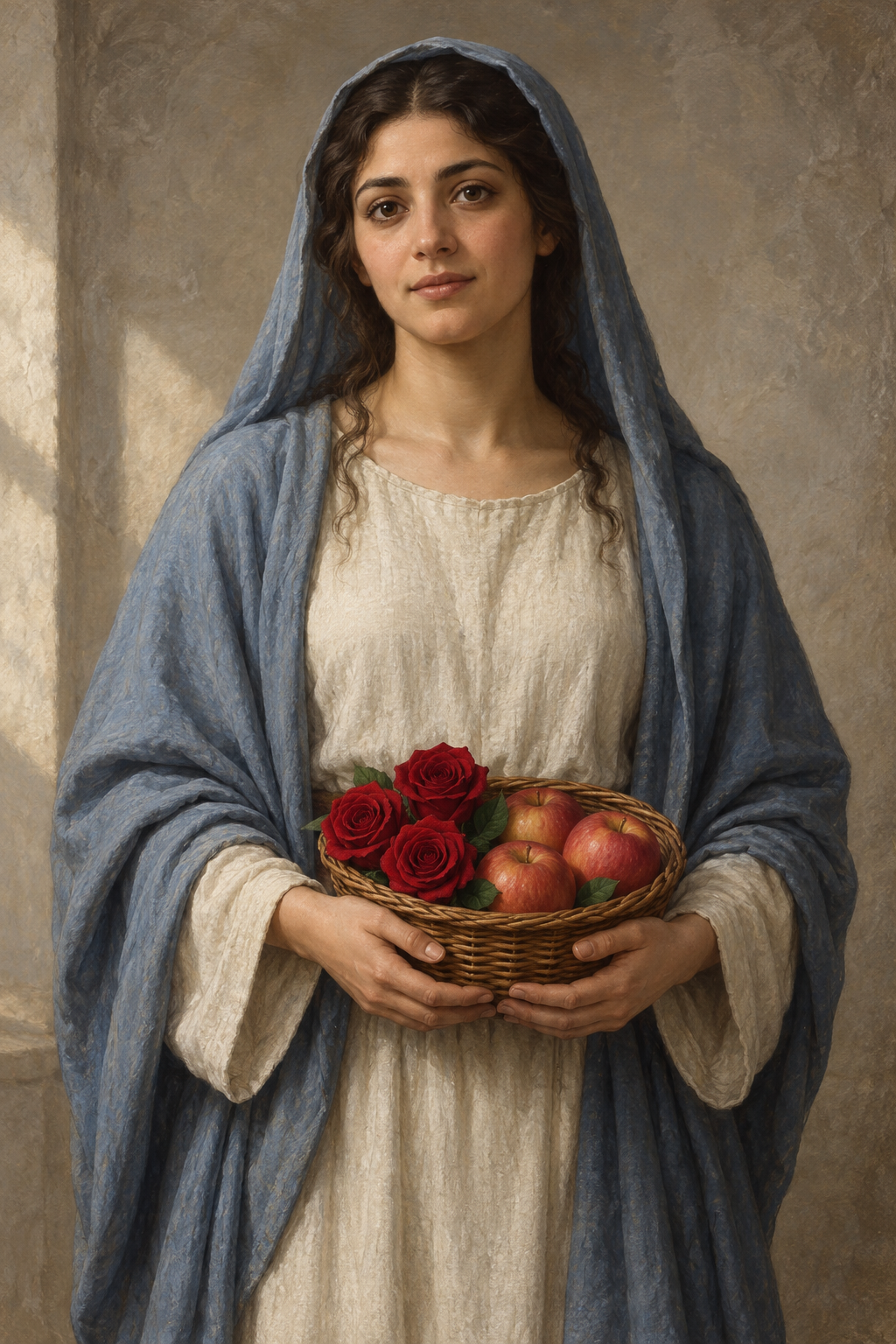
The best-known episode concerns Theophilus, who mocks her hope of entering Paradise. He asks her to send him flowers and fruit from her heavenly bridegroom’s garden. Before her execution, a childlike angel brings roses and apples, which she asks to have delivered to him. The miraculous gift, arriving in winter, leads him to confess Christianity and suffer martyrdom himself. This is the devotional narrative behind her familiar basket, rather than an independently verified account of a supernatural event.
E. G. Ryan’s account in the New Catholic Encyclopedia notes the strength of her medieval cult and her popularity among German and Italian artists. It also records the removal of her feast from the universal calendar in 1969. That change concerns a calendar observance; the Orthodox Church in America continues to commemorate her on February 6.
A surviving German stained-glass panel at the Metropolitan Museum of Art makes that later artistic memory tangible. Made in the Middle Rhine Valley between 1440 and 1446, it shows Dorothea with Jesus and a basket of roses, with the Trinity below. The work belongs to a series of the Virgin Mary and five standing saints. It documents medieval devotion, not Dorothea’s appearance in life.
The Diocese of Augsburg also describes her customary representation with roses or apples and records traditional patronage of gardeners and flower sellers, among others. Such associations show how the legend entered everyday religious life. They do not establish her occupation or supply missing details about her family, education or death.
Wondering how to weigh the stories and sources? Learn how to read a saint biography.