Biography
Dubricius
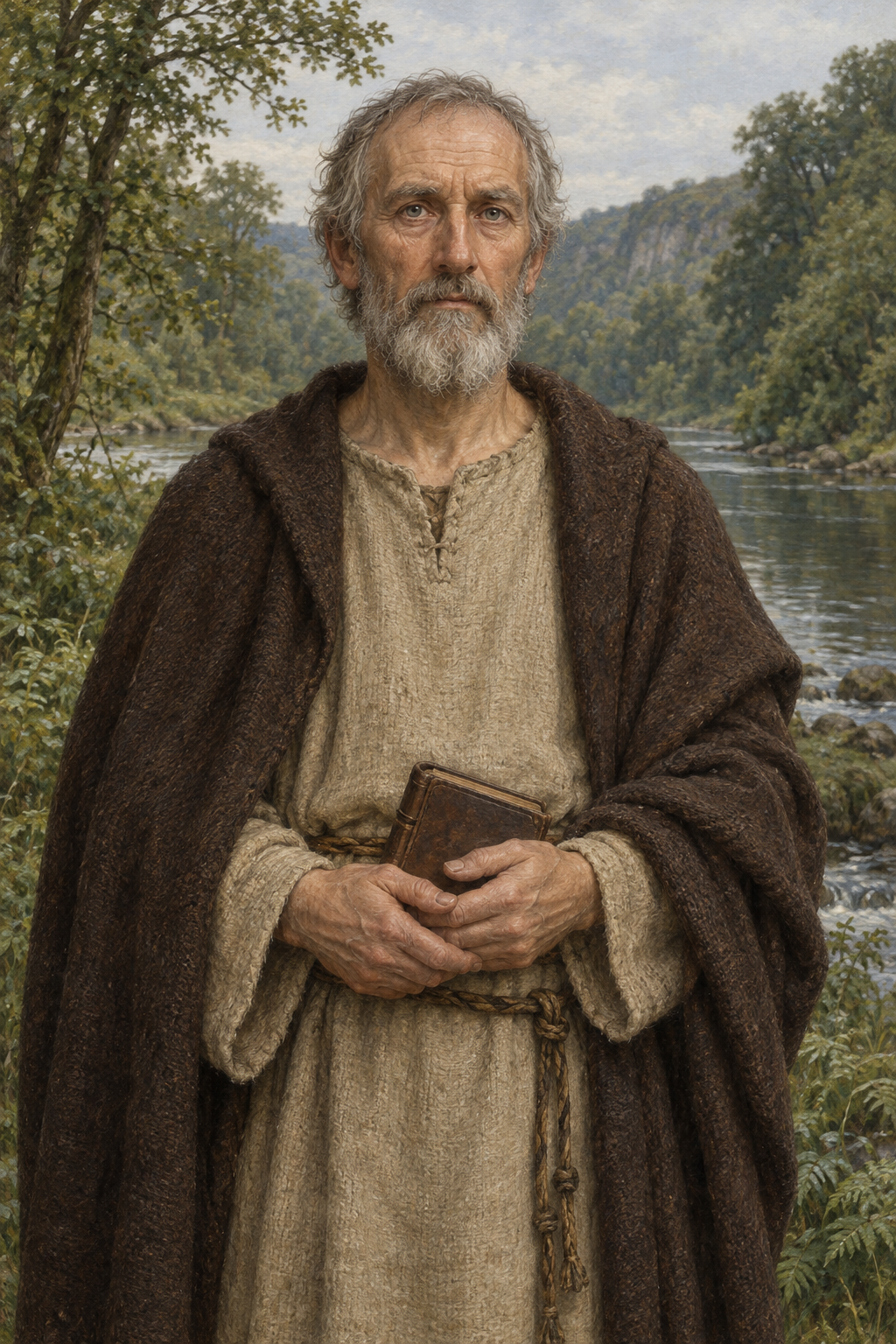
About Dubricius
Dubricius, known in Welsh as Dyfrig, is remembered as a religious teacher and monastic founder associated especially with the region now called south-west Herefordshire. David E. Thornton identifies Hentland and Moccas as his foundations and describes his early reputation for wisdom and learning. The same historian cautions that the later claim making him Llandaff’s first bishop reflects the ambitions of a much later church.
The earliest surviving accounts do not provide a continuous, securely dated life. Hywel David Emanuel points to the Life of Samson as an early witness, associating Dyfrig with Illtud, Samson and Caldey Island. The damaged inscription on a stone at Caldey has sometimes been read as a reference to him, but Emanuel warns that this identification has not been established.
A later Life in the Book of Llandaff tells of his birth at Madley, his mother Ebrdil and a miraculous healing of his grandfather. It describes teaching at Hentland, a further establishment at Moccas and retirement to Bardsey Island. Emanuel treats this material as a collection of traditions shaped long after the events it purports to describe. Its family story and miracles therefore cannot supply an unquestioned account of his childhood.
The chronology is equally uncertain. Thornton notes that the annals place the death of a bishop Dyfrig in 612, whereas his associations in the saints’ Lives suggest activity much earlier. Some scholars have considered the annalistic reference a later addition. Choosing one precise birth or death year would conceal that disagreement.
Llandaff’s medieval interest in him helps explain the form his memory acquired. The Book of Llandaff claimed that Germanus and Lupus had established him as archbishop of southern Britain, with boundaries matching the claims of Bishop Urban’s twelfth-century see. Thornton rejects this as reliable evidence of Dyfrig’s own authority.
The Diocese of Llandaff records the transfer of his remains from Bardsey to the cathedral around 1120 under Bishop Urban. The present cathedral building also belongs to the Norman period. This later shrine history is important to his remembrance, even though it does not settle the disputed claim that he personally founded the episcopal see there.
His name also survives in church dedications outside Llandaff. Historic England records the church of St Dubricius at Whitchurch in Herefordshire, with a thirteenth-century foundation and later rebuilding. Its medieval fabric preserves another stage of devotion rather than a building securely dating from his lifetime.
The Catholic national calendar for Wales commemorates Dyfrig on November 14 as an optional memorial. Its account remembers his monastic teaching, prayer on Caldey and retirement to Bardsey. That liturgical remembrance keeps his religious legacy visible while the details of his life remain matters for careful historical judgment.
Wondering how to weigh the stories and sources? Learn how to read a saint biography.