Biography
Dulce Lopes Pontes
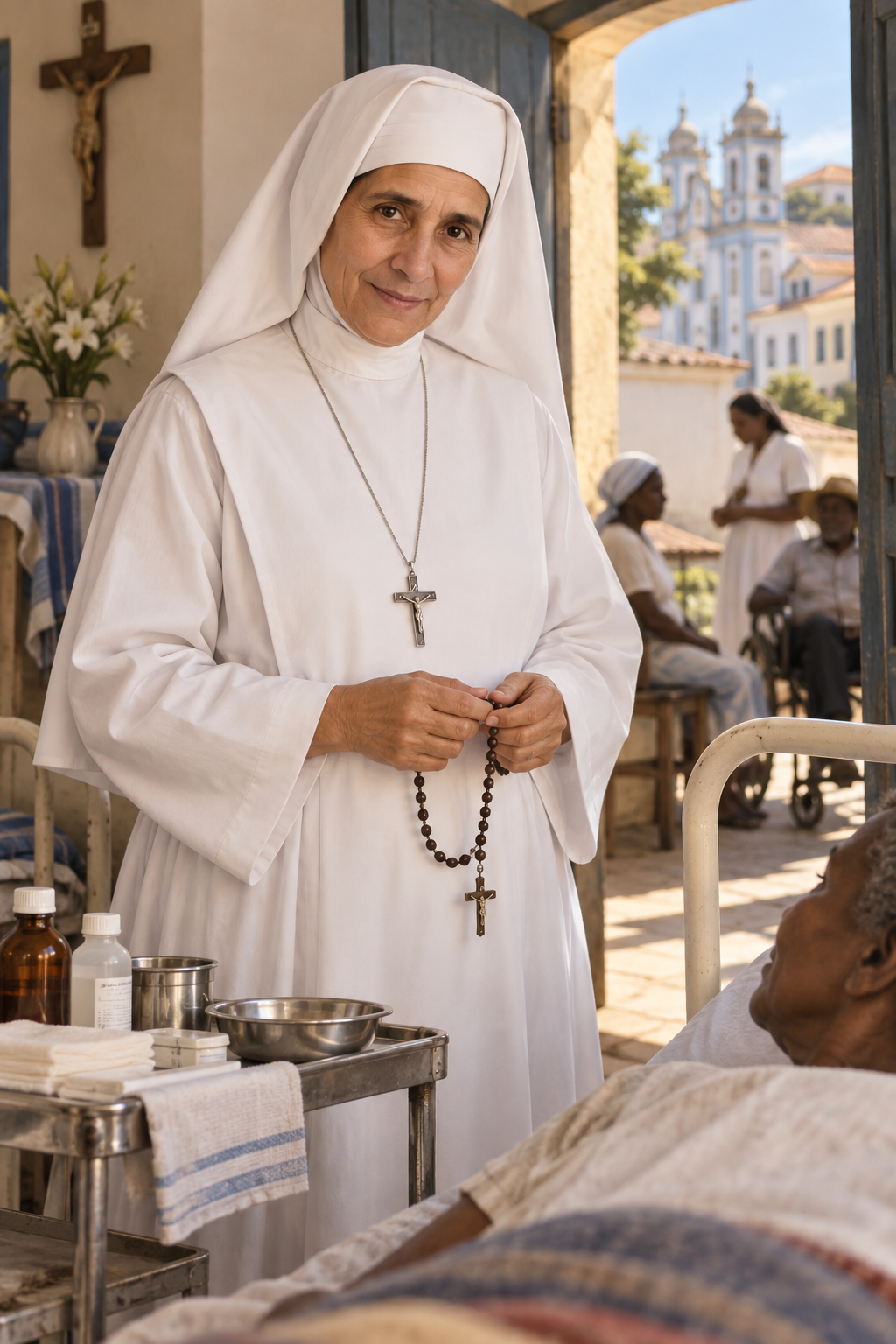
About Dulce Lopes Pontes
Dulce Lopes Pontes was born on May 26, 1914, at Sao Salvador da Bahia. The Dicastery for the Causes of Saints gives her baptismal name as Maria Rita and names her parents as Augusto and Dulce Maria de Souza Brito Lopes Pontes.
She was the second of five children. Her mother's death when Maria Rita was six became an important family wound and later shaped the religious name she chose. The public profile should mention that loss without making it the whole key to her vocation.
The Dicastery profile says that around the age of sixteen Maria Rita began to show a practical charity that people around her could see. In the family cellar, she welcomed poor children, adults, and elderly people, then asked relatives, neighbors, and acquaintances for food, clothing, medicine, and small sums of money to relieve their needs.
That episode matters because it places her service before any large institution. Her later hospital work did not begin as an abstract project. It grew from household space, improvised help, and a young woman's willingness to notice poor neighbors who had nowhere else to go.
While she was attending teacher-training school in Sao Salvador da Bahia, Maria Rita also entered the Third Order of Saint Francis. The same period brought her into contact with the provincial superior of the Missionary Sisters of the Immaculate Conception of the Mother of God, a congregation in the Franciscan family.
After receiving her teaching diploma, she entered that congregation on February 8, 1933. The official profile gives August 15, 1934, as the date of her religious profession and says that she took the name Dulce in memory of her mother.
As Sister Dulce, she soon connected religious life with the needs of workers in Bahia. In 1935 she founded what the Dicastery profile calls the first Christian workers' movement in Sao Salvador, the Saint Francis Workers' Union. In 1937 she founded the Workers' Circle of Bahia.
Those associations also show why her sanctity cannot be reduced to private kindness. The source presents her as a sister who organized lay workers and made Christian service visible in ordinary social life.
The worker projects were followed by education. In 1939 she inaugurated the Saint Anthony College, a public school in the Massaranduba neighborhood for workers and their children. These details should stay in the final page because they show that her charity included formation, labor dignity, and concrete local organization.
The same year, 1939, she began sheltering sick people in abandoned buildings in Sao Salvador. The profile does not present this as a polished program. It shows a religious sister trying to make room for sick poor people before adequate space or resources existed.
In 1949, with her superior's permission, Sister Dulce housed seventy sick people in a shelter made from a chicken coop adjoining the congregation's house. The image is startling, but it should be handled carefully: not as picturesque poverty, but as evidence of how improvised and urgent the work was.
The charitable works took institutional shape over time. In 1960 the Ospizio Sociale Suor Dulce was inaugurated, with statutes covering the foundations connected with her work and identifying its Christian and humanitarian character. The page should avoid using current institutional statistics unless they are separately verified for the live organization.
Sister Dulce also met figures who helped frame her work within the wider Catholic Church. The Dicastery says Cardinal Avelar Brandao Vilela invited Mother Teresa to Sao Salvador in July 1979, and Sister Dulce met her then. One year later, she met Pope John Paul II.
On February 8, 1983, the new Sant'Antonio hospital was inaugurated. The official profile says people in Bahia regarded it as another sign of Sister Dulce's mission; the public page can state the inauguration plainly and leave devotional interpretation to the source rather than amplifying it.
Her final years were marked by serious illness. The Dicastery profile says her condition worsened in November 1990. In October 1991, when John Paul II visited Sao Salvador, he went to the Obras to visit Sister Dulce.
Sister Dulce died at Sao Salvador da Bahia on March 13, 1992. The profile says that throughout Brazil she was known as the "Mother of the Poor" and the "Good Angel of Bahia"; if those titles are used, they should be presented as sourced popular titles, not as official biographical facts.
The Dicastery records her beatification by Benedict XVI on May 22, 2011, and canonization by Pope Francis in Saint Peter's Square on October 13, 2019. It also gives August 13 as her liturgical memorial. The page should keep the canonization context brief and let her daily service carry the profile.
Artwork should show a Brazilian religious sister in a simple white habit and veil in a modest charitable hospital or infirmary setting, with a rosary and restrained medical-care cues. Avoid institutional logos, current Obras statistics, miracle scenes, graphic illness, and any claim of exact historical likeness.
Wondering how to weigh the stories and sources? Learn how to read a saint biography.