Biography
Edmund of Abingdon
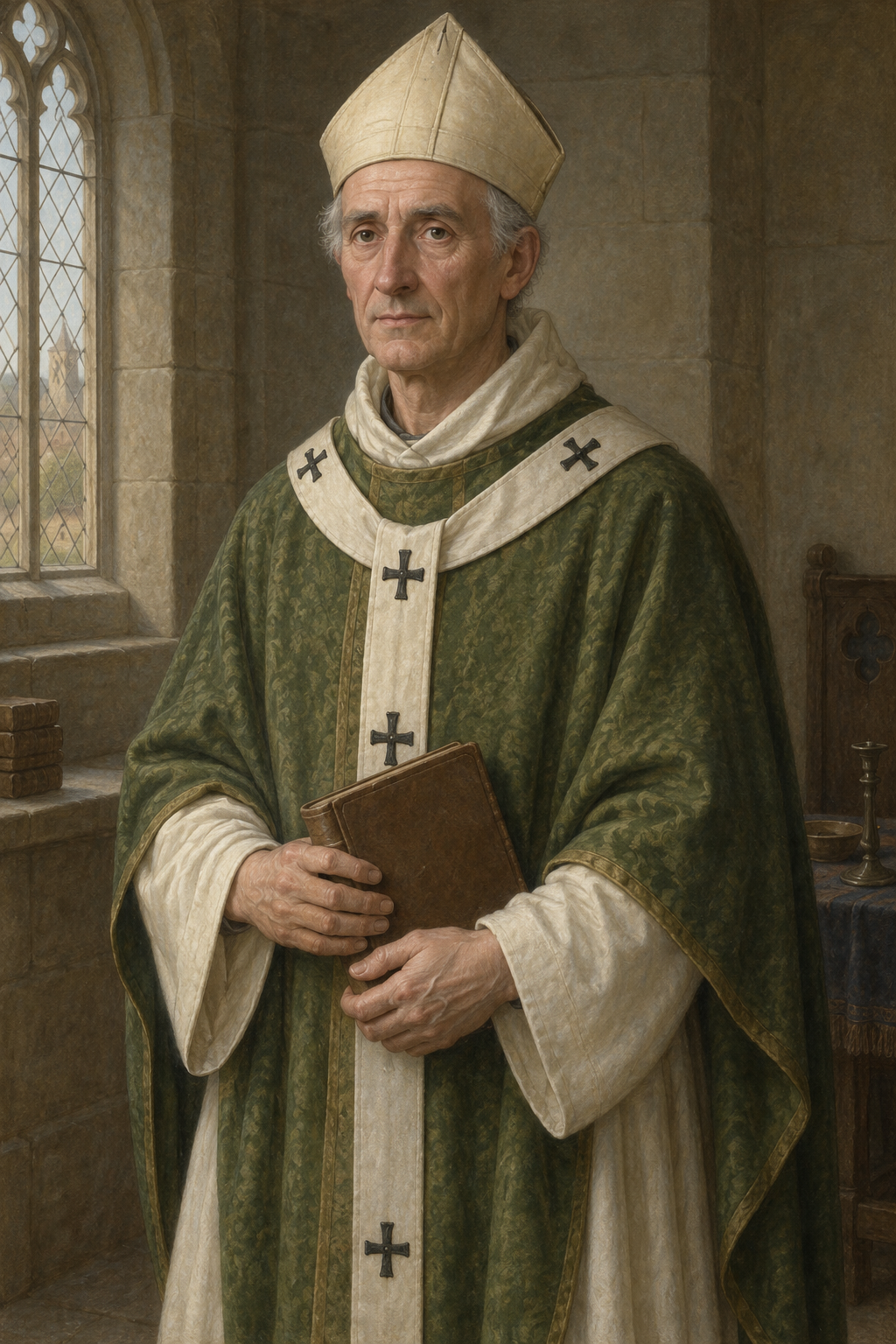
About Edmund of Abingdon
Edmund of Abingdon was a teacher and theologian who became archbishop of Canterbury in 1234. His early career crossed between the schools of Oxford and Paris. After teaching the liberal arts, he pursued theology and returned to teach it at Oxford. In 1222 he became treasurer of Salisbury Cathedral. His election to Canterbury in 1233 brought him from scholarly and cathedral life into a demanding English church office. He was consecrated on April 2 the following year.
The title of treasurer needs explanation. The Abingdon historical society’s account distinguishes custody of the cathedral’s vestments, bells and ceremonial supplies from the modern role of managing all its finances. Edmund received the prebend of Calne for his support. The Salisbury appointment also placed him within a network associated with Archbishop Stephen Langton and Bishop Richard Poer. Learning, patronage and public responsibility were closely connected in his advancement.
Religious accounts remember a life of prayer and austerity, accompanied by kindness to poor and sick people. Columba Edmonds’s older biography describes him attending the sick himself and giving little time to sleep. These are elements of the devotional tradition, rather than a diary of his daily routine. That same account records his commission to preach the Sixth Crusade in England. His preaching belonged to the political and religious world of his age, including its support for crusading warfare.
His appointment came during conflict between Henry III and rebellious barons. C. H. Lawrence credits Edmund’s firm leadership with reconciling the king and the party of Richard Marshal and securing changes to the royal council. Yet his years as archbishop also involved repeated disputes and litigation. The peacemaker was an active participant in government and ecclesiastical conflict, not simply a secluded scholar unwilling to exercise authority.
The local historical study describes bishops negotiating truces in the Welsh border country and Edmund pressing Henry to dismiss Peter des Roches. Later, a dispute with the Canterbury monks concerned Edmund’s proposed administrative establishment at Maidstone. The monks feared for their own position and appealed to the king. Such disagreements complicate a simple picture of an innocent prelate opposed only by hostile outsiders: the institutional interests of other churchmen were also at stake.
His spiritual writing offers another approach to his life. Cate Gunn describes the Speculum religiosorum as a work combining instruction in Christian belief with guidance toward contemplation. Edmund drew on established teachers, including Augustine, Gregory, Bernard of Clairvaux and Hugh of Saint-Victor. His contribution lay in bringing inherited teaching together for use, rather than claiming a wholly new spiritual system. Although associated with religious houses, he remained a secular priest.
The work reached readers through several languages and forms. Gunn distinguishes the original Latin text from an Anglo-Norman version and a later translation back into Latin, usually called Speculum ecclesie. Middle English readers knew it as the Mirror of Holy Church. These versions could serve professed religious and readers outside monastic communities. Their differences are part of the work’s history of use, not merely mistakes to be removed in pursuit of one unchanged text.
Annie Sutherland explains one practical feature of this teaching: fourteen short meditations accompany the seven hours of prayer, pairing scenes from Christ’s Passion with other moments in his earthly life. Prayer is organized around repeated attention to Christ throughout the day. This gives a more specific sense of Edmund’s spiritual concerns than general praise of his learning or holiness alone.
In the passage for meditation before matins, Edmund asks readers to consider the season, hour and place of Christ’s birth. His description stresses winter cold, midnight and a shelter open to the surroundings. The scene invites attention to the vulnerability of the infant Jesus. It is a medieval devotional interpretation, not a historical reconstruction of Bethlehem’s architecture or a claim that the Gospel supplies those details.
Edmund died at Soisy on November 16, 1240, during a journey toward the papal court, and was buried at Pontigny. Lawrence rejects the familiar story of voluntary exile as historically unsupported. Canonization followed on December 16, 1246.
His name remains attached to St Edmund Hall at Oxford. The college cautiously describes his residence and teaching on its site as traditional; the first surviving documentary reference to the hall dates from 1317. The dedication preserves his reputation as a teacher without making him the documented founder of the later institution. The history of devotion also extends beyond Oxford. Edmonds records a pilgrimage by 350 English visitors to Pontigny in September 1874 and identifies relics preserved in several English churches. Such visits connect later communities with the medieval saint, while leaving questions about particular relics distinct from the documented history of the journeys.
In the Catholic Diocese of Portsmouth he is honoured as a joint principal patron. Its calendar keeps November 16 as a solemnity, giving his memory a continuing place in communal worship.
Wondering how to weigh the stories and sources? Learn how to read a saint biography.