Biography
Edward the Martyr
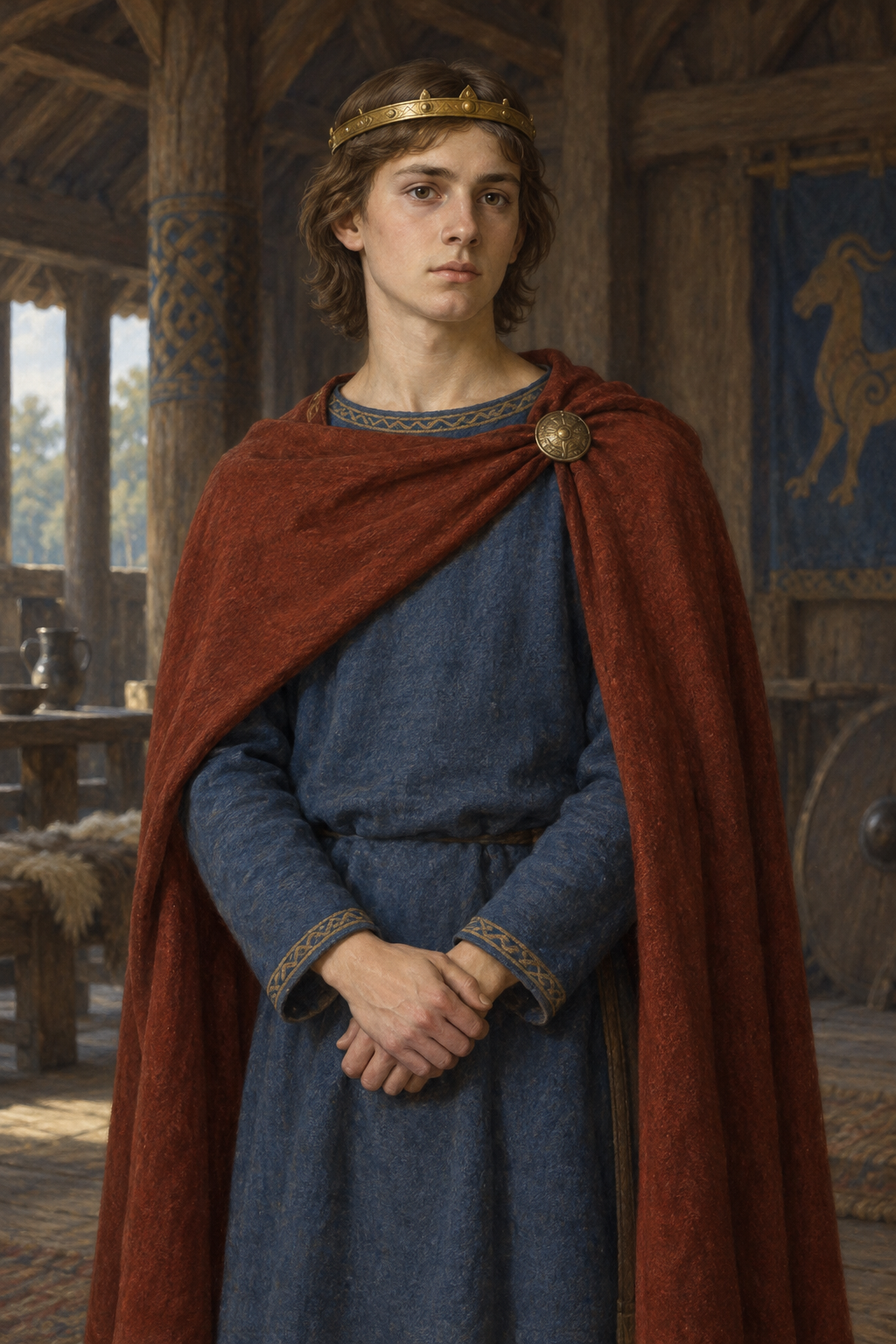
About Edward the Martyr
Edward the Martyr ruled England for only a few years before his violent death. He succeeded his father, Edgar, in 975, while still young. His younger half-brother Æthelred also had supporters, and the succession brought rival groups into conflict. Edward’s death at Corfe in 978 ended his reign and opened the way for Æthelred to become king. The family relationship is important: these were sons of the same father, not unrelated claimants to the throne. His reign preceded the Norman conquest.
His youth meant that older churchmen and nobles were prominent around him. Ryan Goodman points to the witness lists of Edward’s surviving charters, where Dunstan, Oswald and Æthelwold appear alongside leading secular figures. These records suggest the importance of experienced advisers, although they cannot recover the king’s private education or every decision made in his name. Family connections and loyalties among powerful households formed part of the political setting in which he ruled.
One later charter illustrates the disputes surrounding royal and monastic property. In a grant to Abingdon, Æthelred recalled that leading men had chosen Edward as king and assigned lands for Æthelred’s support. Some had previously been given to the monastery by Edgar. The charter describes their forcible removal from the religious community and offers compensation. It survives in later manuscript copies and has attracted differing scholarly judgments, although several editors consider it probably authentic. Its account complicates any picture of Edward’s reign as an uncomplicated defence of monastic interests.
The place of his death also needs care. The National Trust distinguishes the Anglo-Saxon occupation at Corfe from the stone castle built after the Norman conquest. Archaeology has identified a substantial earlier wooden structure. Edward’s visit therefore belongs to a setting different from the imposing ruins now associated with his name. A portrait or retelling that places him before the later castle would confuse two periods.
The familiar accusation against his stepmother, Ælfthryth, is not established by the earliest evidence. J. L. Laynesmith traces explicit blame to a later Passion and subsequent writers. Byrhtferth’s earlier account describes an attack by supporters of Æthelred, but does not make the queen its organizer. The distinction matters: later storytelling turned uncertainty about a political killing into a much more definite story about a wicked stepmother.
Nor do the early narratives present an entirely gentle young king. Laynesmith notes that Byrhtferth acknowledged Edward’s violence toward members of his household. She also questions whether the surviving description proves a planned assassination rather than a fatal confrontation. These are historical possibilities, not established verdicts. They prevent the later title of martyr from being treated as evidence that every account of his character or his killers’ motives is reliable.
Goodman emphasizes that Æthelred’s personal responsibility is doubtful, even if his supporters were probably involved. The killing burdened the beginning of the new reign with a damaging memory. The historian therefore separates the young successor from the faction whose actions advanced his position. Benefiting from another person’s death does not, by itself, demonstrate that someone ordered it. This distinction is especially necessary when the surviving evidence concerns children surrounded by influential adults.
The Anglo-Saxon Chronicle remembers his death with grief and indignation. Its extended account contrasts the killing and an undistinguished burial at Wareham with the honour subsequently paid to his remains. The writer interprets that reversal as divine vindication. This is powerful evidence for Edward’s developing religious reputation, but its language is a judgment of faith rather than an independent investigation of the crime. The same translated collection records the movement of his body from Wareham to Shaftesbury.
His cult developed during the reign of the brother who succeeded him. B. W. Scholz records the elevation of Edward’s remains at Shaftesbury in 1001 by Æthelred’s order, followed in 1008 by a decision of the king and council to observe his feast. These acts show public recognition of the cult; they should not be presented as a modern papal canonization process. Edward also entered the Roman Martyrology, and his commemoration has continued in Catholic tradition.
At Shaftesbury, remembrance became part of the life of a substantial religious community. The abbey museum describes the shrine’s attraction for pilgrims and its contribution, alongside royal patronage, to the house’s wealth. Miracles were attributed to the remains. The abbey closed in 1539, its nuns left, and its buildings eventually became ruins. The surviving site preserves the setting of that long devotion even though the medieval community no longer worships there.
Later claims about relics remain disputed. The Catholic parish at Shaftesbury explains that bones discovered at the abbey in 1931 were not universally accepted as Edward’s and eventually went to an Orthodox shrine at Brookwood. The parish also records images and dedications at Shaftesbury, Swanage and Wareham. These continuing forms of remembrance can be described without declaring the disputed bones authenticated.
Wondering how to weigh the stories and sources? Learn how to read a saint biography.