Biography
Egidio Maria of Saint Joseph
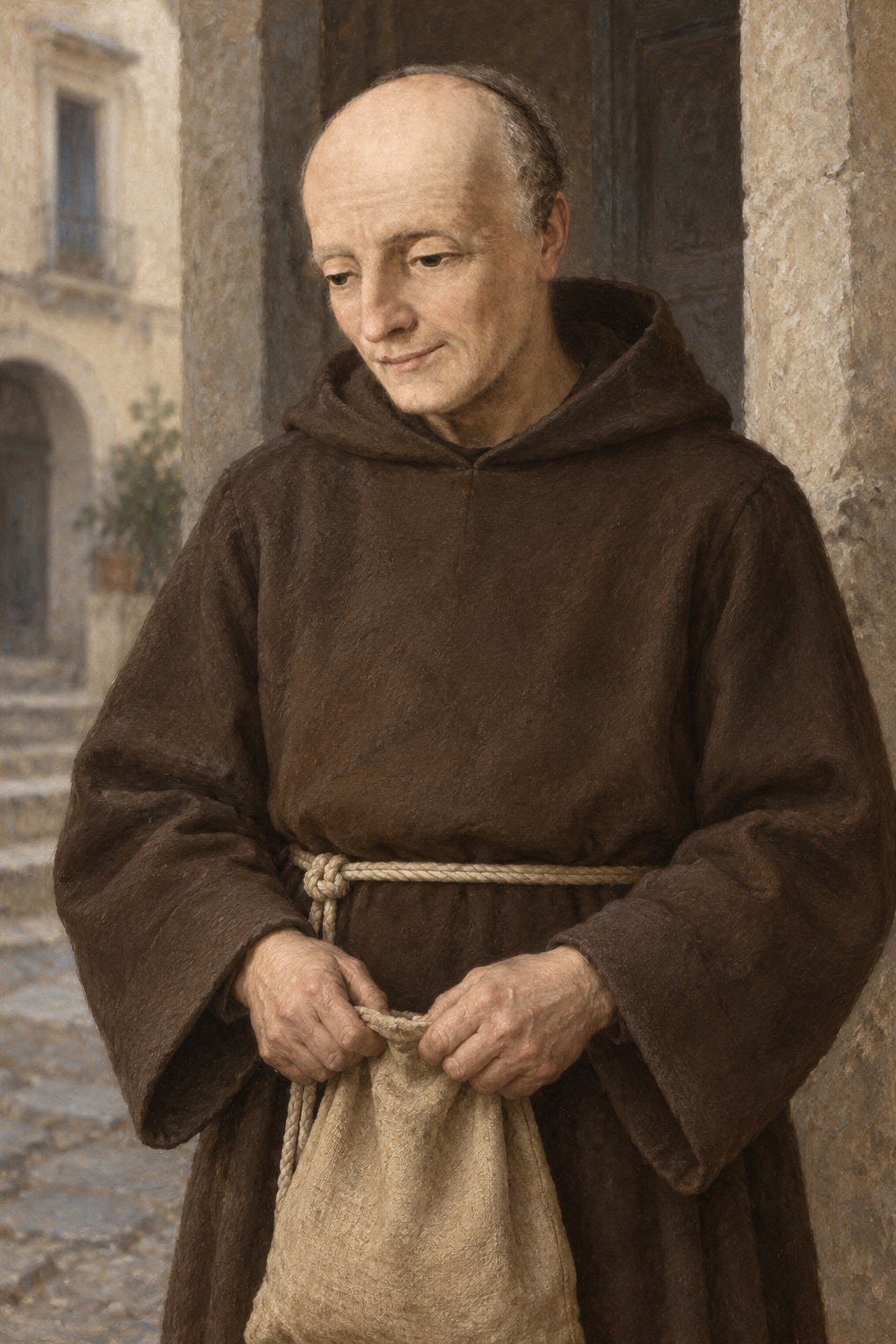
About Egidio Maria of Saint Joseph
Egidio Maria of Saint Joseph spent much of his life doing practical work for his Franciscan community and meeting people who needed help. Born Francesco Antonio Pontillo at Taranto on November 16, 1729, he learned rope making and textile work. After his father died, responsibility for supporting the family fell to him. His eventual entry into religious life followed arrangements for their needs, rather than an immediate departure from those responsibilities. He joined the Alcantarine Franciscans in 1754 and made his profession at Galatone on February 28, 1755.
Before becoming a friar, he belonged to the confraternity of Our Lady of the Rosary. C. J. Lynch’s account describes his early devotion and the family’s dependence on his labour. He entered the order as a lay brother, not an ordained priest. The work for which he became known was therefore not the ministry of a parish priest: it consisted of cooking, receiving visitors and collecting alms, alongside the prayer and shared life of his community. He also encouraged devotion to Mary and Joseph among the people who welcomed him.
He first worked as a cook at Squinzano. After a brief stay at Capurso, he was assigned in 1759 to San Pasquale a Chiaia in Naples. He remained associated with that community for the rest of his life.
The move gave his service a public dimension. Giuseppe Buffon describes the friar walking through Naples to collect donations, sharing some of what he received with people poorer than himself and offering advice across social divisions. Alms gathering brought him into repeated contact with households outside the friary. His reputation developed through these encounters and through stories that neighbours told about his help. Buffon treats those narratives as part of the city’s collective religious memory.
Franciscan tradition also emphasizes the prayer that accompanied this work. Luis Ruiz Gutiérrez links Egidio’s devotion to the Eucharist with his admiration for Paschal Baylon, another Franciscan lay brother. His devotion to Mary was especially associated with Our Lady of the Well at Capurso. These connections place him within a particular religious tradition, rather than presenting his generosity as an isolated personal trait unrelated to worship or community.
The same devotional account describes his attachment to the people of Naples and their affection for him. It tells of crowds objecting when his superiors proposed sending him elsewhere, and of widespread mourning at his death. Such accounts preserve the strength of his popular reputation. Their descriptions of extraordinary healings belong to the history of devotion and should be distinguished from an independently documented medical record.
At his canonization, John Paul II connected his care for others with contemplation of Christ’s birth and the Eucharist. The pope emphasized ordinary duties within the fraternity as well as encounters with poor people outside it. Egidio’s religious example, in this interpretation, joined prayer with attention to concrete needs. The homily also recalled his efforts toward reconciliation in a city marked by social tension and severe poverty.
Buffon examines a further part of the story: how later generations in Taranto made the friar their own, although he had spent most of his life elsewhere. Twentieth-century emigrants in New York helped support devotion and circulated accounts of favours attributed to him. Their participation connected remembrance of the saint with attachment to their place of origin. Buffon presents this as a history of changing communities and their hopes, not simply an extension of events from Egidio’s lifetime. He also examines how Taranto’s industrial development shaped later accounts of the saint, as writers related his working background to concerns about employment, health and social change.
He died in Naples on February 7, 1812. Leo XIII beatified him in 1888, and John Paul II canonized him on June 2, 1996.
Taranto’s recognition developed before the canonization. The archdiocesan newspaper records his designation as co-patron of the city by Archbishop Mazzella in 1919. It also describes anniversary observances planned in 2026 around his birthplace, the cathedral and San Pasquale, including processions and worship. The account shows how local remembrance continues to link the places of his early life with the later religious community that honours him.
The museum associated with San Pasquale at Taranto preserves another form of remembrance. Its collection includes reliquaries, a wooden statue, devotional offerings and objects identified with Egidio, among them prayer books and a death mask. Such objects bring visitors into contact with the material history of his cult. They complement the written accounts while requiring the same care about provenance and the distinction between an object’s history and a miracle attributed to it. The reliquaries themselves range from the nineteenth century to the present, documenting successive generations of devotion. The museum also displays a staff associated with him and recounts its survival in a fire as miraculous. That explanation is the museum’s devotional tradition, not a conclusion established by examining the object.
Wondering how to weigh the stories and sources? Learn how to read a saint biography.