Biography
Elena Guerra
About Elena Guerra
Elena Guerra was born in Lucca on June 23, 1835. The existing catalog stores her birthplace as Lucca, Italy, and this draft preserves that field.
Her life remained closely connected with Lucca. That local setting should be more than scenery: it was the city in which she learned, taught, founded, wrote, and became remembered by the Catholic community.
Elena is now canonized, but she entered this batch with an older in-review record. This draft uses current 2024 evidence for canonization while preserving the existing fields until final approval.
The sources present her as a foundress, educator, and promoter of devotion to the Holy Spirit. The page should hold those themes together rather than reducing her to only one devotional title.
Education was a practical part of her vocation. The biography should show Elena working through formation, community discipline, and the steady teaching of young people and religious sisters.
The dedicated Elena Guerra source and the local diocesan memory help explain the Lucca context and the congregation's understanding of her charism.
Her foundation became known as the Oblates of the Holy Spirit, connected with the Sisters of Saint Zita. The article can name the community without turning the page into a modern institutional profile.
Elena's devotion to the Holy Spirit shaped her writing and public Catholic memory. The page should describe that devotion concretely through letters, prayer, formation, and renewal rather than through vague language.
She is often remembered for urging wider attention to the Holy Spirit in the life of the Church. That claim is supported by the sources, but it should not be exaggerated into unsupported influence over every later movement.
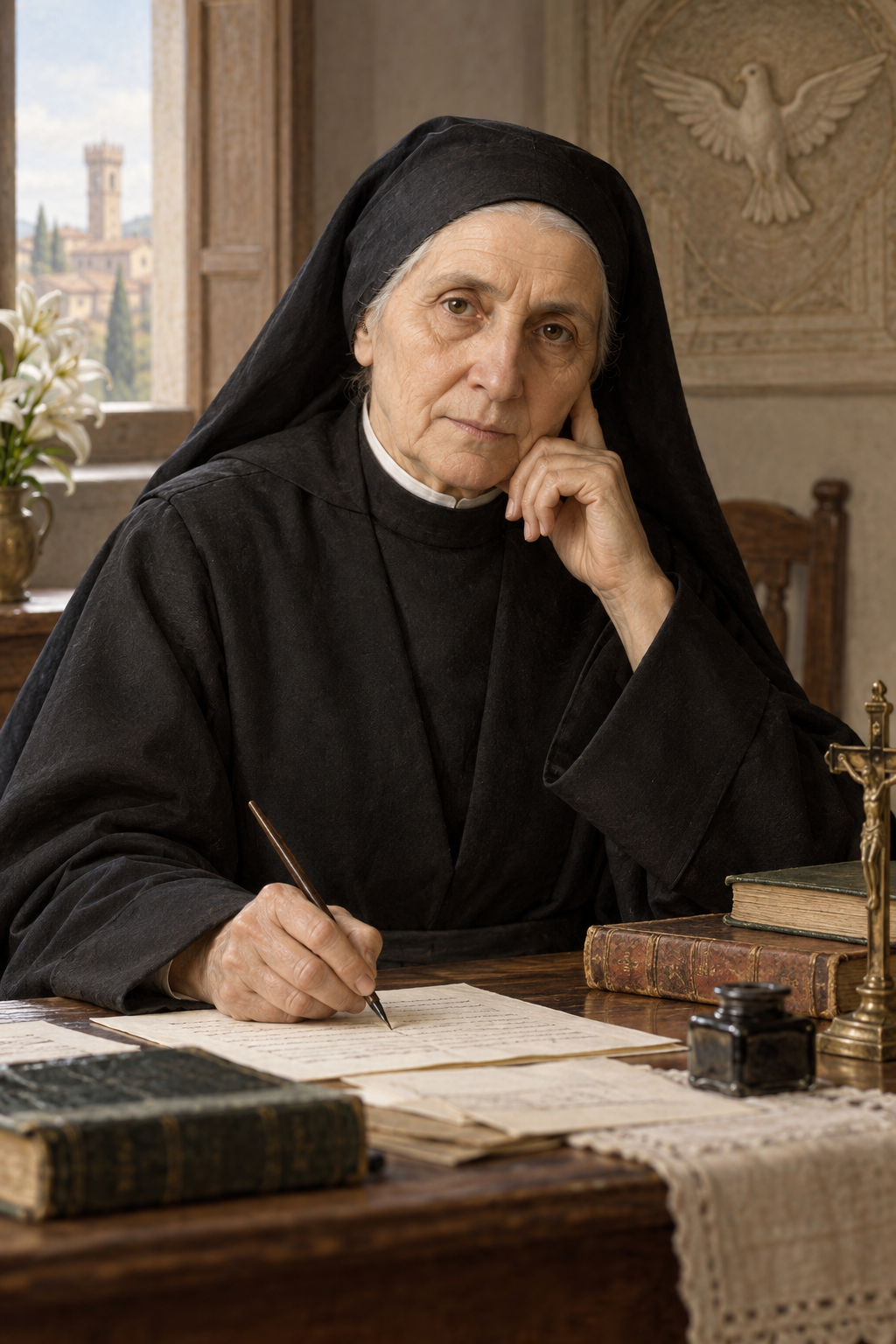
The biography should avoid modern charismatic symbolism that would pull her out of her own time. A restrained dove motif in artwork is enough; glowing effects or contemporary conference imagery would be misleading.
The catalog classifies Elena as `Monk / Nun`, and this draft preserves that field. Her foundress identity belongs clearly in prose, even if no additional class is added before approval.
Her correspondence and formation work also show leadership. Elena was not only a private mystic; she organized a community, taught, wrote, and tried to shape Catholic renewal through disciplined religious life.
The Archdiocese of Lucca source helps anchor her memory in place.
That local memory matters because the catalog currently leaves the death-place field blank. Sources support Lucca for her life and death context, but this draft preserves the blank structured death place until final review.
Such restraint prevents a draft from quietly changing structured data before the single deferred approval for the whole range. The biography can still make Lucca central to her story.
Elena died on April 11, 1914. The existing catalog stores that date and the Roman Catholic feast day of April 11, and this packet keeps both unchanged.
She was beatified by John XXIII in 1959. Her canonization is current and requires recent sourcing: Pope Francis canonized her on October 20, 2024.
That 2024 fact should be dated explicitly in the final packet because it is recent enough to be confused with older blessed-status records.
The page should not treat canonization as the whole story. Elena's significance comes from a lifetime of teaching, founding, writing, and urging prayerful attention to the Holy Spirit.
It should also avoid sentimental language about inspiration. Her work had structure: classes, letters, community governance, religious formation, and practical attention to the people entrusted to her.
Artwork should show an elderly Italian foundress in a simple dark habit and veil, seated at a writing desk with letters, devotional books, crucifix, and a subtle carved or painted dove motif.
The generated portrait follows that direction. It does not claim to be a historical likeness, and it avoids glowing supernatural effects.
Elena Guerra's enduring significance is the union of prayer and formation. She asked the Church to remember the Holy Spirit, but she did so through the daily work of teaching, writing, and building a religious community.
The final page should leave readers with a Lucca foundress at a writing desk: attentive, disciplined, and patient in a long vocation of education and spiritual renewal.
That image is intentionally quiet. Elena's work did not depend on spectacle, but on repeated acts of teaching, correspondence, formation, and prayer. The page should show that religious renewal can be carried by letters, classrooms, community rules, and careful spiritual counsel as much as by public events.
Because her canonization is recent, the final packet should explicitly separate older blessed-status sources from the 2024 canonization notice. This prevents the profile from preserving an outdated public status while still respecting the longer history of her cause and local devotion in Lucca.
Her witness is therefore both old and new for the catalog. The historical life belongs to nineteenth- and early twentieth-century Lucca; the public status now belongs to the Church's current canon of saints. The final review should hold those two timelines together with exact dates.
Wondering how to weigh the stories and sources? Learn how to read a saint biography.