Biography
Elias of Enna
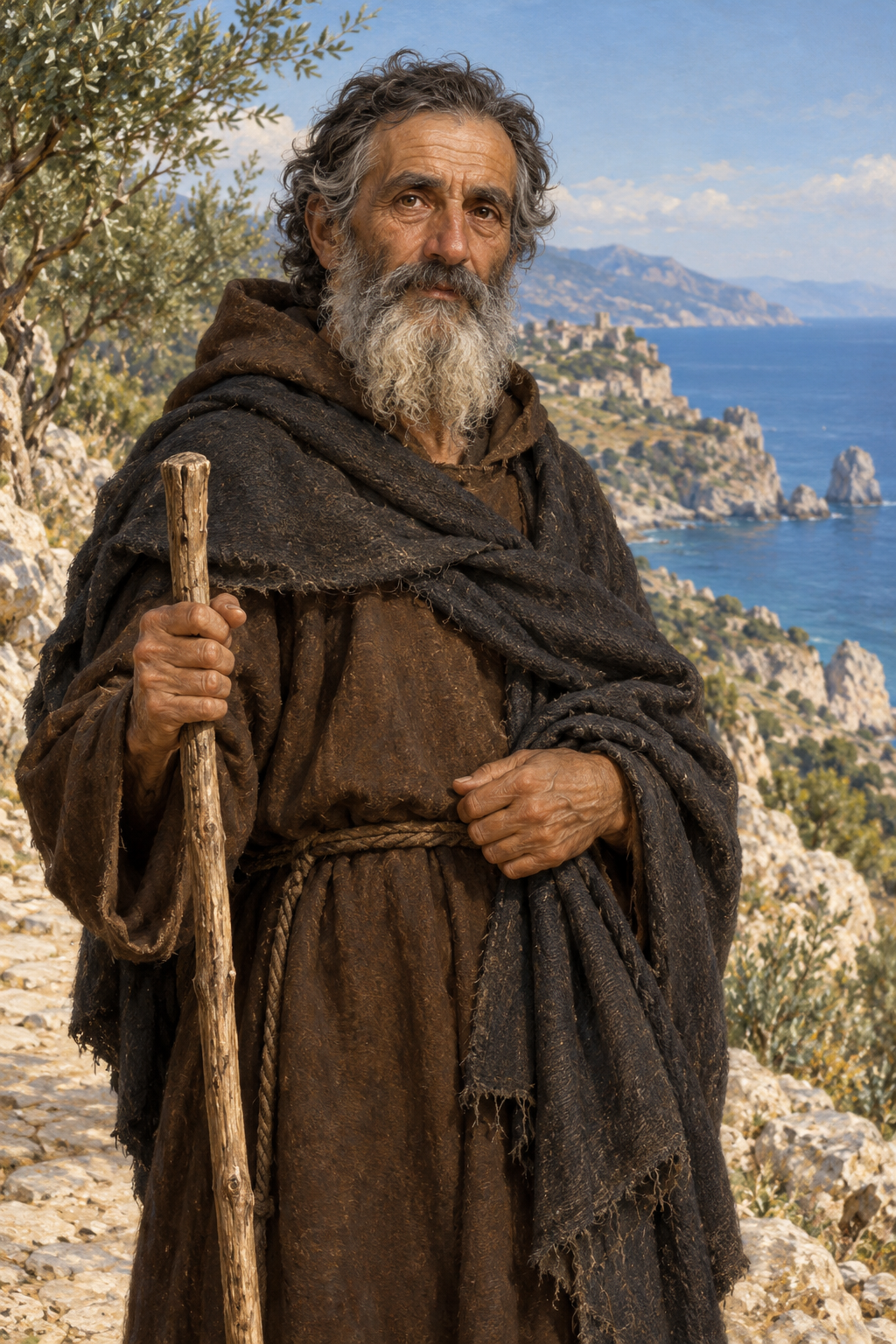
About Elias of Enna
Elias of Enna was a wandering monk whose remembered journeys linked Sicily and Calabria with the eastern Mediterranean. He founded a monastery in the region of the Saline, near Seminara, but travel remained part of his life. Known before becoming a monk as John Rachites, he was probably born at Enna around 823. His biography places him amid the warfare that unsettled ninth-century Sicily, while also portraying a religious traveler who crossed the boundaries between Christian and Muslim territories.
The early story survives in a Life written after his death. It tells of capture, transportation to Africa and service in a Christian household. A false accusation there recalls the biblical story of Joseph, one indication that the account follows established religious models. Its chronology is difficult to reconcile with his later reception as a monk at Jerusalem under Patriarch Elias III. Vera von Falkenhausen therefore treats the early adventures cautiously, rather than accepting their timetable as a continuous historical record.
Pilgrimage gives these journeys a religious purpose in the narrative. Elias visited the Holy Land and traveled through Egypt, where the account associates him with places of Christian devotion around Alexandria. A proposed journey farther east gave way to travel toward Antioch. Adele Cilento’s study follows his route back through North Africa and Sicily and onward to Greece and southern Italy.
In Sicily he acquired a companion, Daniel, who accompanied him through later stages of his life. The two eventually settled in Calabria, where Elias established the monastery of the Saline. Their movements continued during periods of danger, taking them to places including Patras and Amalfi. The Life also places Elias in contact with the authorities. When a rebel named Kolumbos faced execution, Elias intervened on his behalf. Near the end of his life he set out in response to an imperial summons, but illness prevented him from reaching Constantinople. He died instead at Thessalonica.
The Life includes encounters with Muslims as well as accounts of conflict. In one episode, men ask Elias to explain Christian belief, and the narrator supplies a speech defending the Trinity and attacking Islam. Cilento identifies its conventional Byzantine polemical structure: it is evidence of the author’s religious argument, not a transcript of an independently verified conversation. She also draws attention to stories in which Muslim leaders respect a Christian holy man. These episodes complicate a narrative otherwise strongly shaped by the threat of raids, although they cannot by themselves establish what ordinary relations between communities were like.
His death is commemorated on August 17, with 903 generally accepted as the year. That year is a reconstruction, connected with the Life’s anticipation of the attack on Thessalonica in 904, rather than an independently dated death record. After about ten months, the account says, Georgios transported his body toward Calabria, where Daniel and the monks received it. Elias must be distinguished from the younger Calabrian monk called Elias the Cave-Dweller; a claimed succession between them is not secure historical evidence.
The written account itself needs similar care. Jacques Bompaire’s review of Giuseppe Rossi Taibbi’s critical edition explains that its principal Greek witnesses are manuscripts in Messina and Naples, copied centuries after Elias lived. The editor placed the Life’s composition around 930–940 and left its author anonymous, rather than confidently identifying him with Daniel. Earlier Christian lives, especially Athanasius’s account of Antony, supplied literary models.
André Guillou likewise distinguishes the extravagant early narrative from the later sections, which contain more substantial information about contemporary events. His review recognizes the importance of the Life for the history of Greek Christianity in southern Italy while stressing the need for critical reading.
The places associated with him remain linked through pilgrimage. In November 2022, a delegation from Enna visited Palmi and Seminara with church and civic representatives. At Seminara they venerated relics in the Basilica of the Madonna dei Poveri and visited the Orthodox monastery dedicated to Elias the New and Philaret the Gardener. The visit prepared joint anniversary celebrations and renewed contact between the communities that remember him.
That remembrance continues across church traditions. In April 2023, an Orthodox pilgrimage visited Enna during celebrations marking the traditional twelve-hundredth anniversary of his birth. Metropolitan Polykarpos celebrated the Divine Liturgy in the Carmine church, and a relic was brought from Seminara. The Catholic bishop Francesco Milito also attended.
Wondering how to weigh the stories and sources? Learn how to read a saint biography.