Biography
Elias the Cave-Dweller
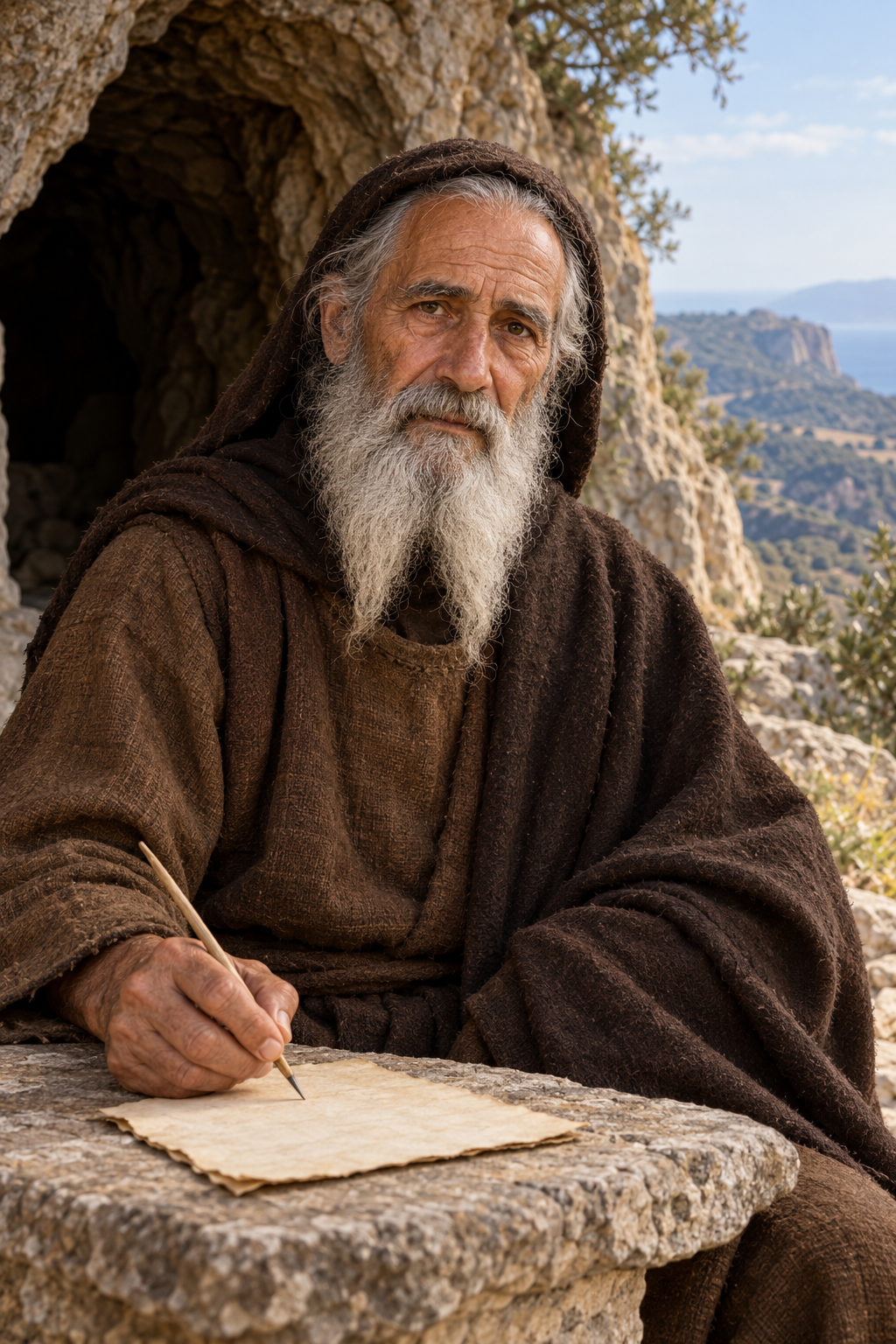
About Elias the Cave-Dweller
Elias sought solitude in the caves of southern Calabria, but the arrival of other monks gradually made him the leader of a community. His name, the Cave-Dweller, recalls the setting in which he became an abbot. The medieval account also remembers him as a copyist, linking the work of books with the prayer and practical needs of a growing monastery.
He was born at Reggio into a prosperous family, probably between 860 and 865. The conventional year 864 is not independently documented. According to his Life, a childhood accident left one hand disabled. He chose monastic life while still young, traveling first to Sicily and then to Rome, where the elder Ignatius became his teacher. Back in Calabria, he received the monastic habit from Arsenius.
The Life gives a concrete picture of work under Arsenius: Elias carried water and cut wood, adapting his tools to his injured left arm. It also presents the two monks complaining to a local official after a priest took land belonging to their monastery. They were beaten after making their complaint. The narrative interprets the official’s subsequent illness and death as divine judgment; this is the biographer’s religious explanation, not an independently established cause of death.
Raids and the danger of attack interrupted their life in Calabria. Elias and Arsenius sought refuge at Patras, before returning to the region of Reggio. After Arsenius died, Elias eventually joined the hermit Cosmas and his disciple Vitalius in a cave near the monastery of the Saline. Visitors and new monks followed. A larger cave was found, and another monk named Cosmas arranged a new entrance that admitted sunlight.
The attacks described in the Life also shaped the community’s remembrance of Arsenius. The narrative tells of raiders opening his grave in search of treasure and then trying unsuccessfully to burn his body. Andrew Jotischky reads this episode as a statement about Christian resurrection and the holiness of the dead monk. Its reported speeches and miraculous outcome belong to the religious argument of the Life. They cannot simply be treated as a transcript of an encounter.
The community’s Life attributes to Elias a demanding teaching about obedience, prayer, manual work and care for poor people. Monks were to support themselves through their labor and share with those in need. The same account preserves severe rules, including restrictions on food and the exclusion of women from the monastery. Near his death, it represents him urging his companions to continue their communal duties without resentment and to place charity above personal grievances.
Elias also encouraged learning within the community. Falkenhausen describes him as probably a copyist, while cautioning that no surviving manuscript can be identified as his own work.
The closing account describes an illness endured in his cell and burial in the cave after an overnight vigil. It places clergy and laypeople at his deathbed, giving the community’s farewell a setting wider than the monastery alone.
The chronology remains difficult. His death is conventionally placed in 960, but Vera von Falkenhausen cautions that the latest securely datable episode in the Life concerns the rebellion of John Byzalon in 921–922. The narrative’s author knew Elias, yet also relied on older monks’ recollections. Its principal Greek witness is a manuscript copied at Messina in 1308.
Elias must remain distinct from Elias of Enna. The critical prosopography questions the story that the older namesake appointed him as successor, since it appears in only one of their Lives and may have served to enhance his reputation.
His story later reached Latin readers. Jotischky places a Latin translation around 1080, in the setting of the monastery of Santa Eufemia and its Norman connections. The cave monastery was among Santa Eufemia’s possessions. He suggests that translating the Life could help the new owners claim continuity with a local cult. At the same time, the evidence does not justify assuming that a transfer of ownership simply erased the Greek community.
His memory remained attached to Melicuccà. The metropolitan government’s account identifies Elias as the town’s former protector, before devotion to John the Baptist became established. It also records the cave complex and neighboring monastic remains, together with an annual celebration on September 11. This is evidence of an enduring local remembrance; it does not make him the town’s present principal patron.
The surviving site includes more than a place of solitary prayer. The official local account describes remains associated with communal production and storage, including a mill, cellar and winepress, as well as a burial ground.
Wondering how to weigh the stories and sources? Learn how to read a saint biography.