Biography
Elisabeta (Safta) Brâncoveanu
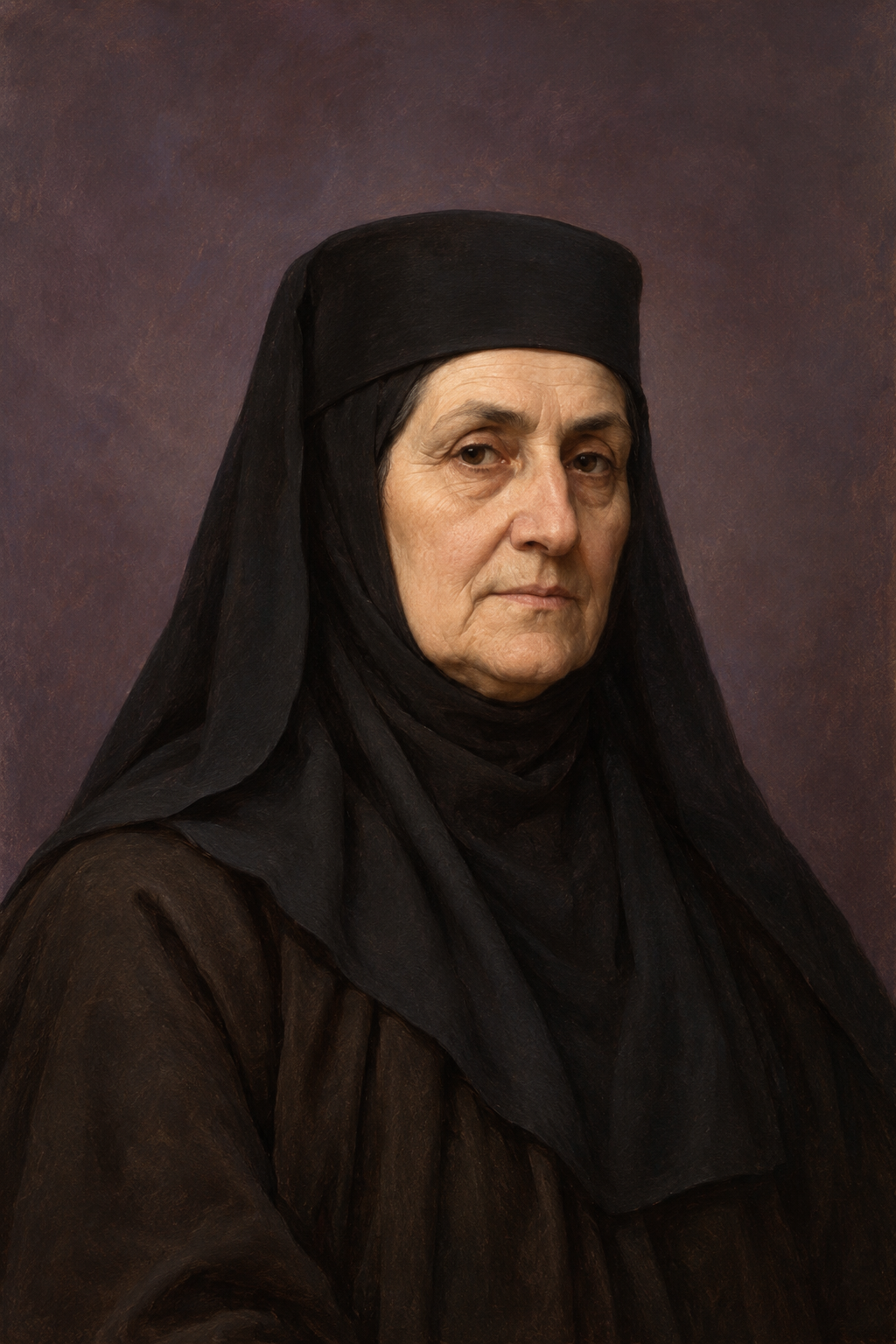
About Elisabeta (Safta) Brâncoveanu
Elisabeta Brâncoveanu, usually known as Safta, was a Romanian noblewoman whose widowhood led to hospital founding and monastic life. Born in Iași in 1776, she married Grigore Brâncoveanu in 1791. The couple had no children of their own and adopted her niece Zoe Mavrocordat in 1824. Grigore died in 1832.
Safta carried forward her husband’s wish to establish a hospital in Bucharest. She purchased land near Domnița Bălașa Church and contracted with architect Joseph Hartl. The planned building had six large wards, each containing ten beds, with rooms for staff and facilities for bathing. The work turned a charitable intention into a substantial institution.
Hartl’s original commission covered the kitchen and laundry as well as the hospital itself. Safta’s correspondence shows her choosing people she trusted to carry out these intentions. On March 20, 1838, she appointed Manuil Serghiadi a trustee, acknowledging his help with the construction and regulations. Her letter allowed him to serve for as long as his circumstances permitted. In October she wrote to the bishops of Argeș, Râmnic, and Buzău asking them to join the hospital’s governing body. She identified Serghiadi and Iancu Nădăianu as longstanding members of her household in whom she placed confidence.
The Brâncovenesc Hospital opened on October 14, 1838. Safta appointed trustees and established rules for choosing qualified staff, preserving the institution’s property, and managing its income. Estates and shops supported its operation. Those endowments also included enslaved people: the hospital’s published history records her donation on October 28, 1838 of ten Roma households and four unmarried Roma craftsmen. The foundation’s charitable purpose coexisted with her participation in slavery.
Two marble inscriptions preserved from the hospital record how Safta wanted it to operate. The first provided for both male and female patients, while excluding chronic illnesses. Its initial sixty beds could increase or decrease according to the foundation’s income. The metropolitan was to supervise the hospital independently of the administration of other hospitals, with two trustees handling its management. He was expected to inspect conditions personally at least once a month. An annual meeting of bishops, family representatives, other nobles, and merchants would examine accounts and patient registers. The number of patients who recovered was to be made public.
The second inscription protected the donated estates against sale or exchange, even an exchange offering a financial advantage. It also required the church and hospital to keep separate accounts, although they could assist one another in necessity. These rules survive on large marble slabs that were formerly displayed at the hospital’s entrance. After the hospital’s destruction in 1984, the stones entered the Bucharest museum collection. The surviving inscriptions preserve the founder’s administrative intentions alongside her religious language.
Another document, written by Safta in Greek on October 18, 1838, gave Serghiadi the estate of Stoenești. She explained the gift as recognition for years of service to her husband’s family and to herself after his death. Serghiadi subsequently arranged for the estate to return to the hospital after his own death. His initial provision reserved part of its income for two nephews; he later removed that condition after making other arrangements for them. The exchange reveals the personal relationships involved in sustaining the institution’s resources.
The hospital continued to develop during Safta’s lifetime. An architectural archive identifies a second wing designed by Hartl in 1842, supported by a surviving National Archives plan. A further building campaign begun in the 1850s added surgical accommodation and a pharmacy while improving the older wings.
She later settled at Văratec, where her mother had also become a nun, and took the monastic name Elisabeta. Her church biography remembers gifts of liturgical objects to the monastery and assistance to other religious houses, including communities on Mount Athos. It describes her continuing her prayers in her cell when illness prevented church attendance.
Her later correspondence gives a more personal view of life at Văratec. In a letter dated June 14, 1855, reproduced in the scholarly literature and discussed by Ioan Popoiu, she told her spiritual adviser Maxim that illness prevented her from attending church. Maxim was then visiting Xiropotamu on Mount Athos. The letter places her continuing religious relationships within the physical limitations of old age.
Popoiu also cites the writer Dimitrie Bolintineanu’s account of Văratec, published in 1859. He remembered her withdrawal from a prominent social position and her hope that Moldavia and Wallachia would unite. In his account, she spoke of that hope as a reason she had wished to remain alive. This recollection belongs to the testimony about her final years, rather than to her surviving administrative documents.
She died on August 11, 1857. Her remains were moved to the monastery’s ossuary in 1864. The Romanian Orthodox Church canonized her in 2025 and commemorates her on August 17. Elisabeta is honored alongside Nazaria and Olimpiada as one of the protectors of Văratec Monastery.
Wondering how to weigh the stories and sources? Learn how to read a saint biography.