Biography
Elizabeth Ann Seton
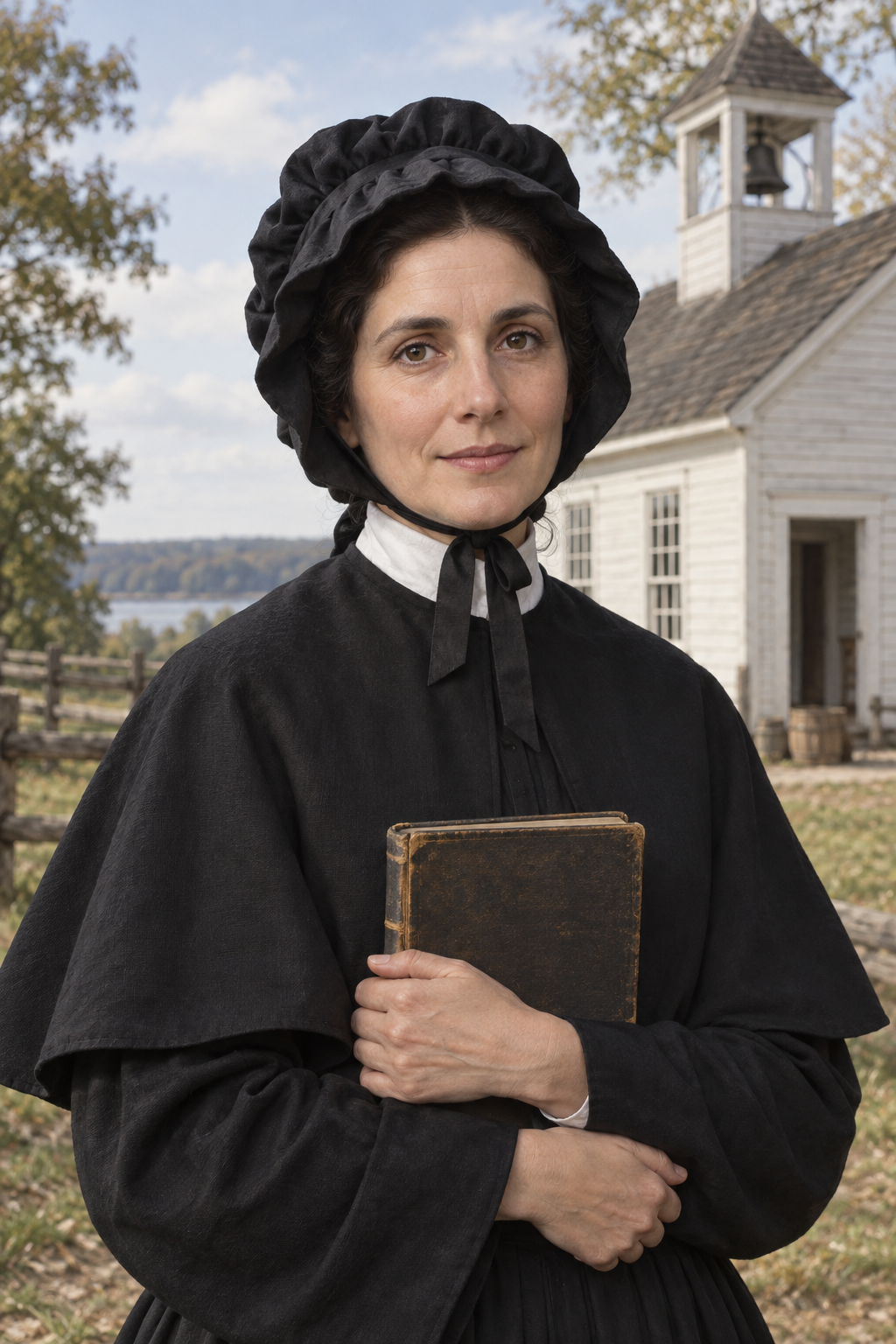
About Elizabeth Ann Seton
Elizabeth Ann Seton built a community of women devoted to education and practical care while continuing to carry the responsibilities of a mother. She was born Elizabeth Ann Bayley in New York City in 1774. Her mother died during her early childhood, and her father's remarriage was followed by a difficult family separation. Elizabeth found lasting pleasure in music, poetry and the natural world. Her journals preserve religious aspirations alongside private reflections and favourite passages from her reading.
A surviving commonplace book gives a more personal glimpse of those early years. Between 1788 and 1801, Elizabeth copied poetry that interested her, assembling selections from thirty-two poets. The subjects ranged from friendship and romantic love to nature, death and immortality. Scholar Ellin Kelly identifies the collection as evidence of her movement from adolescence into marriage and motherhood. These were passages she selected from other writers, not poems that should automatically be attributed to her. They show a reader whose interests extended beyond explicitly devotional books.
She married William Magee Seton in January 1794 and became the mother of five children. Before her own widowhood, Elizabeth had already joined organised care for other families. In 1797 she helped found a society supporting poor widows with young children and served as its treasurer. With her sister-in-law Rebecca, she also nursed sick and dying people among relatives, friends and neighbours. The family's circumstances deteriorated as William's health failed. Hoping a different climate might help, Elizabeth travelled with him and their eldest daughter to Italy. The journey ended in bereavement: William died in December 1803. The Filicchi family, his business associates, then welcomed Elizabeth and her daughter. Their Catholic practice, particularly belief in Christ's presence in the Eucharist, made a deep impression on her.
Her correspondence with Antonio Filicchi and his family records conversion struggles and their aftermath. The surviving papers also contain letters to her children. Her Leghorn journal follows the Italian visit from arrival through her husband's final illness and death.
Back in New York, she entered the Catholic Church in 1805. Finding a secure income remained difficult. A boarding house for boys lost its pupils after parents learned that its proprietor was Catholic. The financial consequences affected the children she had to support as well as her own position. An invitation to teach in Baltimore eventually offered a new start. She moved there in 1808, and other women began to join the work that would develop into a religious community.
The move to Maryland connected her with Bishop John Carroll, who encouraged her educational work. The school in Baltimore outgrew its first setting, and Elizabeth moved to Emmitsburg in 1809. There she founded the Sisters of Charity. Her attempt to earn a living for her family had become an institution with a wider purpose: educating children and responding to need. The Maryland Commission for Women's account places both her family obligations and the difficulties of her early school ventures within that foundation story.
Teaching involved individual decisions about children, not simply opening a school. In a letter to Basil Elder dated 18 January 1813, Elizabeth discussed his daughter's lessons and conduct. She wanted music instruction arranged without sacrificing reading, grammar, spelling or arithmetic, and explained its additional cost. Another surviving account, Sister Rose White's teaching schedule for 1812, records classes in English and French, geography and bookkeeping. It also notes confusion during changes of class. The school was an ambitious undertaking whose everyday routines still required attention and adjustment.
Leadership brought disagreements as well as collaboration. Historians Regina Bechtle and Judith Metz identify correspondence concerning William Dubourg's resignation as superior and Elizabeth's difficulties with his successor, Jean-Baptiste David. Their study draws attention to letters addressed to Elizabeth, as well as those she wrote herself. This evidence complicates a foundation story in which every adviser simply agreed: the emerging community had to work out how authority and responsibility would be exercised.
The work soon reached beyond Emmitsburg. In 1817, Elizabeth sent three sisters to New York to establish an orphanage. A school followed that mission. The New York congregation later became independent of the Emmitsburg branch, while acknowledging its origin in the group she had sent. Education and care for children remained joined in this development. Her legacy was therefore carried by other women's labour and by communities that could adapt their organisation after her death.
Elizabeth died at Emmitsburg on 4 January 1821. Her family life and religious leadership were remembered together when Paul VI canonized her in 1975. In his homily, he acknowledged the religious formation she had received as an Episcopalian and welcomed representatives of that communion. He also recognised her continuing affection for people from whom conversion had separated her. Her enduring contribution lies in the connection between faith, family responsibility and institutions that enabled women to teach and serve.
Wondering how to weigh the stories and sources? Learn how to read a saint biography.
Explore similar vocations
Prayers for Elizabeth Ann Seton
Elizabeth Ann Seton — Latin collect petition
da nobis, eius intercessione et exemplo, sedula te semper caritate quærere et in servitio cotidiano sincera fide invenire.