Biography
Émilie de Villeneuve
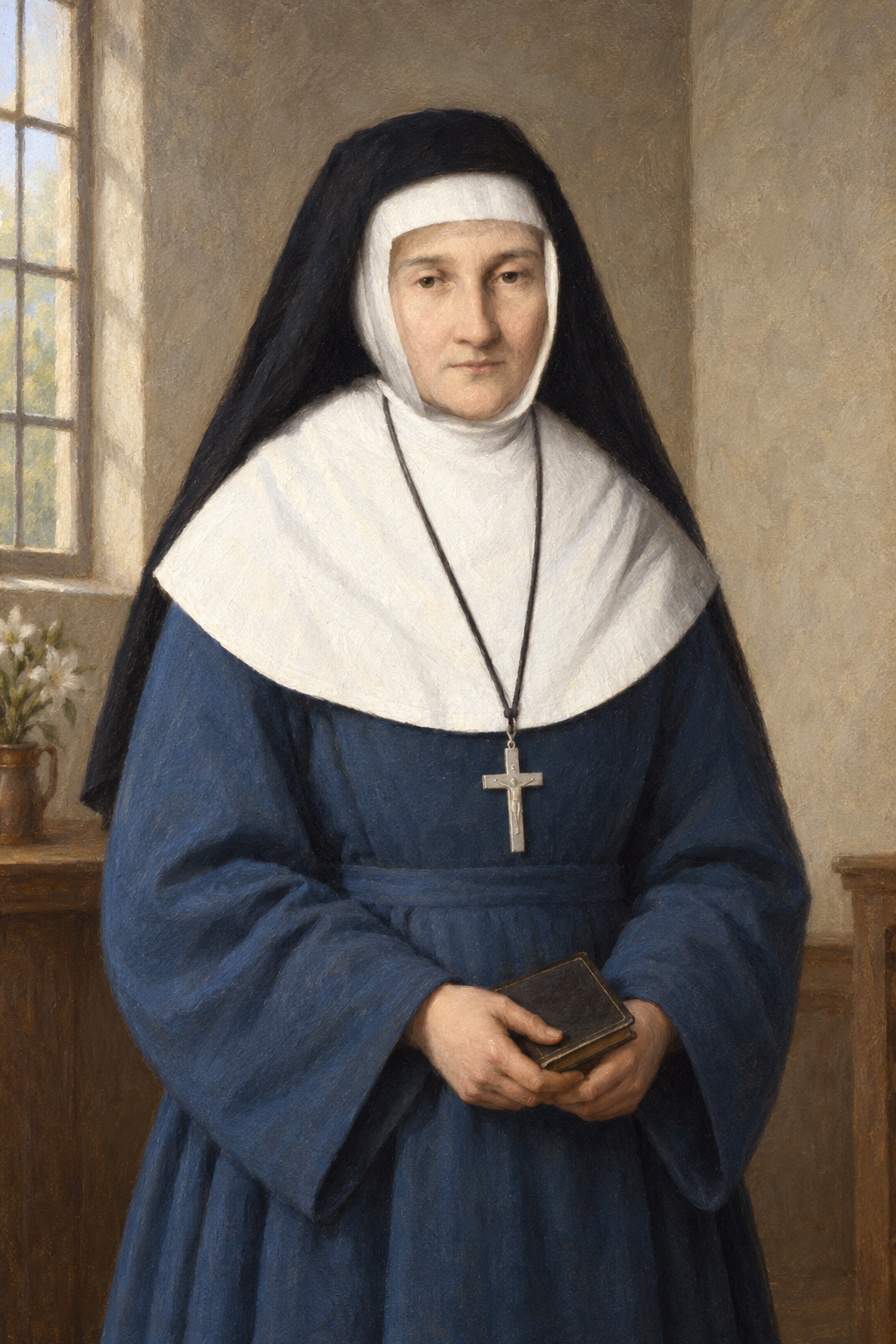
About Émilie de Villeneuve
Émilie de Villeneuve founded the Sisters of Our Lady of the Immaculate Conception at Castres, a community also known as the Blue Sisters because of its habit. Born in Toulouse on March 9, 1811, she grew up partly at her family’s estate at Hauterive. Her mother died while she was young, followed a few years later by her sister Octavie. These losses marked a childhood that had begun in a wealthy household.
She later returned to Hauterive and took responsibility for family life while her father was mayor of Castres. She considered joining the Daughters of Charity, but her father required a period of reflection. Her eventual response took shape in a new congregation, founded with two companions on December 8, 1836. Its work began locally, among people whose circumstances differed greatly from those of her own upbringing.
Taking the religious name Sister Marie, Émilie committed herself to serving poor girls and young women. The first workshop opened on March 19, 1837. In 1840 the sisters established a house at Saïx, where they taught and cared for sick people. She also undertook the construction of a motherhouse as the community grew. A refuge opened at Castres in July 1846, adding another form of assistance to the congregation’s work.
The workshop did not receive an uncomplicated welcome. The Clairval biography describes complaints from local seamstresses who considered its work unfair competition. Criticism spread beyond the trade itself, and Émilie needed encouragement to persevere. Difficulties also arose within the congregation. She separated novices from professed sisters to improve formation and worked on constitutions that would give the growing community a clearer structure. Service required organization as well as good intentions.
The congregation’s expansion depended on practical agreements. Albert Sène’s study records a municipal contract for prison care in 1838 and civil recognition that allowed the sisters to receive support and teach. The institute obtained legal recognition in 1852 and papal approval that December. Its rules also developed: in 1841 a fourth vow, directed toward the salvation of others, made its missionary purpose more explicit. Its growing schools combined modest fees with free places for children selected by the municipality or by the sisters.
Preparation for Africa brought different expectations together. Sène notes that some recruits intended to become foreign missionaries, whereas others had joined for local service. Four sisters were selected in 1847, with funds supplied by the congregation and free passage authorized by the French government. Their undertaking belonged to a colonial setting, even though the immediate invitation came from missionaries. Important details of their accommodation and support remained unsettled when they prepared to leave.
Émilie’s letter of November 15, 1847, addresses the first four missionaries as women entering an unfamiliar life. She asks them to recognize the responsibility involved in their appointment, to remain grateful and to expect hardship. Her encouragement is explicitly religious: trust in God, self-renunciation and faithfulness to their vocation should sustain them through deprivation. The surviving published excerpt presents neither comfort nor immediate success as something they could demand.
She accompanied the sisters to Brest before their departure. They reached Gorée in January 1848 and initially stayed with the Sisters of Saint Joseph of Cluny. The diocesan account records their move into a house at Dakar that April. Its anniversary report remembers the undertaking through education, healthcare and other forms of service, carried forward by later generations of sisters.
Leadership brought personal strain. The Clairval account describes the failure of a proposed foundation near Amiens and a later period of exhaustion during which Émilie struggled with sleep and appetite. She eventually decided against reviving that project. In 1853 she resigned as superior general, while continuing as an assistant and novice mistress. Her withdrawal from the principal office did not end her participation in the community.
She died at Castres on October 2, 1854. Accounts differ over her illness: the congregation’s biography places her death in the cholera epidemic, while Clairval identifies a separate outbreak of sweating sickness. The disagreement makes a precise retrospective diagnosis uncertain. The date and place of her death are much more securely reported than the medical explanation.
Her congregation’s archive guide locates the founder’s original records in Rome, alongside records of its administration and spiritual life. Other community and personal papers are divided between Rome and Castres. These holdings preserve the institutional setting behind the later accounts of her life; a guide to their location is not itself a substitute for reading the individual documents.
Pope Francis canonized Émilie on May 17, 2015. His homily linked her care for poor, sick, imprisoned and exploited people with a life rooted in Christ. He presented that service as the fruit of sustained love, rather than an isolated achievement. Her remembrance holds together religious commitment and practical attention to people whose needs could otherwise be overlooked.
Wondering how to weigh the stories and sources? Learn how to read a saint biography.