Biography
Enrique Angelelli
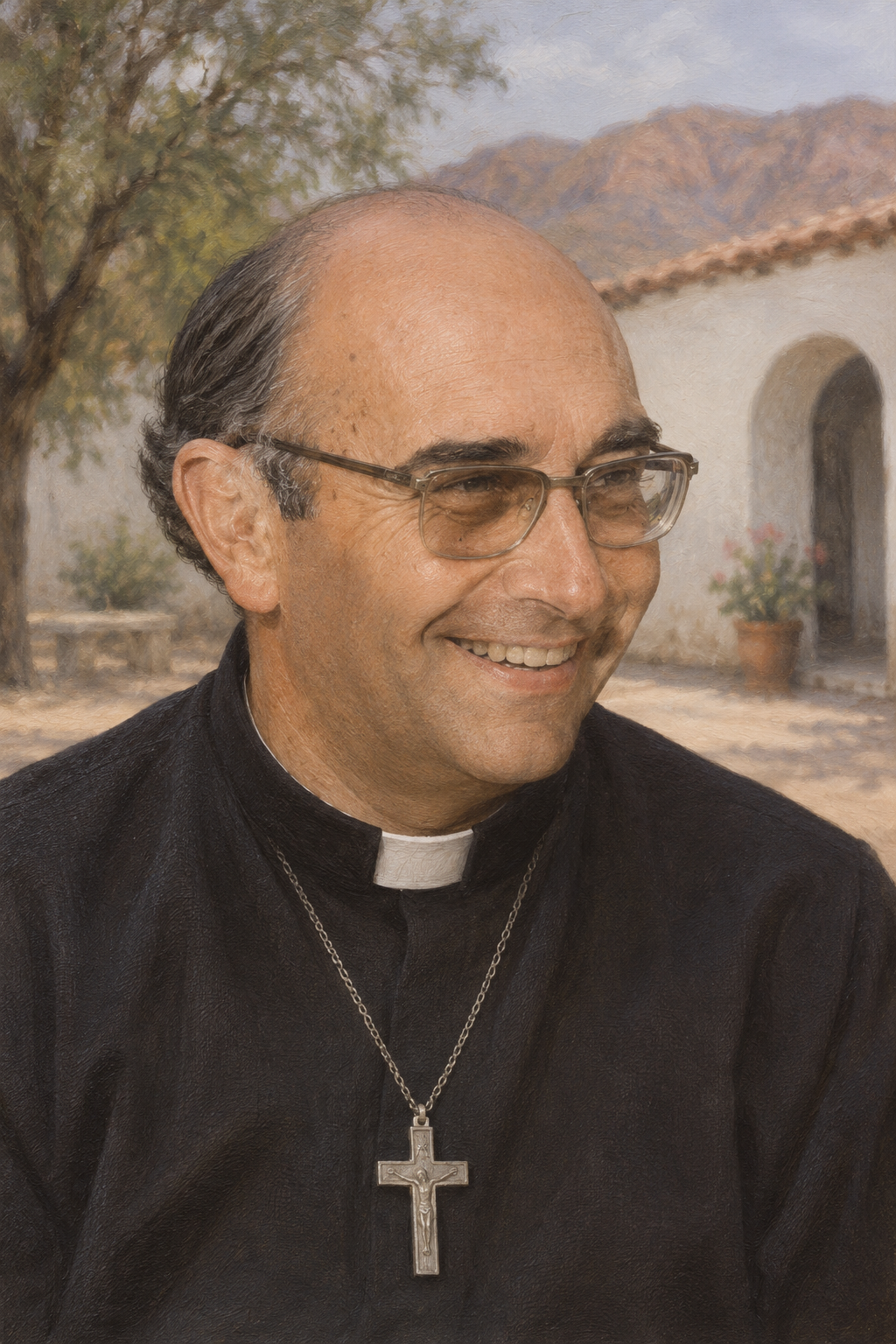
About Enrique Angelelli
Enrique Angelelli grew up among market gardeners on the outskirts of Córdoba. His parents, Juan Angelelli and Angelina Carletti, were Italian immigrants, and he was born in 1923. Schooling and family moves took him through different parts of the city before he entered the diocesan seminary at fifteen. He completed his theological studies in Rome, where he was ordained in 1949 and later earned a qualification in canon law. On returning to Córdoba, he combined parish duties with care for patients at the Hospital Clínicas.
Work with the Young Christian Workers brought him into close contact with working people, students and their organizations. The diocesan biography also records teaching, catechetical work and service in church administration. His responsibilities were varied, but a concern for people facing poverty and exclusion linked them. After appointment as auxiliary bishop of Córdoba, he continued to visit communities and support clergy and religious working among poorer households. His later ministry in La Rioja developed from this earlier experience rather than beginning with his transfer there.
Angelelli took part in the Second Vatican Council. Historian Diego Fares places him among the bishops associated with the Catacombs Pact, a commitment to a simpler church close to poor people. The council’s renewal and Latin American discussions about human dignity shaped his understanding of episcopal service. When he became bishop of La Rioja in 1968, he sought to put those commitments into parish life and social action. Fares describes the resulting opposition as extending across influential sectors, including some within the church itself.
The commitment to poverty was more than a preference for modest personal belongings. Fares describes the pact as a refusal of the customary symbols of ecclesiastical power and a decision to place poor people at the center of ministry. That combination helps explain why changes within the church and questions of public justice were closely connected in Angelelli’s work.
His pastoral planning asked priests, religious and laypeople to share responsibility. Pablo Nazareno Pastrone’s study describes diocesan meetings, commissions and pastoral weeks as instruments of that common work. Angelelli also valued the region’s popular religious traditions rather than treating local culture as an obstacle to ministry. Economic questions, particularly land and water, were part of the same setting. He favored rural cooperatives in which local people could work together and obtain access to land, including the CODETRAL initiative associated with the Azzalini estate.
These choices brought conflict. Pastrone traces restrictions on the broadcasting of Mass and growing campaigns against the bishop. Angelelli was attacked during a patronal celebration at Anillaco in 1973, where opponents challenged his authority. The dispute involved social and economic interests as well as religious language. Archbishop Vicente Zaspe subsequently visited as Paul VI’s representative and affirmed the Catholic character of the diocesan pastoral work. Such support did not remove the hostility that surrounded the bishop and his collaborators.
In a letter to nuncio Pío Laghi dated 5 July 1976, Angelelli described the practical consequences of persecution. Priests and sisters were being harassed, meetings with catechists were difficult to hold, and religious celebrations were obstructed. He reported another threat to his own life. The published excerpt also protested the detention and torture of people he knew as conscientious members of the church. He asked that these events be considered with faith and hope, while making their seriousness clear. This is the bishop’s own account as reproduced in a later judicial record; the original archival letter has not been independently inspected here.
The letter also challenged the claim that military repression defended Christian faith. Angelelli reported a conversation in which military leaders joined the language of a religious crusade to the destruction of supposed enemies. He asked the nuncio to consider the consequences before further harm occurred. His warning belonged to a concrete report about the conditions facing his diocese.
Angelelli died on 4 August 1976 while travelling with Father Arturo Pinto near Punta de los Llanos. The subsequent judicial record rejected the presentation of his death as an ordinary road accident. The court described another vehicle deliberately obstructing the path of the vehicle Angelelli was driving, causing it to overturn. Pinto survived. The findings placed the killing and the attempted killing of Pinto within state terrorism and classified them as crimes against humanity. In December 2015, the cassation court confirmed the criminal convictions while dealing separately with questions concerning detention arrangements.
The trial verdict of July 2014 had imposed life sentences on former military officers Luciano Benjamín Menéndez and Luis Fernando Estrella. The public prosecutor’s contemporary report records the verdict and the prosecution’s satisfaction that the requested sentences had been imposed.
The criminal case established legal responsibility for the killing.
The church’s recognition addressed Angelelli’s witness as a Christian. He was beatified with Carlos de Dios Murias, Gabriel Longueville and Wenceslao Pedernera in La Rioja on 27 April 2019.
Wondering how to weigh the stories and sources? Learn how to read a saint biography.